
Who could have seen it coming?
Financial markets are full of surprises. Here’s how to possibly avoid some of the costlier ones. After they are sitting on losses or regretting a missed opportunity, some investors will literally blame the messenger. Why didn’t my favorite financial publication warn me about this, or why were they so pessimistic about what turned out to be a great opportunity?
There are reasons for this. One should be obvious: Unlike parts of the paper like my column at The Wall Street Journal, Heard on the Street, reporters report. They rely on the assessments and opinions of participants in the financial markets. If most people expect, say, a recession, as a majority of Wall Street economists did this time last year, that is likely going to be the conversation they have with any two or three talking heads. It is also likely to be reflected in prices. And, as we know, they were dead wrong–the U.S. economy actually grew at an annual rate of above 5% last quarter.
Another reason is that the people who sit on the masthead of a publication are overly obsessed with big, round numbers. They are one way that financial journalists, and hence the savers and speculators who follow them, miss the forest for the trees.
Financial journalists and editors are told to drop what they’re doing because some big, round financial number is about to be breached. The number is lighting up search engines so we need to be all over it–clicks are what pay the bills these days. Just like a watched pot never seems to boil, though, those milestones taunt us. Sometimes we even wind up ignoring the big picture as a result–a mistake we’re making right now.
I recall conversations in February 2020 at The Wall Street Journal about what seemed like the imminent crossing of Dow 30,000. The day that the index got the closest to that milestone China reported that the number of cases of a deadly virus recently named Covid-19 were actually 10 times as high as previously thought. In the sixth paragraph of the “pan”–our daily, rolling markets story–a Goldman Sachs report saying that a drop-off in exports to China could lop half a percentage point off of U.S. economic growth that quarter gets a mention.
As we know, investors who took comfort in that mild assessment, if they ever even got that deep into the article, were about to be blindsided by what should have been an obvious risk to their portfolios and the world economy. The index would within weeks be flirting with 18,000 points.
The recent breach of 5% on the benchmark U.S. Treasury note was a bit different. Just like a watched pot never boils, it took quite a while to happen. And when it did (only during non-U.S. trading for those of you checking), the tsunami of coverage went from causing angst to inspiring a wave of buying buy people who haven’t seen yields like this since the Bush administration. Here’s Barron’s Magazine:
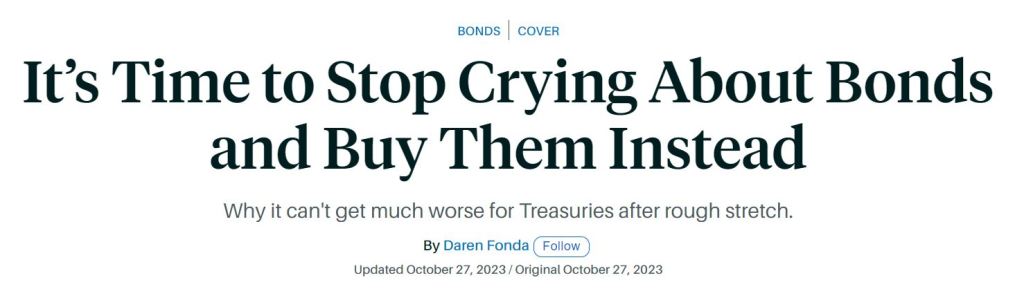
Whether or not you locked in 5% or are cursing yourself for sitting on the sidelines doesn’t matter all that much. What does is that the cost of money went from nothing to quite a bit in a hurry after many years of artificially low interest rates. During that time, government borrowing around the world ballooned–especially in the United States. Federal debt held by the public has gone from $5 trillion in 2007 to more than $25 trillion today.
The interest on that debt is climbing fast as old bonds roll over and new ones are issued. It was more than $800 billion in the past 12 months and is well on its way to passing $1 trillion a year. For perspective, net interest is now nearly the size of all non-defense discretionary spending. And I’m afraid that defense isn’t about to become less of a priority. As alarming as that sounds, the average rate on that debt was only 2% a year ago and just recently crossed 3%. Despite all the attention it received in newsrooms, the 10 year note was actually the last maturity to breach 5%.
If bond yields stay even at today’s slightly more modest level for any appreciable length of time then already ominous projected trillion dollar annual deficits will be much higher. That will affect not just our pocketbooks but America’s ability to wage war, deal with banking crises, and much more. The panglossian 10-year budget projections by the Congressional Budget Office have interest rates somehow staying at 3% this year and no recessions ever. Anyone paying attention should see that rates being this high could have a double-effect on the budget deficit by also pushing growth lower, hurting tax revenue.
Like Covid pretty becoming uncontainable by early 2020, it might in theory be possible to alter that trajectory with some extreme efforts like massive tax hikes, but the political will and recognition of the threat need to be far greater. If this were just a warning about interest costs being high for a while or taxes needing to rise then you could call my cute headline alarmist. The problem, though, is that the numbers will within just a couple of years be too big to reverse.
How so? Either rising bond yields will become self-fulfilling as the people who buy bonds with the hope of an expected positive return worry about America losing control of its budget with programs like Social Security and Medicare set to deplete their funding early next decade. Like an emerging market, a vicious cycle of rising rates can accelerate the reckoning. By my estimate, simply adding a single percentage point to the average interest rate would result in $3.5 trillion in additional borrowing by 2033.

More likely, though, the effect of all this on the economy will soon push the Fed to resume expansion of its balance sheet or to at least start cutting no matter how high inflation is. With fixed income, it is your real return that matters, and that could turn negative. Of the few tricks left in the Fed and Treasury’s arsenal to control the problem, allowing that to happen is the most likely.
This is what risk expert Michele Wucker calls a “Gray Rhino” – “a highly probable, high impact yet neglected threat” – a mix of a black swan and elephant in the room. Yet record sums have flowed into exchange traded funds that own long-term U.S. Treasury bonds.

That has been a good short-term trade, but it sounds like a potentially awful long-term bet. Buying anything on the assumption that a greater fool will provide liquidity when you’ve made your money is a silly risk. I’ll finish this essay with the standard “not investment advice” boilerplate, but I’ll also tell you what I’m doing with my own little pile of savings. None of it is in bonds with a maturity beyond three years except for those that compensate me for future inflation. I’ll gladly give up a capital gain in long term bonds to avoid what, through inflation or some other means, looks like it could be ugly.

 Spencer Jakab
Leave a comment