Author: SJ

  • Buy the “Wrong” Stock, Hit the Jackpot

    I wrote about the phenomenon of tech stock doppelgängers showering riches on people who can act quickly, but mostly parting fools from their money.

    Zoom Technologies is carrying on a long American tradition: making people rich by accident.

    Not to be confused with Zoom Video Communications, a unicorn that went public in April, making its backers truly wealthy, the similarly named penny stock appears to have benefited from mistaken identity. A $1,000 investment in late March would have been worth over half a million dollars by mid-April. Even now, assuming one were able to find a buyer, it would be worth $175,000.

    Zoom joins the likes of doppelgangers Tweeter and Snap Interactive. Similarly confusing episodes happened in the last tech bull market. For example, penny stock Appian Technology surged by nearly 19,000% because it shared a ticker with a hot initial public offering on Nasdaq, AppNet, in 1999.

    Of course all of these scenarios enriched people already owning the shares of the “wrong” company, and only if they acted quickly. Buyers fooled by similar names or tickers usually regret it. Not always, though. Mistaken buyers of food company Sysco back in March 2000—when red-hot Cisco Systems briefly the world’s most valuable company—have made 571% since then compared with a loss of 12% by owning the “correct” stock.

  • Is Crypto Ready for Stephen Moore?

    If you can’t beat’ em, join ‘em. And if you can’t join ‘em?

    Pundit Stephen Moore withdrew last month from consideration for a position on the Federal Reserve Board. Now he is joining a group that wants to “perform Fed-like duties,” but not for traditional money. He will, according to Fox Business, join Decentral, which aspires to be “the world’s decentralized central bank,” performing a stabilizing role for cryptocurrency.

    This raises a few questions. Bitcoin, the most valuable cryptocurrency, is hugely volatile in dollar terms, but its supply is famously limited by design. Its appeal lies in the lack of a central bank.

    But supposing Mr. Moore’s outfit were able to stabilize values, would it be hawkish or dovish? Back when Barack Obama sat in the White House, Mr. Moore decried the Fed’s “easy money policy” as the recipe for the next crisis and advocated a return to the gold standard. When he was hoping to be nominated by Donald Trump, though, he advocated cutting rates by half.

    Crypto investors eager to see their purchasing power maintained would prefer the 2015 version of Stephen Moore.

  • Let’s Call it ‘Miracle Gas’

    I’ll admit that when I heard U.S. official call natural gas exports ‘molecules of freedom,” I thought it was pretty stupid. But a little research shows that the fuel has inspired people for millennia.

    There is something in the air these days in Washington: methane with a smattering of higher alkanes and perhaps a little hydrogen sulfide.
    Booming U.S. natural-gas production has put a swagger in the step of government officials now that the fuel is being exported around the world in liquefied form. Some see it as a political lever for democracy as much as an economic boon. The U.S. undersecretary of energy sparked much hilarity this week when he referred to the fuel as “freedom gas”—a moniker that reminded many of Iraq war era “freedom fries.”

    But natural gas, once called “fossil gas,” was inspiring people way before the fracking boom. Historians surmise that a lightning strike on Mount Parnassus, where it may have seeped from the ground, created the flame that inspired the Oracle of Delphi. Some attribute the burning bush that Moses encountered in the wilderness to a similar phenomenon and also pillars of fire that played a role in Persia’s ancient religion.

    Millennia later, then, why shouldn’t the miraculous boom in U.S. gas output, with all its ramifications, inspire some flowery language?

    WSJ.com 5/20/2019
  • In a galaxy far, far, away

    The column I edit, Heard on the Street, has to find one mildly ridiculous business story for each issue of the paper, in addition to all the serious, analytical stuff. This usually isn’t a challenge, though there are occasional droughts when we have to dig deep.

    Thank goodness for people like Patrick Byrne, CEO of Overstock.com. He is a gift to seekers of corporate hilarity and I was a bit mean to him today.


    Patrick Byrne felt a great disturbance among his shareholders, as if millions of voices suddenly cried out for an explanation. This compelled the chief executive officer of Overstock.com to write one of the more bizarre news releases in recent memory about his reasons for selling 900,000 “founder’s shares” of the retailer.
    “Frankly, I had no idea that shareholders would demand explanations of why and how I might want to use my cash derived from my labor and my property to pursue my ends in life,” he wrote.
    Mr. Byrne detailed a number of personal projects, including charitable causes, for which he needed the cash. Even after all these years, he is most famous for a different rant about an alleged conspiracy to damage Overstock’s share price involving a “Sith Lord.” Mr. Byrne backed efforts to expose and punish allegedly manipulative short sellers.


    Despite some spikes in the share price, the short sellers were basically right. Since the 2005 “Sith Lord” speech, the stock has dropped by 77% compared with a 133% gain for the S&P 500.
    Perhaps Mr. Byrne should have directed more energy to running the company. Do or do not. There is no try.

  • Making Monkeys out of Hedge Fund Stars

    The darts don’t lie

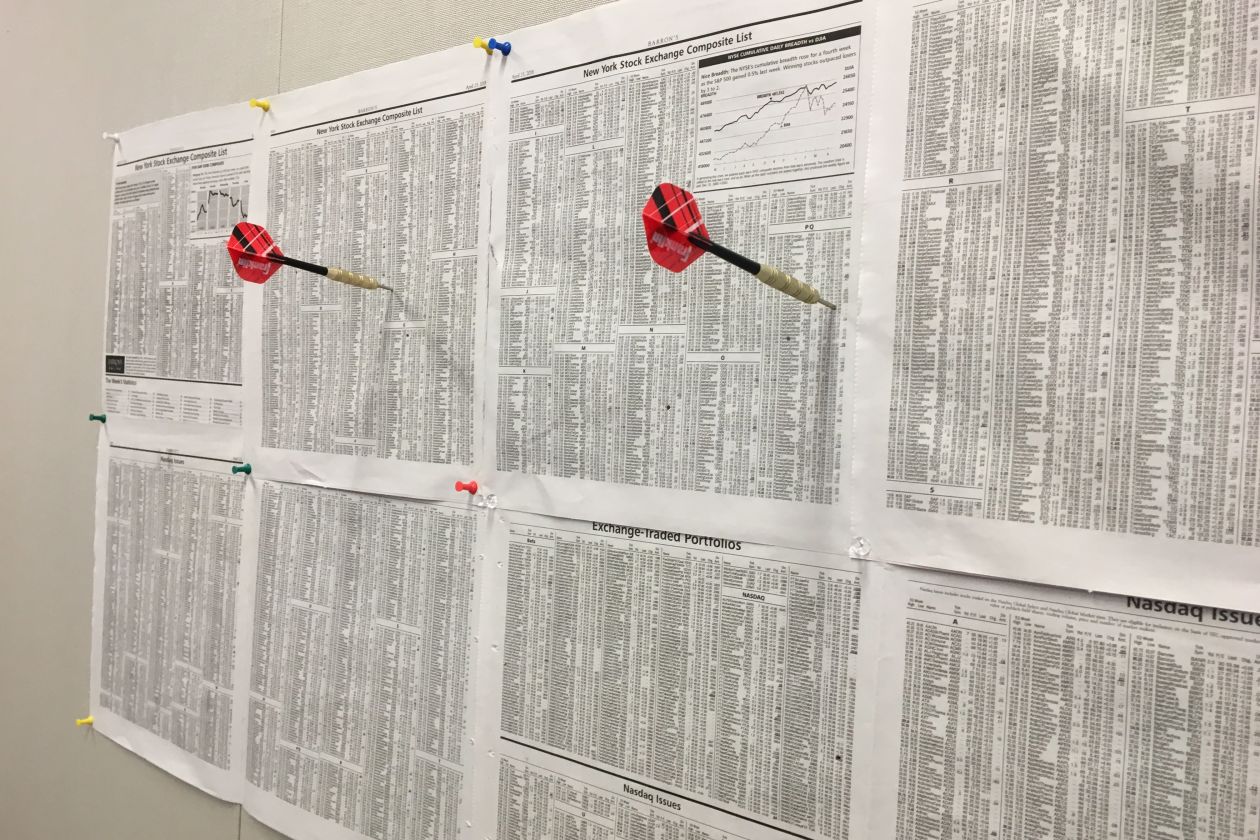
    So we decided a year ago to poke some fun at the masters of the universe who unveil their stock picks each year at the Sohn Investment Conference . My team and I decided to throw darts at stock listings and see how things panned out. It was a blowout.


    No animals were harmed in this financial experiment, but some human egos were bruised.
    Burton Malkiel famously wrote in “A Random Walk Down Wall Street” that “a blindfolded monkey throwing darts at a newspaper’s financial pages could select a portfolio that would do just as well as one carefully selected by the experts.” A year ago the journalists at Heard on the Street decided to see if they could beat the crème de la crème—fund managers presenting their stock picks at the annual Sohn Conference in New York.
    The results were brutal. Heard columnists, not monkeys, threw the darts at newspaper stock listings, but Mr. Malkiel would still approve. The columnists’ eight long and two short picks beat the pros’ selections by a stinging 27 percentage points in the year through April 22. Only 3 of 12 of the Sohn picks even outperformed the S&P 500.

  • Mueller Needs a Literary Agent

    I published my book without the benefit of a literary agent (long story), but going through the process without one made me appreciate what one can do for you, even if I got in the door at Penguin/RandomHouse on my own. This week I asked in an Overheard column how much money Robert Mueller could have earned if he had the rights to his free-to-read report on President Trump and his associates. Various versions were the number one, two, and four sellers on Amazon as of Monday morning.


    If Robert Mueller was like most authors, he would be pingingAmazon.com ’s website hourly to track the popularity of his eponymous report. He also would be jumping for joy. As of Monday morning, various versions of the partially redacted text occupied the first, second and fourth slots among all books.

    Of course, unlike the opportunistic publishers charging money for the 448-page tome, which can be read for free online, Mr. Mueller won’t be receiving royalties on his best seller. The fortunes of the various versions, available for preorder for as much as $26.89 in hardcover and $10.22 in paperback, speak volumes, though.
    No. 2 in sales overall is a version containing a foreword by legal scholar and sometimes Donald Trump defender Alan Dershowitz. Despite costing a dollar more, readers seem to prefer a copy less flattering to the president featuring analysis by three Washington Post journalists.

    From the Overheard column, April 22, 2019
  • Some personal news …

    The following memo went out today at The Wall Street Journal from finance editor Charles Forelle.

    I’m delighted to announce that Spencer Jakab is the new editor of Heard on the Street.
    Spencer is a rock of the Journal’s financial commentary. He has been deputy editor of Heard since 2015, and he wrote the Ahead of the Tape column for years before that. His knowledge of companies, markets and financial instruments is encyclopedic. (By my Factiva count, Spencer did nearly 800 Tapes in about 45 months; good luck finding a topic in our universe he hasn’t touched.) He is an incisive financial thinker who embodies the Heard’s spirit of smart, provocative and timely analysis. He also writes killer ledes. He’s the ideal leader for our expansion of the Heard.
    Before the Journal, Spencer worked at the Financial Times and here at Dow Jones Newswires, and was a stock analyst at Credit Suisse. He is the author of “Heads I Win, Tails I Win,” which is, naturally, a book about investing.
    Spencer’s move means we are looking for a new Heard deputy. Please get in touch with him if you are interested. And please join me in warmly congratulating Spencer. I believe he’llbecelebratingatOlive Garden.
    -Charles

  • GE Brings Bad Things to Light


    PHOTO: YURIKO NAKAO/BLOOMBERG NEWS

    If nothing else, General Electric Chief Executive Officer Larry Culp has a keen grasp of investor psychology. A little more than a week after he let slip at a conference that industrial free cash flow at the troubled conglomerate would be negative this year, he attached specific, ugly numbers to that expectation in a Thursday morning investor update. GE shares rose sharply anyway as the glimmers of hope and specific action Mr. Culp outlined lifted spirits.

    (Read the rest of this column in the WSJ).

  • The world’s worst investor goes to Denver

    aapic

    I will be regaling the crowd at the Portfolio Management Institute on May 2nd in Denver, Colorado. The title of my talk is “Lessons From the World’s Worst Investor.” That evening I will give the same talk to the Denver chapter of the American association of Individual Investors.


  • I Am a Bad Gym Member

    gymSo there were a few new faces at my gym this week. I seem to recall seeing the same thing about a year ago and about a year before that. If you go frequently enough, and particularly if you normally work out at the same time of day, you notice these things.

    Although no Charles Atlas, I’m a creature of habit and as regular as rain when it comes to exercise. Other than when I’m traveling, I can count the number of days a year that I fail to show up on the fingers of one hand.

    So why is such a loyal customer a bad gym member? Failure to wipe down the equipment? Loud grunting? Hogging the Stairmaster? No, no, and no – it’s precisely because I show up so frequently. I didn’t think much about this before my old gym started facing financial difficulties and finally went out of business. It had been there for 15 years with its main competitors being a fancier but much more expensive gym in town and a similarly-priced but less personal chain in a neighboring town.

    During the last year that they were in business a handful of new competitors opened up nearby – a fancy spinning studio, an expensive interval training chain, a cult-like group workout/prison-style gym franchise, and finally my current gym, which is basically a newer, shinier copy of my old one.

    Just based on what I could observe, my gym seemed at first to be plodding along despite all the new entrants. My view was limited, though, to two types of members:

    1. My fellow cheapskates who only paid for the “floor” and not the more lucrative group classes or personal training sessions; and
    2. Members who exercise almost every day.

    People like me, it turns out, aren’t doing the owner any favors by showing up religiously. Gyms, you see, aren’t very cheap to run. They open early, close late, take up a lot of space and pay high bills for heat, electricity, hot water and janitorial services. Their machines are expensive (several thousand dollars for a new stair climber or elliptical) and break frequently. Even after they raised prices a couple of times, I was paying, by my rough calculation, about $1.03 per hour spent at the gym. How many people like me would a gym have to pack in per hour to cover its overhead? Probably a lot more than it can comfortably hold.

    Therein lies the answer to how gyms can stay in business with such daunting economic factors working against them: All those people I’ve seen the last couple of weeks but probably won’t be seeing in a month or two. Author Dan Davies explains in “The Secret Life of Money” that 75% of gym memberships are taken out in January as people attempt to fulfill their New Year’s resolutions but that the vast majority only actually go a handful of times.

    In addition to these nearly perfect customers, the other segment of my old gym’s clientele that kept them afloat were those who paid extra for premium services like zumba classes, personal training, or $5.00 protein shakes with an 80% profit margin. It seems, though, that many of the members willing to pay a premium were lured away by the new offerings in town. By last summer, a month or two before my gym said it would close, it offered a month of free spinning sessions for “floor members,” presumably in the hope that we’d step up our subscription. My wife and I went a few times and were shocked to see how few of the bikes were occupied. One time it was just the two of us.

    So there you have it – I’m a bad gym member. I shudder to think how crowded the facility might be or how much they would have to charge if everyone were like me. Even if they leave dumbbells lying around or fail to wipe off the elliptical, I won’t complain about the new January people again.

    (This post also appeared on LinkedIn and on Cacophonyandcheese.com)