Mrs. Jakab and I got a hearty round of applause this February. Frankly, I found it sort of embarrassing.
It wasn’t one of those mean claps—the sort unfortunate waiters get when they drop a stack of plates in a busy restaurant. But it also wasn’t actually meant to make us feel good. Instead, the target audience was the other people in the room.
We were in Florida for a four day break from the winter chill, having flown out just hours before a blizzard shut down much of the Northeast. Our hotel on St. Pete Beach was costing us $23 a night for three nights—something for almost nothing.
Yes, we were attending a timeshare presentation. In exchange for 90 minutes of our time, we got about $1,200 worth of lodging value and a master class in how to sell people a terrible and expensive product.
Lots of people who have jobs that pay them way less than $800 an hour after taxes consider that a bad tradeoff. I’ve asked and the most common answer is that they’re afraid they’ll wind up buying something.
But why? Are the time share salespeople doing the Jedi mind trick on them? They’re good, but they’re not that good.
They do push some pretty effective psychological buttons during those presentations, of course. This is a product that’s sold rather than bought.
Almost nobody buys a timeshare by going onto an operator’s website or after reading a brochure. Sales are made on the day of a presentation, and it’s nearly unheard of for prospects to walk out of the room and still buy after thinking about it.
So here’s my advice if you took the offer: Enjoy the free stuff, but also make the most out of the experience. Instead of feeling like an economic hostage, think of it the way a sociologist might when visiting a Flat Earther convention.
Marvel in the naivete of your fellow attendees and their failure to ask any relevant questions. Be respectful, and don’t waste your breath pointing out unrealistic claims or the inconvenient facts the salespeople gloss over.
If the salesperson asks whether what they’re talking about sounds interesting, which they will repeatedly, don’t lie. Just tell them you have more questions.
I realize not all of you will be as into it as a finance geek like me, but it’s a glimpse into a weirdly durable economic model. It also could be a genuinely useful way to sample and learn about the product. Many timeshares are nice, and you don’t actually have to sign an ill-advised contract to stay at one (more on that later).
The chances are good that at least one of the people attending the presentation with you will take the bait and walk away paying tens of thousands of dollars, probably via high-interest debt, for their week in paradise. It isn’t a nice thing to do to people, and that’s one reason you shouldn’t feel at all badly accepting the company’s hospitality with no intention of buying–-being a “mooch” in timeshare salesperson lingo.
They’ll never use that word in front of you, of course: I heard it by watching the great documentary “Queen of Versailles” about the trophy wife of a time share magnate who set out to build the biggest house in America. It didn’t end well.
The nastiness of that term gets to one of the reasons why some people buy. There are lessons that you might employ in your own life, though in a more benign way, I hope. Humans have a natural instinct to reciprocate and will feel ashamed if they don’t.
That and other parts of the sales pitch are all explained in the superb book Influence: The Psychology of Persuasion by Robert Cialdini. I almost felt dirty after reading it.
If it helps, realize that the cost of the free nights you got is low—much less than what you just saved off of the rack rate. It’s from inventory that would be vacant or that’s set aside for marketing purposes. The largest cost is the salesperson’s time. Marketing a single time share takes multiple attempts and might cost about $12,000.
How can they still make money? Because the time share isn’t actually “worth” $48,000, which is what they asked us to pay. (Yeah, really, at 16.49% interest after a proposed $12,500 down payment).
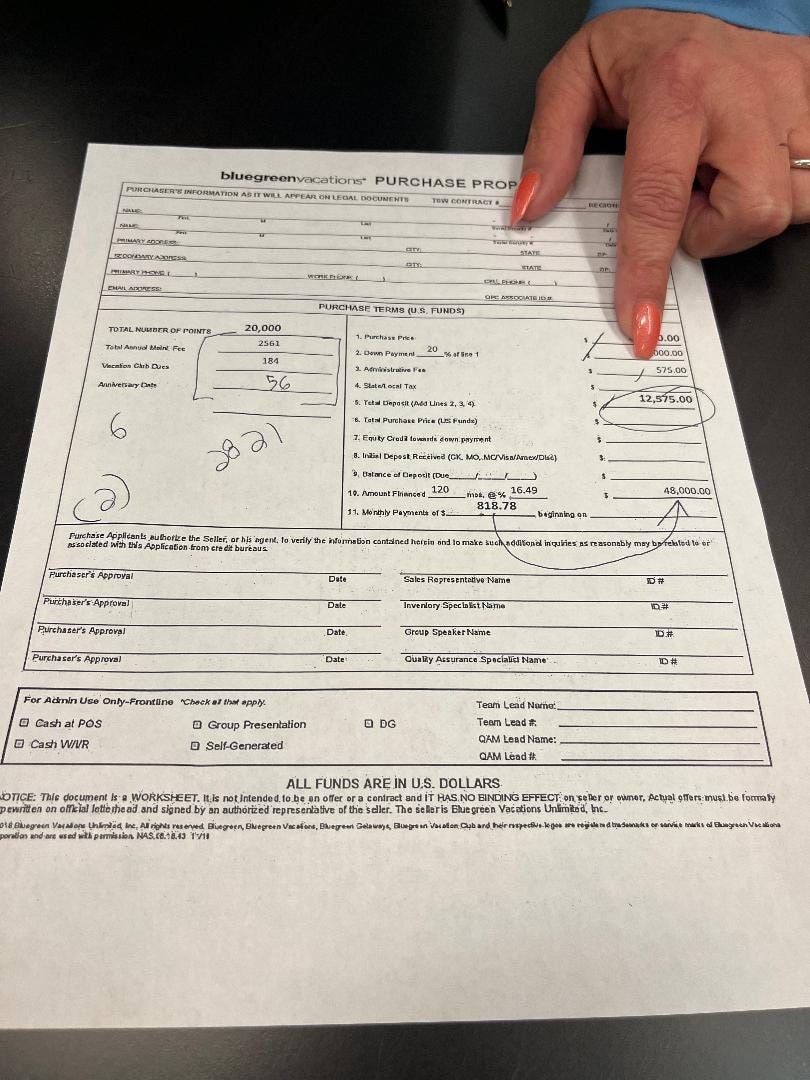
These companies aren’t in the business of building new resorts when they get enough people to bite. The one in Florida I’ve visited about 24 times with my family was built in the early 1990s.
The company is selling you something it got very cheaply, as a week or as points, that it recycled from unhappy former customers or people who defaulted on those loans at 8 to 10 cents on the dollar. Rinse and repeat, and make money off of the financing too. Its main expense is marketing and carrying unsold weeks.
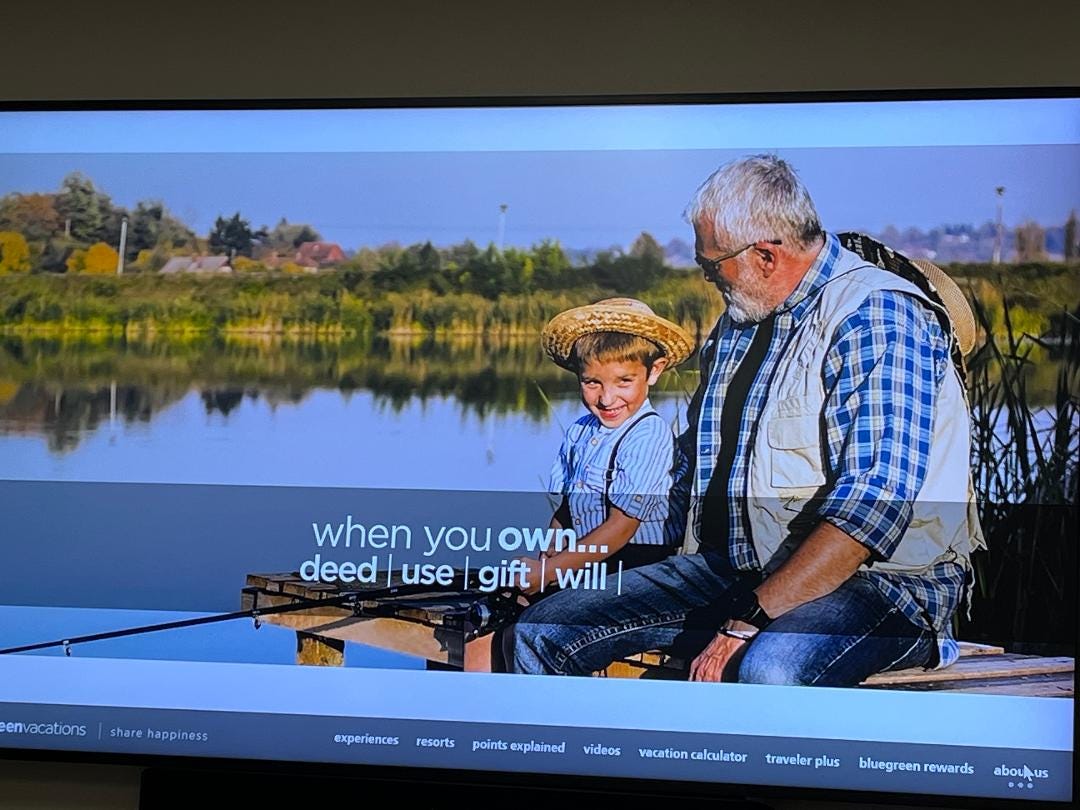
If you don’t keep up with your maintenance fee then time share companies will come after you or even your heirs. That’s why so many time shares are on sale for a buck at sites like eBay. Here’s a heartwarming graphic from our presentation of what a great legacy it is for your family 🙄. (They knew their audience—this was a mostly older grandparent crowd).
Our saleswoman was very folksy and nice. Being likeable is a Cialdini idea and we heard her entire life story.
When we got to the end of the presentation and told her “thanks but no thanks,” it wasn’t over. The manager came over and crossed out the price she had quoted, offering us a much cheaper deal.
She made it very clear that it would expire as soon as we walked away. (Narrator voice: It doesn’t, and we could have asked for more). That’s based on another Cialdini sales principle called scarcity.
Back in February we didn’t take the bait, but then they offered us something that actually was tempting—maybe because we had asked so many questions and seemed like we might be on the fence. It was basically a longer “sampler” stay at a nicer set of resorts for not much money, though not nearly as good of a deal as we were getting on that trip.
It wasn’t a no-brainer, but Mrs. Jakab and I thought it over and agreed to do it. The rest of the couples were still either sitting with individual salespeople or lining up for a later version of the group presentation we had attended in a different room. They walked us past there to sign the papers for the sampler and the time share sales staff applauded us.
Why? Because it looked like we were buying. That gets to another Cialdini concept: social proof. If the middle-aged couple from New Jersey thought it was worthwhile then maybe they should too.
In the end, we didn’t go for the sampler. The saleswoman had failed to mention several blackout dates. The woman doing the paperwork read it to us in the boilerplate warning before we signed on the dotted line and they refunded our credit card.
We felt a pang of regret as we walked back to our room to meet up with our snoozing son because it was still a pretty decent offer. Fear not, though—we got a pitch from a higher-end timeshare operator about a month ago for another three-night stay. We’re going to a lovely resort on Hilton Head Island for three nights for $124 in total after a resort credit and staying in a two-bedroom suite.
Now the problem with three nights is that it isn’t cheap or easy for three people to travel somewhere. But our stay will actually be for 10 nights. For another $2,400 I used a site called RedWeek (membership required, but the $25 is well worth it IMHO) to book an additional seven nights under a separate reservation.
A similar 10-night stay booked directly would have cost us $6,800. The reason for the bargain is that the other nights are being sold to us indirectly by a time share owner trying to recoup their maintenance fee, which is $1,892 a year. They could sell their week for about $1,700 before expenses—a fraction of what they paid during one of those presentations.
We’ve rented many weeks this way. After doing a lot of research and finding an ethical agent, we also bought a heavily discounted week from another owner during the financial crisis at a fantastic oceanfront resort where we’d been renting as a family for years.
It’s hard for five people to squeeze into a hotel room. Eating out three-times-a-day is expensive too. It’s like having a vacation home without the hassle.
That’s part of the time share presentation sales pitch, but it’s true. We went in understanding the product and knowing we just wanted to snag that specific week basically forever.
We also have a liability forever, but we can either sell (for not much) or just leave the deed out of our estate so as not to saddle our sons with it.
Most people aren’t exactly like us. But if all you want is a few free nights in the sun, consider attending one of those presentations and paying attention instead of watching the clock. You might learn something.


Leave a comment