
An investor being called “the next Warren Buffett” is a lot like an athlete gracing a magazine cover or a company slapping its name on a stadium. And it isn’t just a prelude to a stumble–compiling a track record as good and long the Oracle of Omaha’s is basically impossible.
But what about turning a company into “the new Berkshire Hathaway?” There are and have been a handful of stocks that have served investors very well as pools of patient capital such as insurer Markel, cable baron John Malone’s various entities and some now-defunct conglomerates with roots in the 1960s.
Before last week, money-losing videogame retailer GameStop seemed like a pretty unlikely addition to that short list. Its meme-inspired shareholders have the attention spans of fleas and the company’s C-suite resembles a revolving door as it heads for its sixth consecutive year of losses.
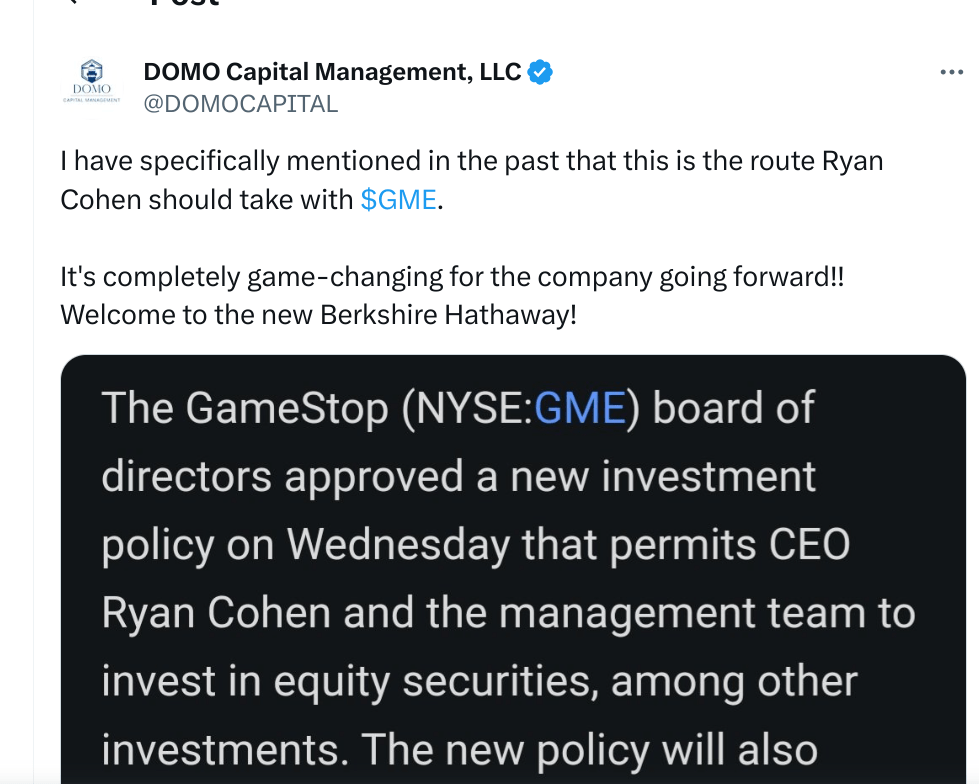
Yet the board’s recent decision to allow Chief Executive and Chairman Ryan Cohen to invest the company’s cash in stocks–a step one analyst called “inane”–has invited Berkshire comparisons that aren’t completely off-base. The textile company that became Buffett’s investment vehicle was itself a lousy business. Buffett eventually threw in the towel on those operations, using the company’s excess cash to earn early investors 40,000 times their money.
Cohen certainly has a, um, different approach than Buffett, but he has shown a knack for buying low and selling high. He mainly bought his GameStop stake before “Roaring Kitty” helped send its shares to the moon, accumulating most of his 36.8 million shares in mid-2020 for about $30 million. Less than a year later, with the stock still elevated from a historic squeeze, the company sold a split-adjusted 20 million shares, raising $1.67 billion in an at-the-market offering to its enthusiastic retail investors. The stake owned by his holding company, RC Ventures, is still worth close to $400 million.
More recently, RC Ventures invested $120 million in Bed Bath & Beyond and pushed for changes and board representation. Individual investors dove in, despite the company’s well-documented risk of insolvency. Cohen then sold his entire stake months later for a quick profit of nearly $60 million prior to its bankruptcy filing.
Stocks tend to rise when news breaks of Berkshire taking a stake, but those gains pale in comparison to when a meme stock CEO makes an investment. For example, in 2022 nearly-defunct gold miner Hycroft mining surged by more than 600% after movie chain AMC Entertainment Holdings took a stake. So why not ride the coattails of an investor with social media street cred and an apparent Midas touch?
An obvious reason is that convincing people to buy overvalued stocks isn’t an infinitely repeatable exercise. Buying undervalued ones can be, but it often takes years to be proven right. Attracting sufficiently patient shareholders has been challenging even for Buffett, who has been prematurely accused more than once of “losing his touch.” Is the YOLO trader crowd going to stick around after a few bad years?
If not, he needs different shareholders. But they’ll have to trust him. Cohen, who faces a Securities and Exchange Commission probe into his Bed Bath & Beyond trading, hasn’t been accused of wrongdoing. The fact remains, though, that in order to earn his big scores in publicly-traded stocks, thousands with less money and sophistication had to lose. That could make it hard both to raise more cash in public markets or to pursue the sort of handshake deals Buffett has made over the years.
Even after losing more than four-fifths of its value since its Jan. 2021 heyday, not a single analyst polled by FactSet recommends buying GameStop’s shares. Of course the lesson of the meme stock explosion was that the approval of serious people in boardrooms isn’t always necessary or even desirable to make money in the stock market. And don’t forget the people who earned some of those people’s ultimate compliment–comparisons with Warren Buffett–when riding high: Michael Pearson of Valeant Pharmaceuticals, Eddie Lampert of Sears Holdings and Sam Bankman-Fried of FTX.
So clearly Wall Street isn’t always the best judge of character. Even so, Cohen will have to put up some impressive gains to even enter that conversation and they’ll have to accrue to his public shareholders, not him personally.
 Spencer Jakab