Uncategorized

I Picked the Wrong Month To Stop Sniffing Glue

Back when I was in elementary school in the late 1970s, what my friends and I wanted to be when we grew up came up often. The number one answer by far was “photographer for Playboy,” followed by drummer for KISS. A few degenerates wanted to be lawyers.

Now that I’m middle-aged, I understand that the best job in the world is one that provides a decent living without feeling like work—one you’d still show up to do tomorrow if you won the lottery. “Not feeling like work” doesn’t mean not being a lot of work, though, and boy has this past month been taxing.

I liked my old job, which I had for nearly 10 years, but earlier this year I got the chance to go back to what I love—writing a regular column of my own instead of mostly editing those written by others. This one is daily, which is tough, and it involves getting up really early to finish the newsletter it’s part of. I’m happy with my decision, though.

The irony of doing something like this is that it’s hardest to appreciate just when I really should. The month since “Liberation Day” has seen more chills, spills and thrills than a typical year. More than once I’ve had to tear up what I thought was a perfectly nice newsletter essay because it would have been tone deaf given the latest Truth Social post or market ruction.

I’m struggling to find the right words here given the anxiety many people reading this are feeling about their retirement savings, but I keep reminding myself to slow down and enjoy the madness—to remember how I felt and what smart people were saying during each twist and turn.

The last two times markets got this crazy were in March 2020 and September 2008. Like most of you in 2020, I was trying hard to keep my family virus-free and stocked with milk and toilet paper. I was also figuring out how to edit and manage people on three continents via Zoom meetings and Google docs.

And in 2008 I had just started a new job writing the Lex Column at Britain’s Financial Times. My first day at work was when Fannie Mae and Freddie Mac were taken over by the U.S. government and I was just trying to learn how to file stories and deliver what my editors wanted.

In the next several days banks and insurers were being rescued and Lehman Brothers, located a couple of blocks away, went bust. I don’t think I even walked over there until months after they had taken down the sign—it was a Barclays office by then and I had a meeting with their strategist. I asked to see Dick Fuld’s office and was told it had been dismantled.

In both cases the market history being made hour-by-hour felt like a blur. When I read Andrew Ross Sorkin’s “Too Big To Fail” two years after Lehman’s collapse, it filled in the details of an event to which I supposedly had a front seat. And when I did the research for my second book, the one about the origins of WallStreetBets and GameStop mania, I found I had missed many of the crazier details of the rush of dumb money into the market.

There’s another challenging thing about this particular gig: I don’t expect it to last forever, but it’s very hard not to delve into politics given the constant stream of market-moving pronouncements coming out of the White House. The Wall Street Journal’s readership spans the political spectrum, but it skews conservative, and there’s been a fair bit of hate mail for focusing so much on Donald Trump.

I really don’t know what to say because it would be weird not to, and sometimes it feels like I’m walking on eggshells. There was one day this month when the Dow had a 3,500 point swing during the afternoon—the sort of change that would be typical for an entire year—because of the Oval Office intervention that Scott Bessent and Howard Lutnick staged.

If being a financial columnist is the best job I can imagine, being a politics reporter is close to the opposite for me. People who work in finance might not all be the loveliest, but politicians manage to be both boring and awful—a rare combo. Reporting on it regularly would make me want to gouge my eyes out. It would make me want to gouge their eyes out too, which would bring a visit from the Secret Service.

Anyway, I didn’t write this to complain, and I really shouldn’t. Some people get their stimulation from bungee-jumping. I’m most-excited when the market is doing that, my dented retirement nest egg notwithstanding.

Uncategorized

My Mom Was a Billionaire

Here’s what that taught me

I’m the target of good-natured ribbing in my upper-middle-class New Jersey suburb for my spending habits. My wife’s friends told her they’ll pass on going on vacation with us because I’m too cheap and would probably take a bus from the airport, pack sandwiches, and stay at budget hotels.

Guilty as charged. That’s in part because both my mom and dad spent money like there was no tomorrow when they were kids. They had to–there was no time to waste. 

Without running water or medicine, hardly any food or clothing, and her father murdered by the Nazis, my mom was the poorer of my parents, but she managed to save a little bit of money in 1946, the year she turned five, to buy herself some candy. The banknote she had probably made her a local currency billionaire, yet it was literally worth less than the paper it was printed on by the time she was ready to spend it. My grandmother didn’t have the heart to tell her. With both of his parents still alive and the wisdom of being a decade older, my dad had a few more zeros on his net worth–not that it mattered much.

That was the insane reality in postwar Hungary. From time-to-time I’ve quizzed my colleagues in finance or journalism about which country had the highest inflation in history. They almost always guess Weimar Germany, Brazil, Zimbabwe, or, occasionally, early 1990s Yugoslavia. Nope.

In that fateful year Hungary’s inflation rate hit 41,900,000,000,000,000%. Not a year—a month. At the peak it took about 15 hours for prices to double. I once asked my grandmother how often she was paid and what she did with the money. Couldn’t she just throw it out the window on her lunch break for someone to buy groceries with it before they changed prices on her way home? She just smiled and shrugged. Nobody really wanted to hang on to cash so the main value of her job was that they fed her. She said that if you really needed medicine then the only way to get it was if you had a little bit of gold, which she didn’t.

Here’s the sort of thing my mom might have had in her pocket–a billion pengő–though maybe it was just 10 million, or a million or a thousand, depending on exactly what month she set it aside. (Milliárd=billion in Hungarian).

To keep things somewhat manageable, and to save scarce paper, old bills were printed over and reissued in denominations with nine zeros removed–the millpengő. That only lasted for several weeks, so then came the billpengő. (Billió=trillion).

Three months after the above bill was produced, the government printed, but never issued, a sextillion pengő note (one followed by 21 zeros). Then they gave up and scrapped the currency entirely, introducing the forint and making every pengő legally worthless. (I have almost the full collection of banknotes at home, but unfortunately not the rare specimen below, which is worth about $7,000 today to a collector).

Lots of people have parents who grew up poor. It usually makes you a bit frugal–no bad thing in moderation, though sometimes people don’t want to take trips with you 😢. But having almost no money and seeing money cease to have meaning are two entirely different things. To me, at least, those stories make any level of wealth or savings seem ephemeral.

It’s hard to imagine that in a country as blessed as the United States, the issuer of the world’s reserve currency. We have an “exorbitant privilege” compared with people whose wealth, salary, and future pensions are denominated in rubles, bolívars, dirhams, ringgits, pesos, reais, or, sadly, forints. Everything from the cars in our driveways to the appliances in our homes and smartphones in our pockets are more-likely-than-not procured from industrious foreigners who gladly accept electronic bits and bytes representing dollars. Since we don’t have as many useful things to sell them, the surplus is recycled into our financial system. Trillions of dollars are parked in Treasury bills, notes, and bonds earning hundreds of billions in interest annually. With a budget deficit of $1.8 trillion last fiscal year–the second biggest ever–the interest is effectively deferred, with no anxiety about it being paid.

You can read plenty of clickbait nonsense on the internet from doom-mongers comparing America’s fiscal future to Weimar Germany or Zimbabwe (they would cite Hungary if they or their readers were more aware of history). Things would have to go very, very wrong for that to happen.

But we certainly could get a whiff of it. I’m surprised how little my educated friends and neighbors question the solidity of our currency. It’s just a construct, backed by nothing but faith in America’s centrality to the world economy, the wisdom of its leaders, and its military might. 

My wife and I had dinner this past weekend with two couples who also just shipped their youngest child off to college this year. The conversation soon turned from roommates and majors to the next exciting stage in our lives after becoming empty-nesters: retirement. One dad is old enough to have started collecting Social Security. While he could have gotten more if he had waited longer, I pointed out that it probably made sense to start taking it now because the retirement trust fund could be depleted in nine years. That was news to him and the others, but it was sort of like someone telling them the sun will one day consume the earth in a supernova–the sort of weird, theoretical thing they expect to hear from the nerdy finance guy they know, not an actual concern.

One reason most people aware of that projection by the government’s actuaries also don’t take it seriously is that they assume the federal government will step in and cover any projected shortfall. Paid for with what, though? Even on the outright panglossian projections of the Congressional Budget Office, which foresees no recessions, wars, or crises ever, Social Security, Medicare, and other mandatory outlays will be more than $6 trillion in 2033.

Meanwhile, debt held by the public will have doubled by that year to almost $50 trillion on those benign assumptions, and just the annual interest bill is projected at $1.6 trillion. Yet the model concludes that sane people will lend Uncle Sam the money to cover that interest due plus a deficit approaching $3 trillion for just 3.5% a year. That’s less than the yield on any Treasury bill, note, or bond being sold today.

So will politicians double payroll taxes on people still working or tell retirees that they’re out of luck and that they need to accept a third less each month? Probably neither, but you might not love the alternative. It’s something not totally unlike what Hungary was forced to do in 1945 and 1946. While the economy won’t be in ruins (I hope), the U.S. has an active central bank, borrows in its own currency, and does have a printing press. They don’t even need to worry about issuing banknotes any more because money is mostly electronic. Buying bonds and keeping interest rates artificially below inflation, dubbed “financial repression,” is one indirect way of doing this.

Is that outlandish? Between the prospect of doubling or tripling taxes, what would you expect Washington to do? Taking a step so likely to spur inflation is in-and-of-itself a form of taxation and is dubbed “the cruelest tax” because it raises money from people who live on a fixed income.

Before you pore over the actuaries’ report about Social Security, that might not be the thing that breaks. A war, a financial crash, or another pandemic could all push us close to the precipice. Or it could be that the scales fall from our creditors’ eyes one day and interest rates start to rise on their own, forcing the Federal Reserve’s hand. There is some speculation that the moment is nigh, though that has been predicted prematurely many, many times.

None of this remotely means the dollar will go the way of the pengő, but seeing our savings lose a third or a half of their real purchasing power would be pretty lousy. I started off this note telling you how annoyingly frugal I am. If my fears about the fragility of our currency are justified then I’m doing the exact wrong thing. I should be living it up and accumulating possessions instead of saving as much as I can. 

If you see a new car in my driveway or hear that I’ve been flying business class and staying at The Four Seasons, that might be why. After all, I’m the child of billionaires.

Uncategorized

Goodbye, Yellow Brick Road?

“Don’t fight the Fed” is one of the oldest and best-known nuggets of investing wisdom out there, but do people really understand it?

I have my doubts. Coined more than 50 years ago by the late, great Martin Zweig, who warned investors to be cautious ahead of the October 1987 stock market crash, it basically means that, when the world’s most powerful central bank puts its finger on the scale, you would be wise to be on the same side. Buy when policy is loose, be cautious when it is restrictive.

But something can go from being a novel and useful insight about markets in 1970 to such a piece of conventional wisdom in 2024 that it is best ignored. You might even want to bet the other way by taking some chips off of the table. (Hey, you’re something from the publisher of “The Hungarian Contrarian”–what were you expecting?).

My column this weekend made that point by comparing the faith people have in Jerome Powell sending stocks soaring to new highs to the blind belief Dorothy and her companions initially had in the Wizard of Oz. There was initial excitement in the market, but, as has been the case the last couple of times a bull market was long in the tooth, the market might soon conclude that the man behind the monetary curtain frantically pulling levers isn’t really so “great and powerful.”

Back in Zweig’s heyday the Fed just had to lean in a certain direction to make markets move and individual investors weren’t parsing every word. For 25 years now–ever since the Fed opened the spigots to save the financial system following hedge fund Long Term Capital Management’s collapse–it has repeatedly ridden to the rescue in an increasingly aggressive fashion. That has reinforced the expectation that whatever leads the Fed to be concerned enough about the economy that it might cut rates, or stop raising them, is great for stocks. Once upon a time a disappointing report on the labor market was unequivocally bad news. Now it often sends stocks rallying. When cause and effect are that muddied it should give investors pause.

Why? For one, monetary policy isn’t some sort of magic wand. It takes quite a while to filter through to companies and individuals and to have an actual effect on corporate profits. If the economy is already weakening and valuations high at the outset then the start of a cutting cycle can be a massive head fake.

From my column:

Take the start of the rate-cutting cycle in 2007—one that coincidentally began on the same day of the year, the same starting federal-funds rate, and was for an identical amount, half a percent (50 basis points)—as Wednesday’s move. The effect was electric: The Dow Jones Industrial Average had its largest gain in more than four years, rising 336 points, the equivalent of about 1,000 points today. Lehman Brothers shares were among the top performers, surging 10%.

But, as we know now, stocks were just three weeks from their bull-market peak, a recession would begin in January 2008, and Lehman would collapse less than a year later in the largest-ever U.S. bankruptcy. By that time, the Fed had cut rates six more times—moves of 25, 25, 75, 50, 75 and 25 basis points, in that order. The moves took rates to 2%, their lowest in nearly four years. In the two months following the Lehman panic, the Fed made three more steep cuts, slashing rates to zero (technically a range of 0% to 0.25%) for the first time ever.

Stocks surged then too, with the benchmark S&P 500 jumping 4.7%. The Dow’s gain of 360 points would be nearly 1,700 today. Yet they erased all of that day’s rally in less than a week and would go on to shed another quarter of their value before bottoming in March 2009.

To be clear, the conditions that existed during the housing crisis were extreme, sparking the worst U.S. economic downturn since the Great Depression. Extreme events are by definition rare, and most predictions of doom are false alarms. More money is lost bracing for bear markets than in them, even when they really happen.

Will history repeat? That’s doubtful–the conditions back then were extreme. The housing crisis sparked the worst U.S. economic downturn since the Great Depression. There are plenty of excesses now, but only limited signs that the economy might be headed for a recession at the moment. But starting valuations matter and, based on reliable long-term measures, stocks are more expensive than they have been more than 95% of the time over 150 years of history. They also have returned more than 35% since the Fed began to raise rates. 

A few readers took my column as doom-mongering. It isn’t. I’m trying to puncture a silly narrative that a handful of people in Washington can take a decision that sends stocks soaring from all-time highs. That isn’t their job and, even if it were, they wouldn’t have the power to make stocks rise in perpetuity. The market’s initial rally means nothing. If life were that simple then recessions and bear markets would barely ever happen. In the past century alone there have been 17 and 22 of them, respectively. The Fed has existed during that entire period.

Don’t fight the Fed, but don’t speculate on stocks at record highs because you think it’ll bail you out either.

Uncategorized

Show Them You Care: Be Like Clemenza

‘Tis the season to waste money and enrich huge corporations in a performative act of kindness.

With the school year ending and graduation from college or high school upon us, you have a problem. A gigantic industry will make more than a trillion dollars offering you a solution, pocketing a very handsome profit for itself.

Your kids’ teachers and coaches as well as your children, nieces, nephews, grandchildren, and friends’ and neighbors’ children all traditionally receive a gift at the end of a school year, and especially around graduation. Who has the time to buy an actual physical object for them, though? And who knows if they’ll like it? Returning a small item with a gift receipt is a hassle so they will just have one more piece of junk to clutter up their house.

Gift cards are the obvious choice, which is why hundreds of millions of the plastic cards loaded with money will be handed out year round with peak periods at the end of the school year and the winter holidays.

There are two basic types of gift cards—closed loop and open loop. The far more common closed loop ones are for a specific company such as Applebee’s or Nike and can only be spent there. They’re usually denominated in multiples of five starting around $25. Open loop ones are a pre-loaded debit card that typically comes with a fee for the buyer and an indirect one for the recipient—they lose value over time if not spent.

Both are a bonanza for issuers. First of all, they have your money well before it’s spent, and often it never is. Unused or expired ones earned companies $14 billion in 2020 according to Mercator. You’ve probably heard of “leakage,” the retail industry’s euphemism for losses from shoplifting. This one is called “breakage” and they are a lot more quiet about it. Breakage is pure profit.

For example, Starbucks had what is technically a liability on its balance sheet in early 2022 of about $2 billion. It decided the previous fiscal year that it could book $181 million of that as a gain because some probably would never be used. Meanwhile, it has your cash. If it just put that amount of money in the bank then it would earn an extra $100 million at current interest rates over a year.

There’s more. Most people do spend their gift cards, but usually not exactly the round amounts—particularly for lower-denomination cards that you’re giving the neighbor’s kid for his birthday. The industry calls this “overspend” and it is also a nice chunk of change. Gift card facilitator Blackhawk Network gleefully calculated that people will spend an extra 74% on average on a $50 gift card. The lower the denomination the greater the likelihood that additional money is spent.

Even people who try to spend only about the amount of their gift often can’t because they got one for a business they rarely visit. Speaking as the husband of a school aide, I can tell you that it happens a lot. Mrs. Jakab will eventually use that Dunkin’ card because I keep reminding her about it, but we’re thrifty, make-coffee-at-home people. And many of her fellow school aides aren’t as fortunate as her being married to a lavishly paid journalist and author (🤔). Plenty are trying to keep it going another year or two on creaky knees so they can get a higher Social Security benefit or even to help their adult children with student loans.

Whether they don’t need it or they just really need the money more, this has spawned an inefficient, secondary market in gift cards with the discount to the face value rising the less-frequented the business is. Amazon cards are almost like real money, changing hands close to face value. A $25 gift card for Bob’s Discount furniture, though? Unless you’re buying a $30 sofa, it probably will gather dust. Many do. Or you could sell it online for a whopping $14.

Why do people spend more and more each year on gift cards? Because they’re convenient and it’s polite. But here’s a solution that’s just as convenient for you and far better for the recipient: Give them cash. Legal tender can be spent on literally anything. No, you can’t buy a car or a house with cash without arousing suspicions, but small sums are fine and can even be put in the bank and saved.

Were you considering a more generous gift that would be tougher to spend in cash? Give a check. In the American Jewish community that’s still the default gift for a Bar or Bat Mitzvah and, if a kid is smart, he or she will save a chunk of it. Those small gifts invested in an index fund at age 13 could turn into a down payment for a house at age 33.

Isn’t compound interest the best? Multiples of 18 (the 18th letter of the Hebrew alphabet is Chai, which means “life”) are auspicious, so $180 or $360 if either some or all of the family is invited to the party is pretty standard where I live.

Likewise, if you live in a building with a doorman (generally a team of doormen, plus a “super” in the New York area), you’re expected to hand each of them a holiday bonus. These are people who don’t earn a lot and won’t be reporting these annual tips worth thousands of dollars to the IRS. Cash is appreciated, but most apartment-dwellers write checks these days (makes it more likely they actually get it and that they’ll remember your generosity).

Why don’t people give cash for the many smaller gift-giving occasions? I think it’s because it’s seen as gauche and, sorry for using this word, but “ethnic.” Americans think of the bag full of cash gifts at the wedding in “The Godfather” and the low-class antics of immigrants who don’t know better—a sweaty Clemenza drinking from a pitcher of wine and wiping his mouth on his suit sleeve.

Cash also has a whiff of criminality—like you have something to hide. That perception is both at least a mild inconvenience for the recipient, though, and just wrong. Tony Soprano can buy a gift card with cash and so can you. In fact, criminals love gift cards. Get over it and show that special person you really care by giving them currency.

investing · journalism · Uncategorized

A Financial Crisis in Plain Sight?

Who could have seen it coming?

Financial markets are full of surprises. Here’s how to possibly avoid some of the costlier ones. After they are sitting on losses or regretting a missed opportunity, some investors will literally blame the messenger. Why didn’t my favorite financial publication warn me about this, or why were they so pessimistic about what turned out to be a great opportunity?

There are reasons for this. One should be obvious: Unlike parts of the paper like my column at The Wall Street Journal, Heard on the Street, reporters report. They rely on the assessments and opinions of participants in the financial markets. If most people expect, say, a recession, as a majority of Wall Street economists did this time last year, that is likely going to be the conversation they have with any two or three talking heads. It is also likely to be reflected in prices. And, as we know, they were dead wrong–the U.S. economy actually grew at an annual rate of above 5% last quarter.

Another reason is that the people who sit on the masthead of a publication are overly obsessed with big, round numbers. They are one way that financial journalists, and hence the savers and speculators who follow them, miss the forest for the trees.

Financial journalists and editors are told to drop what they’re doing because some big, round financial number is about to be breached. The number is lighting up search engines so we need to be all over it–clicks are what pay the bills these days. Just like a watched pot never seems to boil, though, those milestones taunt us. Sometimes we even wind up ignoring the big picture as a result–a mistake we’re making right now.

I recall conversations in February 2020 at The Wall Street Journal about what seemed like the imminent crossing of Dow 30,000. The day that the index got the closest to that milestone China reported that the number of cases of a deadly virus recently named Covid-19 were actually 10 times as high as previously thought. In the sixth paragraph of the “pan”–our daily, rolling markets story–a Goldman Sachs report saying that a drop-off in exports to China could lop half a percentage point off of U.S. economic growth that quarter gets a mention.

As we know, investors who took comfort in that mild assessment, if they ever even got that deep into the article, were about to be blindsided by what should have been an obvious risk to their portfolios and the world economy. The index would within weeks be flirting with 18,000 points.

The recent breach of 5% on the benchmark U.S. Treasury note was a bit different. Just like a watched pot never boils, it took quite a while to happen. And when it did (only during non-U.S. trading for those of you checking), the tsunami of coverage went from causing angst to inspiring a wave of buying buy people who haven’t seen yields like this since the Bush administration. Here’s Barron’s Magazine:
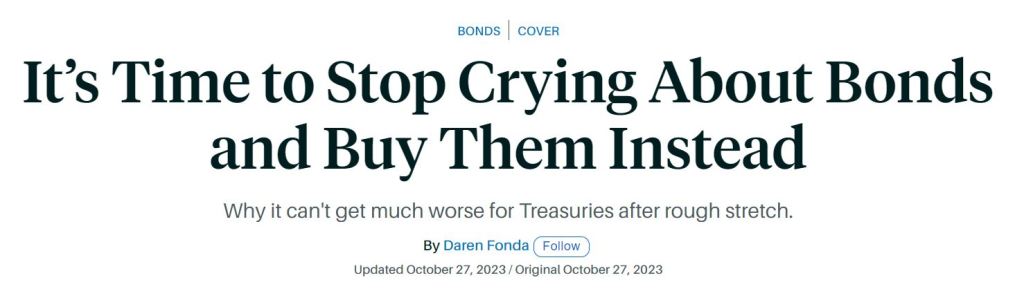
Whether or not you locked in 5% or are cursing yourself for sitting on the sidelines doesn’t matter all that much. What does is that the cost of money went from nothing to quite a bit in a hurry after many years of artificially low interest rates. During that time,  government borrowing around the world ballooned–especially in the United States. Federal debt held by the public has gone from $5 trillion in 2007 to more than $25 trillion today. 

The interest on that debt is climbing fast as old bonds roll over and new ones are issued. It was more than $800 billion in the past 12 months and is well on its way to passing $1 trillion a year. For perspective, net interest is now nearly the size of all non-defense discretionary spending. And I’m afraid that defense isn’t about to become less of a priority. As alarming as that sounds, the average rate on that debt was only 2% a year ago and just recently crossed 3%. Despite all the attention it received in newsrooms, the 10 year note was actually the last maturity to breach 5%.

If bond yields stay even at today’s slightly more modest level for any appreciable length of time then already ominous projected trillion dollar annual deficits will be much higher. That will affect not just our pocketbooks but America’s ability to wage war, deal with banking crises, and much more. The panglossian 10-year budget projections by the Congressional Budget Office have interest rates somehow staying at 3% this year and no recessions ever. Anyone paying attention should see that rates being this high could have a double-effect on the budget deficit by also pushing growth lower, hurting tax revenue.

Like Covid pretty becoming uncontainable by early 2020, it might in theory be possible to alter that trajectory with some extreme efforts like massive tax hikes, but the political will and recognition of the threat need to be far greater. If this were just a warning about interest costs being high for a while or taxes needing to rise then you could call my cute headline alarmist. The problem, though, is that the numbers will within just a couple of years be too big to reverse. 

How so? Either rising bond yields will become self-fulfilling as the people who buy bonds with the hope of an expected positive return worry about America losing control of its budget with programs like Social Security and Medicare set to deplete their funding early next decade. Like an emerging market, a vicious cycle of rising rates can accelerate the reckoning. By my estimate, simply adding a single percentage point to the average interest rate would result in $3.5 trillion in additional borrowing by 2033.

More likely, though, the effect of all this on the economy will soon push the Fed to resume expansion of its balance sheet or to at least start cutting no matter how high inflation is. With fixed income, it is your real return that matters, and that could turn negative. Of the few tricks left in the Fed and Treasury’s arsenal to control the problem, allowing that to happen is the most likely. 

This is what risk expert Michele Wucker calls a “Gray Rhino” – “a highly probable, high impact yet neglected threat” – a mix of a black swan and elephant in the room. Yet record sums have flowed into exchange traded funds that own long-term U.S. Treasury bonds.

That has been a good short-term trade, but it sounds like a potentially awful long-term bet. Buying anything on the assumption that a greater fool will provide liquidity when you’ve made your money is a silly risk. I’ll finish this essay with the standard “not investment advice” boilerplate, but I’ll also tell you what I’m doing with my own little pile of savings. None of it is in bonds with a maturity beyond three years except for those that compensate me for future inflation. I’ll gladly give up a capital gain in long term bonds to avoid what, through inflation or some other means, looks like it could be ugly.

Uncategorized

Yes, Ukraine Is a Real Country

I’m writing this eight hours after the shocking headlines that left so many of us feeling anguished and helpless. Whatever the eventual scope of Vladimir Putin’s “special military operation” by the time you read this, it’s a good moment to consider the question of what is and isn’t a real country and how worried we should be when parts of one are lopped off by invaders.

In Putin’s view, Ukraine is just part of the same Slavic, Russo-centric motherland. Once upon a time I shared his opinion, though not for the same cynical reasons. While my lifelong interest in the region and certificate from Columbia’s Central and East European (now Harriman) Institute hardly makes me an expert in the region–there are thousands of people with the language skills and specialization you should listen to before me–allow me to share my early impressions of the country now being sliced apart and of its people.

I had been living in Budapest, Hungary in the summer of 1992 between my two years of graduate school and the highlight of my summer was going to be a late August train trip through the former Soviet Union. With Hungary’s rickety telephones and Russia’s even worse ones, it would take 30 attempts to get through on a static-filled line on a call that could cost me half my then-meager weekly pay. But I finally got a visa, a plane ticket and a few hundred dollars and I flew to St. Petersburg on a Tupolev 134, my first of many journeys on scary Soviet passenger jets.

I stayed with Yuri, a Russian man a few years older than me whom I had befriended that year at International House in New York. The city was poor but stunning. Walking through the archway to the Hermitage where the October Revolution had started 75 years earlier, strolling along the canals during the long summer nights, and visiting the Summer Palace were magical experiences.

My friend Caryn and I had some trouble securing sleeper train tickets to Moscow because local mafiosi had bought them all up and were selling them at a 1,000% markup. That made them a whopping $5 or so. After an exciting night of drunken brawls outside the locked door to our compartment (the train had to stop briefly to evacuate an injured passenger by ambulance), we continued to Moscow. It was the first of several trips I would take to Russia’s capital over the next 10 years. The highlight was touring the Kremlin, which felt like (and recently had been) the fading center of an empire spanning 11 time zones. The lowlight was being attacked outside the Lenin Museum by a nationalist demonstrator whom I had photographed because he had the one sign not in Cyrillic: “Death to USA Fascist Israel.” He yelled американский еврейский шпион! (American Jewish spy!) at me as he tried, unsuccessfully, to take my 35 millimeter camera. I still have a snapshot of him somewhere.

After buying more tickets from mafiosi, we departed a couple of days later for Kyiv. Ukraine had only officially been a country for eight months with 92% of its people voting in a referendum to leave the Soviet Union. Functionally, though, it was somewhere in-between. There were no border or passport checks. There wasn’t even a national currency yet. I exchanged a very small number of dollars for “karbovanets” – coupons that looked like Monopoly money and were hardly worth more. I remember paying about a dollar for 600 rides on the Kyiv metro despite the fact that we would be there for just a couple of days. I didn’t have a smaller bill. Despite being rich by local standards, there was hardly anything good to buy. The only proper meal we had was at the home of our hosts, friends of Caryn’s boss in St. Petersburg. She spoke Russian with them and, in typically Russian fashion, their generosity to guests was humbling. As with Yuri and his family in Moscow, we were given the best of what they had to eat and drink when they had very little and allowed to take up the best spot in a tiny, cramped apartment.

Other than being poorer and more chaotic than Russia’s two major cities, I had a hard time feeling that I was in the capital of a different country. Everyone we encountered spoke Russian, and not as a second language–they all spoke Russian to one another as well. A monument to the fort that was the original site of the Kievan Rus, the seed of what would later become Russia, centered around “Muscovy” to the northeast, had a recently-installed plaque in Ukrainian and Russian. I spent a long time comparing the two inscriptions in their own forms of Cyrillic and searching for the handful of differences. It seemed like a stretch to turn what was a dialect into a full-fledged language.

Our next stop after another overnight train, Lviv in western Ukraine, was definitely no longer Russian. Caryn had to use her knowledge of Czech to fill in some of the linguistic blanks. The feel and the architecture were different. But were they Ukrainian? This was once Lvov and before that Lemberg–a Polish and before that a Hapsburg city populated by Jews, Germans, and Poles. The people living there had mostly moved into a depopulated city from the countryside. It was even poorer than Kyiv. We met a young man who spoke good English and asked what the very best place was to eat in the city. Blowing the rest of our soon-to-be-worthless banknotes, we feasted and asked him about life there.

Boarding the train to Hungary, we saw an older man shake the hands of two military officers on the platform still wearing their Soviet uniforms with the peaked caps. He then got into our compartment and it turns out he was a Hungarian doing some kind of business with the locals. He didn’t know English so I spoke Hungarian with him and Caryn spoke Russian with him for the trip to the border. Each of us would translate back to English in the three-way conversation.

When we got to the border, the train had to stop for about two hours because the Soviet Union had a different track gauge than the rest of Europe, ostensibly for security reasons. The train had to be lifted by a crane to have its wheels changed and, while that was happening, two Ukrainian guards got on to shake down the passengers. I had read in a Hungarian paper that summer that anyone not buying a through ticket would be thrown off and forced to bribe their way across the border, potentially waiting for days. The chaotic crowd outside the train window at the station confirmed it. I had sprung most of the rest of my dollars for a far more expensive “international ticket,” but I had lost a small paper customs certificate given to me in St. Petersburg that declared how much “valuta” (foreign currency) I had brought in with me. This was a Soviet form with a hammer and sickle and from what supposedly was a different country, but the guards wanted it and I was afraid that we would be thrown off the train too.

This was happening in the town of Чоп, Ukraine, which is where my father was born. It was Čop when he was born (part of Czechoslovakia) and Csap when my grandfather was born (part of the Austro-Hungarian Empire). All of the Hungarian and Yiddish-speaking local Jewish population had been taken away to Auschwitz almost 50 years earlier and my dad’s family (who by then had moved to nearby Ungvár and then forcibly to its Jewish ghetto) were among the small number of survivors. After the war, the sliver of territory became the Soviet Union and by that time the new nation of Ukraine. So here was another town, like Lviv, populated by “Ukrainians” living in houses built by dead or departed people.

Knowing well that antisemitism remains rife in Ukraine, I was in no mood to delve into family history with the agitated guards, but I wanted to stay on the train. I switched to Hungarian and the two of them did immediately and flawlessly, becoming much more friendly when I told them my father was born in the town. They asked what life was like in America, when he had left, and I kept the details sparse. Then I raised the delicate subject of the missing Soviet form and they looked at each other and told me not to worry about it. I guess I was like a combination hometown boy and celebrity to them. 

As the train started rolling again for the four hour journey to Budapest, I left Ukraine impressed with the warm, resilient people, but not with their claim to being a country with an especially strong historical legacy. First of all, the linguistic and religious differences were more of a spectrum, becoming more Ukrainian (and Polish and Ruthenian) as we headed west, with a little sliver of Hungarian as we reached the Carpathians. The borders of this new country were a Soviet bureaucratic construct.

Thirty years later, my opinion has changed. I’ve been back to the former Soviet Union many times, though never to Ukraine again. What has made the difference has been the bloody, senseless wars and ethnic cleansing I’ve seen in the region and beyond in the name of nationalism and religion. This is the 21st century. We have nuclear weapons and we have weaponized social media that can cause far more harm far more quickly than ethno-religious wars in the past. 

What I’ve heard from friends is that Kyiv, which seemed like such a Russian city back then, is far more Ukrainian today. Even if that weren’t the case, though, it’s a recognized country with borders. If we live in a world where might makes right and maps can be constantly redrawn then we live in a far scarier world. For all of our sakes, we need to stop and say “no more.” A speech in the United Nations by Kenya’s Martin Kimani about Ukraine using the example of his own continent, where borders are even more arbitrary, put it beautifully:

Today, across the border of every single African country, live our countrymen with whom we share deep historical, cultural and linguistic bonds. At independence, had we chosen to pursue states on the basis of ethnic, racial or religious homogeneity, we would still be waging bloody wars these many decades later. Instead, we agreed that we would settle for the borders that we inherited, but we would still pursue continental political, economic and legal integration. Rather than form nations that looked ever backward into history with a dangerous nostalgia, we chose to look forward to a greatness none of our many nations and peoples had ever known.

Martin Kimani

For all of our sakes, let’s forget the historical back-and-forth and just focus on the map. You can see it there in clear black lines–Ukraine is a real country.

Uncategorized

Spinoffs: GE, Johnson & Johnson

I wrote this past week about corporate spinoffs, which are all the rage these days. In a spinoff, a company takes a division or two and hands it to its shareholders, creating a brand new public company. The new company usually doesn’t fit in with its new owners, which can be a very good thing for patient investors.

Funds will own, say, a bank, and now they have a small insurer or whatever and sell its shares. But the managers of the new insurer are suddenly even more motivated as they have stock options and a lot more upside if its shares do well. The famous value investor Joel Greenblatt wrote a gem of a book largely about spinoffs, You Can Be a Stock Market Genius.

As with lots of things in investing, though, the magic has faded. Investing in spinoffs used to be a formula for very good returns, but lately they have lagged. The problem might be too many people reading the same statistics and also too many activist funds pushing companies to split apart for no good reason. With both General Electric and Johnson & Johnson announcing split this past week, I asked whether these latest attempts would create more than some initial excitement.

Breaking apart a company can, in theory, unlock value. Corporate spinoffs as an asset class have done well historically. Value investor Joel Greenblatt highlighted the opportunity for the masses in his book “You Can Be a Stock Market Genius.” Several studies using data from the 1990s through the middle of the last decade have shown that a portfolio of spinoffs can beat the market by 10 to 15 percentage points in the year after they go public. Managers of a newly public company are more focused and valuations often rise to reflect those of peers. But there are catches. One is that investors have to hold on to the spinoff to reap the rewards, and many don’t. Initial selling pressure on spinoffs often creates opportunities for even more outperformance once a new shareholder base is established. But the spinoff secret is out. Activist investors now push companies to reshuffle the deck chairs to generate short-term stock-market gains. Trian, the fund that took a stake in GE in 2017 with disastrous timing, applauded Tuesday’s move.

Uncategorized

Feeling Lucky?

Remember the DC-10? I’m dating myself by telling you that I recall flying on the widebody jet when I was about nine years old. I couldn’t have been much older than that because all of the ones operating in the U.S. were grounded for a while in June 1979. This came after the deadliest airline crash in U.S. history not related to terrorism, American Airlines Flight 191, which killed 273 people. A much longer grounding, more than a year-and-a-half, resulted from the deaths of 346 people in two crashes of the Boeing 737 MAX. And all U.S. air traffic was shut down for days after the 9/11 terror attacks almost 20 years ago which resulted in almost 3,000 fatalities.

While I’m not arguing that any of these were overreactions, they are a sign of how bad we are at weighing danger. I remember many people saying that, even once cleared to fly, they wouldn’t get on a DC-10 or a 737 MAX. Many skipped flying altogether for months after 9/11. Yet there seems to be virtually no concern today about a threat that killed 1,275 Americans in just the past two days – the Covid-19 pandemic.

Proms are going on unmasked, basketball arenas are full of fans with a few people wearing them draped around their chins, and airplanes are packed. Thank goodness 50% of American adults have now been fully vaccinated, but that leaves half who haven’t been. The people who are most likely to eat in a crowded indoor eatery or other high risk activities are also less-likely to be among the half concerned enough about catching or passing on the coronavirus to ever get a vaccine.

I’m not advocating for a lockdown, but the lack of caution is interesting. Somehow two or three hundred deaths from an air disaster gets us spooked, a few thousand dead from a domestic terror incident has us terrified, but 600 deaths a day with many more hospitalized are an acceptable risk.

Why do we think this way? Is it that a deadly fireball on the evening news seems scarier than the abstract thought of hundreds of people spread all over the country who are probably strangers gasping for breath and dying alone of a respiratory illness? An alternate explanation is that 600 is a whole lot better than the 3,000 plus a day who were dying back in January and that we’ve put the danger in perspective. 

The second explanation might be convincing if it weren’t for the fact that lots of people weren’t being at all careful then either. My family and I drove from New Jersey to Florida for our one and only trip of the pandemic over New Year’s. As soon as we got south of the DC suburbs the level of caution began to evaporate. Pee breaks were filled with anxiety as we walked into rural convenience stores and motel lobbies where patrons and employees seemed blithely unaware of the global pandemic.

But then maybe we were the ones who misunderstood risk. In terms of fatalities per mile traveled, a road trip in non-Covid times is about 750 times as likely to be fatal per mile as a plane journey. Being locked in a pressurized metal tube with a hundred or so mostly-masked strangers for a few hours each way might not have been too much more likely to result in infection than those bathroom breaks. 

All’s well that ends well as we didn’t get sick or crash, but maybe we would have been safer flying — even in a DC-10.

Uncategorized

We’re About To Get Schooled

The origin of the phrase “hope is not a strategy” is disputed, but I generally hear it in a business context. I get the feeling that educators are going to become acquainted with it pretty soon.

By this time in August, schools in much of the country are scheduled to be filled with teachers and students. Many universities will start a week or so later. Some will teach remotely, but most are still slated to be in-person or some hybrid thereof. As the dad of kids in both high school and college and the husband of a school employee, I’ve been privy to the plans — if you can call them that — of the superintendents and provosts.

There was a peculiar kind of cognitive dissonance on display early in the Covid-19 pandemic by educators. Of all people, they’ve failed to learn. Back then I contacted the local superintendent and the college provost as cases were spreading about when they planned to send kids and teachers home. The answers were “it’s still rare here” when there was almost no way to get tested and when epidemiologists were warning that it was spreading exponentially. 

That fear of looking dumb or alarmist repeated across thousands of districts and campuses probably cost thousands of lives. It’s somewhat excusable because it was hard back in February or early March to imagine what the world would look like just weeks later. 

But what about now? Decision-makers all certainly know the meaning of “exponential” if they didn’t before. The U.S. has had 145,000 confirmed Covid cases in just the past two days and almost certainly many more unreported ones as people face long waits to get tested in the Sun Belt. What is more, a higher share of those cases is from a young, working-age cohort. Some schools in Florida, which reported over 15,000 cases on Sunday, open in as little as 20 days. I’ve been following private forecasts by Qijun Hong, a postdoc at Brown University, who has been producing remarkably accurate infection models for several weeks. Here’s his latest for Florida.

This is for confirmed cases. Of those tested, very few are children, but this week we learned that an incredible 31% of children tested randomly in Florida were positive. Even if the number of new cases in Florida in August is just half as high as Mr. Hong is projecting, is that low enough to reopen schools? The answer is almost certainly “no,” and here’s why.

In the first month of school alone, about 1 in 60 Floridian adults would be diagnosed with Covid-19. A school with 500 kids will easily have 40 teachers, aides, principals, coaches, secretaries and janitors plus a handful more substitute teachers — all part of that potential pool. And then there are easily 1,000 more adults who live with or regularly see those children who also could be diagnosed. And don’t forget the spouses of those teachers, janitors, principals, and substitutes  — one of them could be diagnosed. Even if we assume that kids can’t spread the illness, the chances that at least one of those 1,100 adults doesn’t face quarantine or receive a diagnosis is tiny.

And if an asymptomatic teacher’s test is positive? With tests taking five or more days to come back, that employee will have had time to infect plenty of other adults and children. Will they all have to quarantine? And if they don’t, who wants to be the substitute teacher for the one who is positive? How many substitute teachers earn enough to take that risk and how many can the school system afford to pay? How sure are they that children can’t pass it on and at what age does it become more likely that they will? Try asking this question and getting a straight answer.

If the substitute starts feeling ill, will the system pay for his or her Covid tests or treatment even though they aren’t on the insurance plan? That substitute may have visited multiple schools, so which school is on the hook and will the teachers or students he or she met at each school then have to quarantine?

What if the first person diagnosed works in a middle school or high school? Well then he or she isn’t in contact with 25 kids daily but more like 125. In the case of a cafeteria worker it would be hundreds. What then? 

The schools tell us they are taking steps, including lots of extra cleaning and social distancing, but how effective will they be? Having half as many kids in a room at a time will help, and so will mandatory masks, but kids aren’t especially careful or sensible. Even 100% compliance with mask-wearing and hand washing only would reduce, not eliminate, contagion. We know that an infected person spending an hour at a party or bar can infect several people. Even if schools are half day, the period of exposure will be longer.

The odds of any given school not being touched by Covid-19 are a bit better in most other states, but not great. One-in-100 or even one-in-500 adults infected in a month still makes an infection at a given school quite likely. With perhaps a third of teachers in higher-risk categories because of age or medical history, it is unfortunately only a matter of time before some of them are on ventilators.

The situation could be even worse for colleges hosting young adults who are most certainly capable of passing on the illness and who generally lack a healthy appreciation of their own mortality. What happens when a student in a dorm of 150 tests positive? He or she will have been contagious for a while. Remember when a single sick person who left the Diamond Princess sparked a lockdown of everyone else in their cabins? Weeks later 691 people on board had it. That was with passengers confined to their rooms and being brought their meals. Will colleges deliver meals to the student? Whose job will that be? And what about shared toilet and shower facilities? How many positive tests in a building before everyone is sent home? Is a dorm being set aside only for those who test positive or will they just be sent home to infect their parents and siblings? And what about international students who can’t go home? Will airlines or Amtrak transport infected students anyway?

I understand why colleges are so eager to have students return in person: money. Empty dorms and students deferring will put even more financial strain on them. I also understand why primary and secondary schools are doing it: pressure from politicians and from parents worried about their children falling behind or about who will watch them while they work. Unfortunately, the plans to keep everyone healthy are vague and ad hoc and we still know too little about this disease.

Instead of hazy, expensive, and unworkable plans, how about doing some serious planning for a better remote learning experience in the fall while the world waits for a vaccine? Online learning in the spring was subpar, but it doesn’t have to be.