Author: SJ

  • Money Tree Podcast Interview

    aapic

    I sat down to speak with Doug Goldstein of the Money Tree Investing podcast to discuss whether it’s realistic to expect to beat the market with any consistency and the media’s role in spooking or exciting investors. He asked smart questions and I tried to give smart answers based on the findings in my book and other personal finance sources. Check it out!

  • Informed Choice Radio

    aapic

    Last week I sat down (well, sat down remotely) to chat with Martin Bamford, a financial planner who, among other things, hosts a podcast called Informed Choice Radio. The topic was why smart investors fail – a subject near and dear to my heart. His questions were smart and I think a few of my answers were as well. The podcast was just published.  Check it out.

  • Heads I Win Voted “Best Read” for Advisers

    aapic

    I’m honored that my book was just listed as one of the best summer reads for advisers by Financial Planning. It’s on the list with some great books such as Michael Lewis’s The Undoing Project,” Daniel Kahneman’s “Thinking Fast and Slow,” and a book called “Great Expectations” by some British guy named Charles Dickens whose name rings a bell.

    “There’s great stuff in here to share with clients, particularly when markets head south. Good behavior is handsomely rewarded for investors with long-term time horizons. I quote from it often.” – reviewer Stephanie Genkin.

    This was a great one-year “bookiversary” gift. I’ll be speaking this fall at the FPA’s Financial Fitness Workshop in New York and at the annual meeting of the American Association of Individual Investors in Orlando for anyone who wants to see and hear me discuss the book’s lessons in person.


  • A Bookiversary Gift for You!

    IMG_0258

    Yesterday marked one year of authordom and I’m in the mood to celebrate. The screenshot above was taken exactly a year ago with my book sitting briefly on top of the business book charts on Amazon.

    While the sales momentum has slowed down just a wee bit, the topic is as fresh as ever. If you haven’t read my book yet or if you have and would like to give an investor in your life a copy, here’s your chance. All you have to do is answer a question without peeking in the book. Send me the answer at spencerjakabauthor at gmail.com. I will give away three signed copies to three randomly-selected people who get it right. Ready?

    Imagine that you and your sibling both receive a large inheritance with the condition that the money be held in trust for 30 years. Your friend is an experienced investor but you aren’t. Your benefactor allows your sibling to invest as he or she sees fit, though only in actively-managed mutual funds and making as many changes as desired, while you have to put the money into a low-cost index fund (60% stocks and 40% bonds, re-balanced annually).

    At the end of the 30 years you will almost certainly have more money. According to a 30 year study of investor behavior that I cite in the book, how much more will you have if your sibling is typical?

    A. 25% more

    B. Twice as much

    C. Seven times as much

    D. 50 times as much

    Good luck!


  • Markets Have Reached Peak Consonant

    img_1926

    We’ve hit peak consonant and that has me worried about the stock market.

    There’s a difference between being an investor and a speculator. I advise readers to stick to the former in my book and to keep it simple. But I also point out that the awful performance of most ordinary savers has a flip side since the markets are a zero sum game. Aside from fees, which are considerable and keep many fund managers and advisers in fine fettle, a small number of speculators reap the rewards of outwitting a large number of suckers. When you zig they often zag. if you want to be one of those guys or girls who can sniff out opportunity or danger and profit from it then you have to be able to read the writing on the wall. I think I just saw it.

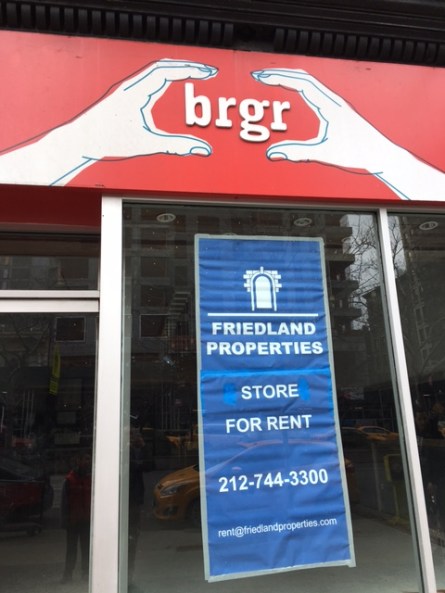
    The trend of naming companies and products with few or no vowels seems to have peaked. The shuttered burger store pictured above, which I walked by yesterday on Broadway,  is exhibit A. Why on earth would this matter, though? Names are just names, after all, and the likes of Flickr, Scribd, or Unbxd are mostly private companies or, like Tumblr,  divisions of public ones with other activities.

    Ah, but trendy names have been a recurring sign of danger in markets. Back in the early 1960s there were the “tronics.” Any company associated with space or electronics did marvelously for a while as the government poured cash into the Space Race. Burton Malkiel writes about a company that sold records door-to-door and changed its name to Space Tone. It saw its stock rise sevenfold in a short period. This sort of irrationality signaled not only a bubble for those particular companies but the beginning of the end of the Kennedy Bull Market.

    Years later, most of us were in the market already during the granddaddy of them all when hundreds of companies with a dot-com in their names achieved lofty valuations. We all know how that ended.

    In fact it seems that, even outside of a bubble, avoiding companies with exciting names is smart. The great investor Peter Lynch wrote in One Up On Wall Street, the first book I ever read about investing, that “a flashy name in a mediocre company attracts investors and gives them a false sense of security,” and he warned against buying stocks that have an x in their name.

    I decided to test this out for an article I wrote for the Financial Times back in 2010 and found 109 companies in the Wilshire 5000 that began or ended with an ‘x.’ They were, in fact, more expensive, far more volatile, and less likely to be profitable. In a stock picking game I’ve been playing for several years I’ve blindly shorted such stocks and made decent returns doing so. ‘Q’ is just as bad.

    So back to the vowel-less companies. Is it a case of what’s old is new again? The Semitic languages, including modern Hebrew and Arabic, had some of the first alphabets and are written mostly without vowels. When I went to Hebrew school they were written in but are considered training wheels in modern Hebrew, much to my confusion in Israel.

    That’s not the case here. There is no convenience factor as with those scripts, just a hipness quotient. My former colleague John Carney once made up a fake company called Grindr that would grind down your enemies, but it turns out someone grabbed the name to start a gay dating app. I considered grabbing the url for Tstr, perhaps to launch a grilled cheese company, but it already was  claimed by “Tacoma & Seattle Trailer Repair.” Darn.

    Anyway, the moment has passed and you’ve been warned. The stock market as a whole is at the 96th percentile of all observations in 135 years based on the Shiller P/E ratio and companies like Tesla with no earnings or free cash flow are worth multiples of established competitors many times their size. Put “cloud” in front of a product and you can command double the multiple. I can go on and on.

    Watch out below – srsly.

  • Happy Bookiversary to Me

    aapic
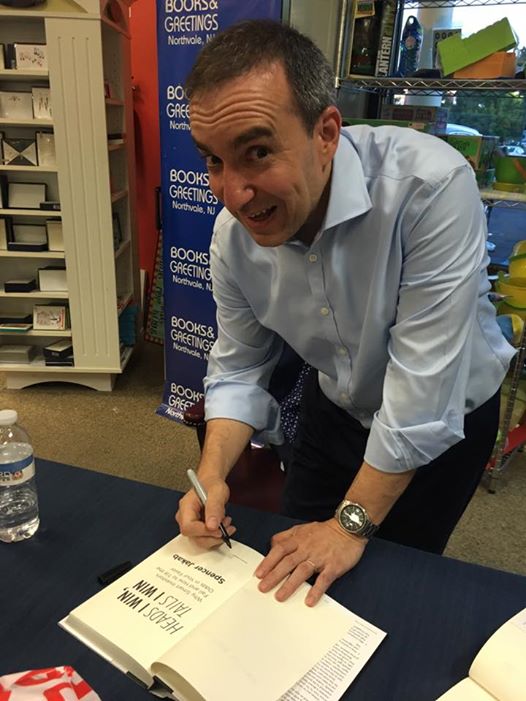
    Signing books at Books & Greetings in July, photo by Angela Schuster

    “How’s the book going?”

    If someone, somewhere had bought a copy of my book every time I’ve been asked that question then Michael Lewis would be quaking in his boots. My stock answer is: “Oh, not a bestseller, but pretty well.” The truth is that it’s actually hard to say. Measured how and relative to what?

    Well, now that I’m at the six month mark since Heads I Win, Tails I Win was released in hardcover, it’s time to take stock. The information about industry sales is pretty patchy, but what I found surprised me.

    According to Steven Piersanti of publishing house Berrett-Koehler there were 256 million adult non-fiction books sold in the U.S. in 2013. That sounds like a big number but, even before counting self-published titles, there are an awful lot of new books per potential reader. He says the average U.S. nonfiction book sells less than 250 copies a year and fewer than 2,000 in its lifetime. That nonfiction average is pulled higher by bestsellers, many by celebrities. The median probably is lower. (For example, Tina Fey’s Bossypants sold 3.5 million copies as of last year). That jibes with what my editor at Penguin/Random House told me – that most books they buy don’t make them a profit. Mine has. It doesn’t even come out in paperback until this summer and I’ve nearly outsold “Hooking Up” by Tia Tequila.

    So I guess I should be pleased. According to my publisher’s partial tally of sales, my book sold a combined 5,207 copies in six months including e-books but not audiobooks. Nielsen BookScan data, which Amazon breaks out on my author page, says that 3,397 physical copies have been sold in the United States. Of those, 499 were purchased in New York, my leading market by far. Los Angeles, Chicago, Boston, and San Francisco also were pretty good.

    The “be cheap and lazy” brand of investing advice sold less-well in the Midwest, but I’m happy to say that there isn’t a metropolitan area where no one at all bought a copy. If you’re the one person who bought it in Toledo, Ohio, South Bend-Elkhart, Indiana, or Davenport-Rock-Island-Moline, Illinois, thank you!

    Should I care about this? Isn’t it the quality that matters? I wish life were so simple.

    It’s true that I poured my heart and soul into the book and that it got really nice reviews and mentions in Forbes, Money, Barron’s, USA Today and The New York Times and was excerpted by The Wall Street Journal, Marketwatch, and others, along with some great advance praise. Book-writing is a business, though.

    So am I in it only for the income? Samuel Johnson famously said that “no man but a blockhead ever wrote, except for money.” Consider me a semi-blockhead, then. Completing a book is an ordeal for the author and his or her family and I would never write one with no expectation of remuneration. On the other hand, the “how’s the book going” crowd would be shocked if they knew the effective pay per hour that a moderately successful author such as myself earns. I try not to think about it, or to guffaw when people ask if I’m planning on retiring to write books full time!

    Publishers pretty much count on people like me who have more passion than common sense. They’re much less sentimental, which is fine – they have families to support too. Even if the prose sings and the subject matter is groundbreaking, they won’t publish a book that they think will sell only 800 copies.

    In that sense, then, the book is doing pretty well. It would have to sell a lot more copies for me to see any income beyond my advance on royalties. On the other hand, the more copies I manage to flog the greater the odds of my next project finding a publisher.

    Stay tuned.

  • Come See Me in Nashville

    Neon Lights of Lower Broadway, Nashville, TN

    Music, hot chicken, Vanderbilt, my sister and her family, more hot chicken – I love coming to Nashville. My next visit and first-ever speaking engagement in town will be on February 9th at 6:30-8:00 in the evening at University School of Nashville. The $25 fee goes towards an excellent cause: the USN scholarship fund.

    The title of my talk is “Beat the Odds and Become a Much Better Investor.” I’ll also be signing and selling copies (at my cost) of my book, Heads I Win Tails I Win: Why Smart Investors Fail and How to Tilt the Odds in Your Favor.

    Sign up here.


  • Upset About the Election? Here’s Something You Can Actually Do

    aapic

    However you feel about the election this past week, it’s unlikely that you’re one of the small group actively taking part in protests against Donald Trump’s election or campaigning to get rid of the Electoral College. It’s silly and fruitless. The Donald chuckles at such impotence.

    I’m a journalist, but the sort who keeps his political opinions fairly private. I don’t donate to political campaigns and haven’t registered to vote in primaries. One thing I’m not shy about, though, is standing up to thugs. I’m not calling President Elect Trump one, by the way. He hasn’t even taken the oath of office yet. I can tell you, though, that one thing that actually gets under his skin happens to be the same one that bothers authoritarian heads of state and corrupt businessmen worldwide: a free and vibrant press

    In China or Russia or Turkey or Africa that often results in newspapers being shut down or even journalists getting murdered. Here, so far, we have disgusting antisemitic tweets, scary chants at rallies, and a threat by Trump to “open up our libel laws” and sue the media into submission.

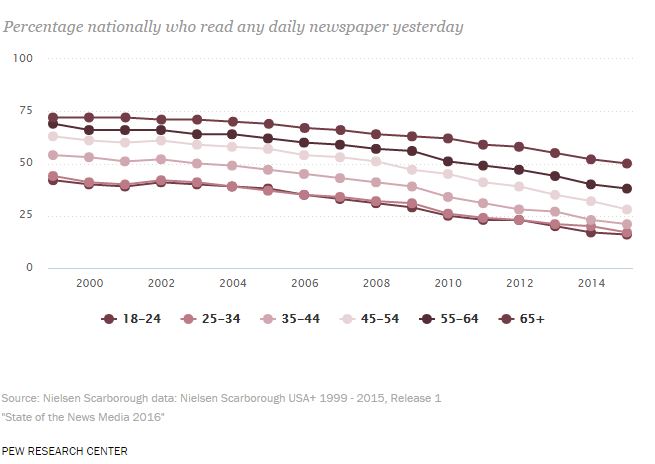
    Despite all that, the main threat to the American media, and dare I say democracy, is apathy. You’ve probably heard that about 100 million people – far more than those who cast a ballot for either Trump or Clinton – simply didn’t vote. But what about the people who didn’t read a newspaper or support one? The reason so many people you and I know are shocked by Trump’s victory in the face of a mountain of concerns about his past conduct, his personality, and his agenda is that we relied on ethical, trusted sources of information about him.  But, according to Pew, just 21% of people ages 35-44 read a newspaper yesterday, down from 44% in 1999. Just 18% of Hispanics of any age did.

    pew

    Many people, perhaps including you,  read a newspaper article reached from a link on social media today but didn’t read another article in the same paper. And you probably didn’t pay for it. The total circulation revenue of all U.S. newspapers in 2014 was just $10.9 billion. It’s now just half of the sales of Starbucks. Between 2006 and 2014 the number of people employed in print journalism fell from 55,000 to 32,900. It’s probably below 30,000 now. Just this past week dozens of people in my newsroom lost their jobs and two sections were discontinued while two others were merged. The result is a thinner paper.

    Do you subscribe to a newspaper or do you just graze on whatever is free on the Internet? Do you subscribe to more than one? Well here’s something you can do that will drive Donald Trump up the wall. You can do it right now at the expense of giving up a few cappuccinos a month or waiting a little longer to upgrade to that snazzy new iPhone: subscribe to an old-fashioned print newspaper.

    Yes, this is what feeds my family, but it isn’t an act of charity and you don’t have to subscribe to The Wall Street Journal. Buy The New York Times or The Washington Post or your local paper. You won’t just be making a political statement.

    Reading a print paper instead of zeroing in on the specific article you want to read on your phone or computer leads you to read all sorts of other articles you weren’t looking for but are glad you found. You don’t get that kind of serendipity in your targeted Facebook news feed or even a digital newspaper app. You’re also getting something hand-delivered to your house that’s an amazing daily undertaking put together by people who could be earning more in a different job and who take a lot of infuriating crap doing it. Even though I don’t write about politics, I get all sorts of nasty comments when I write something people don’t like, disparaging me or my profession, putting “journalist” in quotes. We get called the “lying media” and worse. And yes, of course, the result isn’t perfection. But what a newsroom full of journalists produces is a wonder. I think the British critic AA Gill said it best:

    Newspapers are the size of long novels.They’re put together from around the globe from sources who want to lie, to manipulate, to sell things, hide things, spin things. Despite threats, injunctions, bullets, jails and non-returned phone calls,journalists do it every single day, from scratch. What’s amazing, what’s utterly staggering, is not the things papers get wrong, it’s just how much they get right.

    Come on, make a statement by going retro and reading a paper or two made out of dead trees.

  • The Warren Buffett Argument

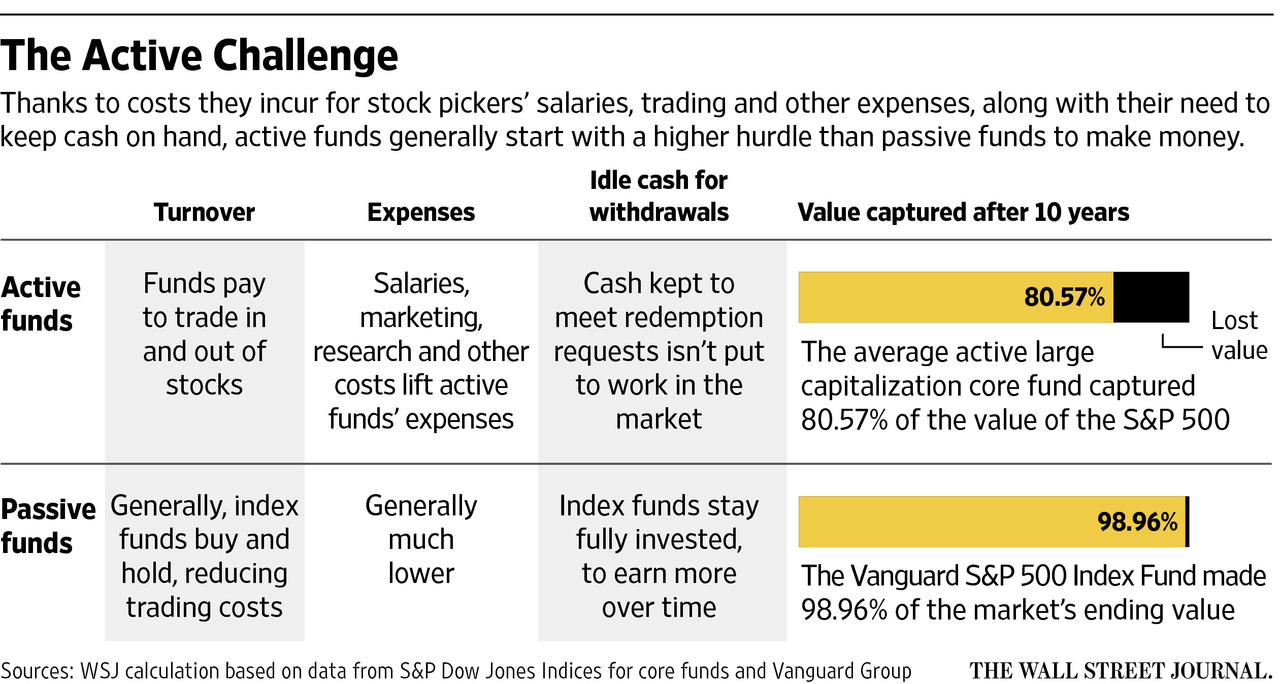
    The Wall Street Journal is running a smart series this week, pegged to the 40th anniversary of the first index mutual fund, on the merits of passive investing. The editors asked me if there were any arguments for why active managers, despite their awful relative performance, are worth it. I came up with three arguments, the most convincing of which readers of my book will be familiar with: “Warren Buffett.”

    aapic

  • Talking Financial “Self Sabotage” With Pete the Planner

    aapic

    Today I talked about financial “self sabotage” and  my book with financial guru and radio host “Pete the Planner.” It’s the subject of a series of interviews he’s doing and a great one for me to discuss. Heads I Win, Tails I Win is, after all, about multiplying your potential nest egg through avoiding unforced errors. Have a listen!