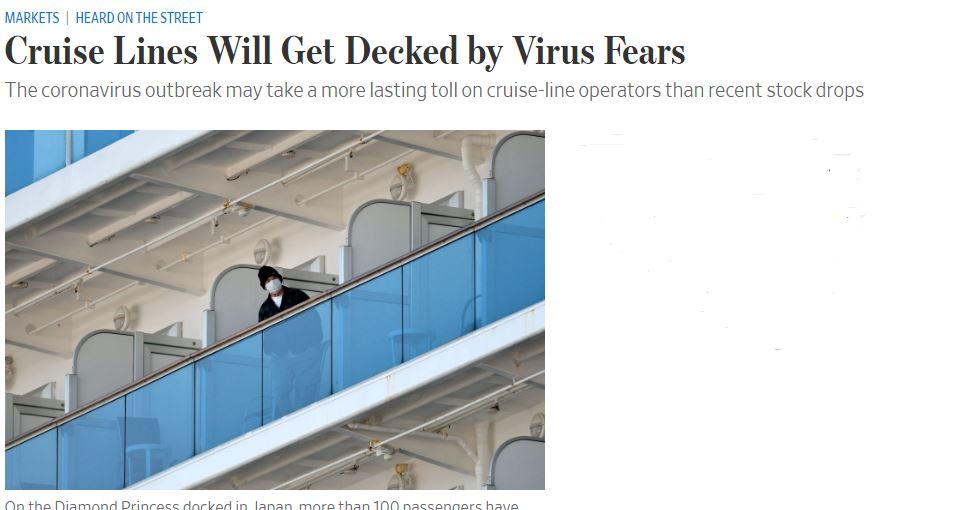
I wrote about the cruise industry. There are often disasters or mishaps like the 2012 Costa Concordia accident or the Carnival “poop ship” in 2013 that produce temporary bargains for people brave enough to pounce on a cheap vacation deal or stock. The latest scary quarantines may be different, though.
There are threats aside from the immediate epidemic. The fact that the quarantines have occurred in Asia may do permanent damage to China’s embrace of cruising in what Carnival management has said it believes will grow into the world’s largest cruise market. About 4.24 million, or 15% of cruise passengers, came from Asia in 2018 according to the Cruise Lines International Association.When cruising was in its infancy in the U.S. it received a warmhearted P.R. boost from “The Love Boat” TV show that ran from 1977 to 1986. To would-be cruisers from China’s emerging middle class, scenes of ambulances and quarantines are leaving a far less heartwarming image than jolly Captain Stubing.
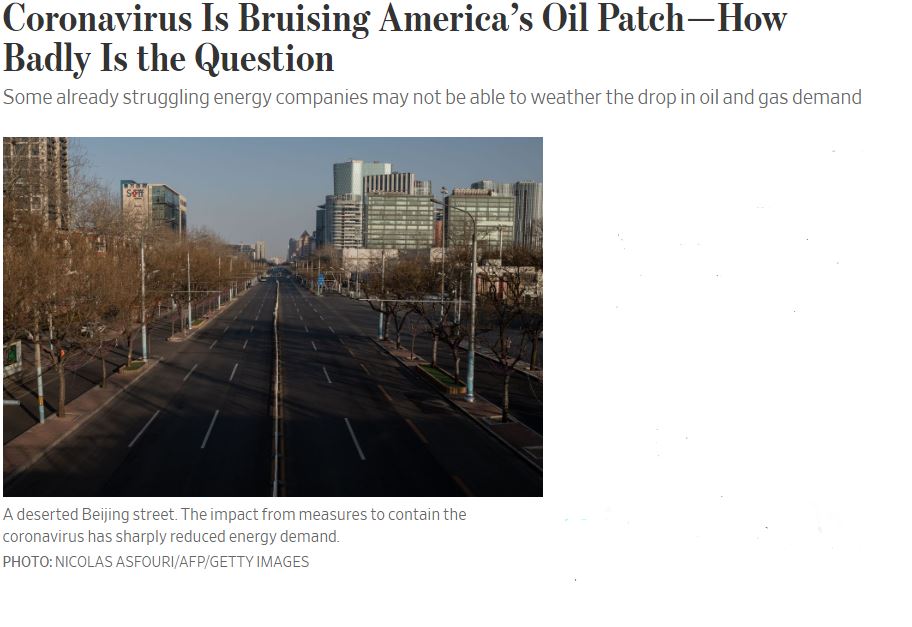
I wrote about the tough times in America’s oil patch and how much tougher they have become since the coronavirus knocked about a fifth off of crude prices.
The oil market is more accustomed to dealing with supply shocks than collapses in demand. While strategic reserves can ease shortages, even the most eager Fed chairman or Treasury secretary can’t create demand for a million barrels of oil a day by pushing a button—not that they would agitate for higher pump prices anyway.
Back when I was writing my book, I decided to start a chapter on the wild, wacky, and frequently value-destroying world of “alternative investments” by playing around with the Hedge Fund Name Generator. It usually combines a color, a geographic feature and a corporate moniker. For example, I just came up with “Red Road Partners.”
For the purposes of the book, I kept trying until it spit out some bizarre or offensive sounding ones like YellowRoad Associates, SolidOcean Markets and, best/worst of all, Black Street Brothers.
The fashion used to be names from Greek mythology and I wrote a LinkedIn post a while back, Letter From a Failing Hedge Fund Manager, in which the author’s fund was called Oedipus Capital. But while you use up the acceptable classical names pretty quickly, the current trend has a ways to go. Just do the math: Six primary or secondary colors times 30 geographic features times seven corporate types gives you 1,260 fund names — way more than you’ll glean from the index in Edith Hamilton’s Mythology. Throw in street or town names and you have tens of thousands of choices.
Doesn’t this confuse people? “Hey man, was I supposed to wire that billion dollars to Golden Lake or Silver Lake?” Isn’t it at least getting a bit old? I know that there is some reflected glory here — BlackRock and what have you — but how about just gaming the system the way the way a plumber does to get to the top of the listings in the Yellow Pages: “2 & 20 Management” or “AAA Amazing Returns Capital?”
Alternatively, just get to the point. “Gigantic Stacks of Money Partners,” for example. It isn’t like there are truth in advertising rules for hedge funds. One of the best funds ever, by the way — though it existed only on paper — was Andrew Lo’s “Capital Decimation Partners.” It gained 2,560% over seven years, though it contained the seeds of its own destruction because it simply sold out-of-the-money puts. In today’s return-hungry world, I bet he could start a real fund, name it that, point out in bold text how it could all end in tears, and still attract huge inflows. What a time to be alive!
I wrote about a hot topic – literally. Every day enough natural gas is burned off to fuel Germany, France, and Belgium combined. It contributes about 1% of global greenhouse gas emissions. The reasons for this tremendous waste are complicated, but there is much that can be done.
Among my resolutions this past year was to read more determinedly — books specifically. Too much of my consumption had become bite-sized: Newspaper articles, Wikipedia entries and blog posts, and often just fractions thereof. I felt a small sense of accomplishment getting through a long New Yorker feature in a single sitting. The Internet, and Twitter especially, have made my attention span a lot shorter.
But books are special and anyone who has seen my desk or bedside table can attest to the fact that I have oodles of physical titles lying around and also that the pile seems to keep growing. I’ll start reading one with the best intentions only to dip into something else that seems more interesting, moving the first one onto a stack that stretches back months or years.
Back when I was about 17, I decided that I wasn’t well-read enough and I made a long list of things I “should” read. My dad had sent me a bunch of books in the mail with notes on the inside cover about what age he had been when he had read them — Jack London, Alexandre Dumas, stuff like that. I didn’t pick many of them up. He died when I was 16 and I felt guilty for being so lazy and uncultured.
I made a list of dozens of books that I figured I “should” read — mostly fiction — and got through much of it by the time I was a freshman in college. A few were enjoyable. Others were a slog. The list broadened my horizons but, in hindsight, the whole exercise was a bit silly. Not much later I read lots of “serious” stuff in college that made a lot more sense with professors putting it into context.
Flash forward 33 years to my older, far more distracted self. Now I actually like some of the highbrow stuff that I made myself read back then and the only books I occasionally force myself to get through are those relevant to my work or for a book club that I joined several years ago (most of those are pretty good).
So this year I decided to finish books before I started the next one and to keep track. And while I didn’t have a “to-read” list, I did have an unofficial goal of reading a book a week and also tilting away from nonfiction. I remember hearing a talk by the science fiction writer Harlan Ellison when I was on my “serious book” binge. He said that he read a book a day and I was amazed. I still don’t know how he did it, but not having a formal job probably helped. I only managed 44 this past year, and that was by forcing myself to finish a few. There were six or seven more that I abandoned, a few of which I’d like to revisit.
I’m no book reviewer but, in case a middlebrow journalist’s year of reading is of any use, here are the highlights and lowlights of 2019:
Books I didn’t finish
Washington: A Life by Ron Chernow. Honestly the only reason I didn’t get through this fantastic biography is that it weighs in at close to 1,000 pages and so many other interesting things had popped up on my bedside table. Also, I had to return it to the library. I thought I knew a lot about the man and the period and I was wrong. Like Walter Isaacson, Chernow is a hugely-talented biographer. I’d read Titan, his biography of John D. Rockefeller, several years ago and also loved it. I’ll swing by the library soon and finish the last few chapters.
In Cold Blood by Truman Capote is another I just didn’t finish. This grisly tale is a modern classic written in 1965 about a 1959 slaying of a family in rural Kansas and a book that I had been meaning to read for a while. Sometimes even “modern” classics feel a bit dated — especially those by a writer like Capote who is so widely-copied — but this one holds up very well. I just ran out of gas.
Snow Crash by Neal Stephenson. After the 5th or 6th science fiction geek in my life urged me to read this book, I finally ordered the paperback from Amazon. It’s certainly clever and I really wanted to learn more about its hero, “Hiro Protagonist.” Reading it 20 pages at a time during my commute just wasn’t the right way to get into the novel’s dystopian world, though. I’ll try again when I’m on a beach or somewhere quiet and isolated.
Books I shouldn’t have finished
Having a lofty reading target has a downside– you stick with books that you sometimes shouldn’t. I don’t want to spend too much time on this part of the list because lots of people probably never made it through my book either.
But I console myself with the knowledge that there are so many truly terrible books published. We have boxes and boxes of awful, self-promoting nonfiction titles at my office that were sent to some reporter for free. As Christopher Hitchens said: “Everyone does have a book in them, but in most cases that’s where it should stay.”
It wasn’t like I picked stuff up at random. I thought I had a pretty good filter — whether the author was someone I’d heard of or if the book had sold well. In the case of these three, those litmus tests failed me. One was even made into a movie. None were actually awful — I stopped reading some real stinkers in the first 10 pages — but these were disappointing.
Ben Horowitz is by all accounts a famously successful venture capitalist, yet his bestseller The Hard Thing About Hard Things is a dud. I was hoping that it would impart some generally useful lessons. They all were specific to running a tech company, and really not even then. It could at least have contained more drama or fly-on-the-wall detail. Horowitz must either have really good instincts about people or really good employees and partners because he comes across as an empty suit in this book.
I had high hopes for WIld: From Lost to Found on the Pacific Crest Trail by Cheryl Strayed. I blame my “y” chromosome for not liking it. I have nothing against female authors, but I’m not a female reader and some books are just targeted at that audience. That’s smart marketing since women buy more books than men. The Guardian’s explanation: “Women know how to read properly, while men have a desultory and, at best, casual approach to books.”
Sure, maybe, whatever. I had read Bill Bryson’s witty A Walk in the Woods about hiking part of the Appalachian Trail a year earlier and loved it. There was a lot about the experience and the trail’s history and also a bit about being grouchy and middle aged. I thought this would be a more serious take on a more serious hike with maybe just a little bit more navel gazing thrown in. There was just way too much about Strayed’s wacky upbringing and dying mother and her feelings and not nearly enough about my reason for picking it up. It shot to number one on the New York Times Bestseller List after Oprah picked it for her book club and was made into a movie starring Reese Witherspoon. So much for bestseller lists.
The force wasn’t with The World According to Star Wars by Cass Sunstein. That’s too bad because he’s quite an accomplished guy. His book with Nobel Prize winning economist Richard Thaler, Nudge, was good and a lot of his other books look really interesting. This one probably sounded promising when he pitched it to his publisher but suffered in the execution. Or maybe I’m just not that interested in the saga of how Star Wars was made. The analogies he drew to real life are pretty strained.
Pleasant Surprises
I love stumbling across new authors. Just because they’re new to me doesn’t mean they’re unknown, of course. Here are a few good ones I “discovered” in 2019:
Full Tilt: Ireland to India With a Bicycle by Dervla Murphy. I found this Irish author by accident, but she’s actually well-known and this is the book that made her a famous travel-writer back in 1965. The title is self-descriptive and her tale is incredible — especially the parts in Afghanistan and Pakistan. Murphy is, according to her Wikipedia page, still alive. It’s amazing that she lived to tell just this tale, frankly.
Tom Barbash is another known writer who was unknown to me. I picked up The Dakota Winters in the leftover bin at my office and really enjoyed it and then passed it on to my mother-in-law who liked it too. It’s a tale that mixes real people and places — John Lennon and various locations in troubled 1980s New York — with the fictional family of a struggling TV talk show host. I was 11 when Lennon was shot and New York was pretty crazy then. This is a nice snapshot.
I don’t often cackle maniacally on the bus to work, but Hits & Misses by Simon Rich had my fellow commuters looking at me sideways. The reviews compared him to Wodehouse and Thurber, which is high praise indeed. I wouldn’t quite say so, but these stories are really, really funny.
Shooting Lessons by Lenny Kleinfeld. Amazon informs me that “customers who viewed this” also looked at Swag by Elmore Leonard, which isn’t surprising. I immediately thought of it while reading this hard boiled story about a cop hunting for a killer preying on drivers of “Makro,” a ride-hailing service like Uber. Great story and pacing.
Old Favorites
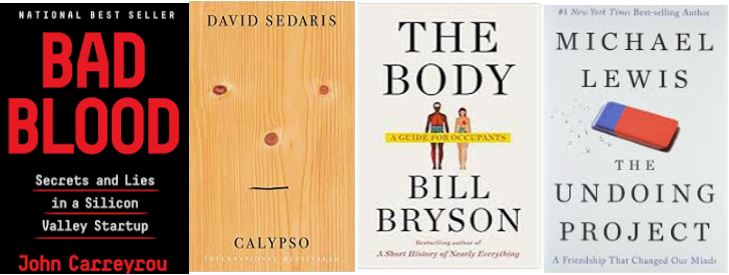
When in doubt, go back to what, and whom, you know and like. I read seven books by five of my favorite writers in 2019: Bill Bryson’s The Body; Exploring Diabetes With Owls and Calypso by David Sedaris; Meet Mr. Mulliner by P.G. Wodehouse; Dead Wake and In the Garden of Beasts by Erik Larson; and The Undoing Project by Michael Lewis. I also read two books each by Bernard Cornwell and Daniel Silva and three by Agatha Christie, but I wouldn’t call any of them a favorite writer – just guilty pleasures. I also read Skin in the Game by N.N. Taleb, which is most certainly not a guilty pleasure, yet it’s the fourth book of his that I’ve read. I might call him a favorite if he hired an editor, but I keep getting sucked into his knotty, boastful, thought-provoking books like a moth attracted to the flame.
The Best of 2019
The books I recommend most highly include two I already mentioned, Bill Bryson’s The Body, David Sedaris’s Calypso, one from a former colleague, Bad Blood by John Carreyrou, two “classics” that I should have put on my 17 year old list, both set in the rural South: Tobacco Road by Erskine Caldwell and To Kill a Mockingbird by Harper Lee; and finally a nonfiction book by Japanese novelist Haruki Murakami, What I Talk About When I Talk About Running.
I just started running in 2018 and really loved Murakami’s deeply personal take written when he was about the age I am now. Bad Blood, aside from being a riveting tale of the fraud at startup company Theranos, is a master class in investigative journalism. The Body is classic Bryson — full of interesting tidbits woven together by a prose wizard. I’d love to be able to write just half as well as him. And the two classics are, well, classics — no need to summarize those. Here is Italo Calvino’s definition: “Classics are books which, the more we think we know them through hearsay, the more original, unexpected, and innovative we find them when we actually read them.”
It sounds like a spoof, but a New Jersey company that says it values “your privacy” is suing to thwart an effort to end a costly and invasive practice: calls from strangers using faked numbers made to appear familiar or even official.
Earlier this year, North Dakota made it a crime to “transmit misleading or inaccurate caller identification information with the intent to defraud or cause harm.” The company, called SpoofCall, argues the law is unconstitutional according to a report by The Bismarck Tribune.
Ironically, SpoofCard was until last year part of a company that also offered a service to “find out who’s calling from blocked numbers.” IAC bought the parent last year but says SpoofCard wasn’t part of the deal.
Chief Executive Officer Amanda Pietrocola says the company only objects to provisions punishing callers for “defrauding people of their time.” “Our goal is to find a happy medium here.” She says SpoofCard doesn’t do business with robocallers but won’t disclose how many calls it enables daily.
Tracking down the company’s attorney was straightforward, but contacting Ms. Pietrocola through her company’s own public website took more effort: It doesn’t list a phone number.
I wrote about the RV industry again. It’s a fascinating business, and apparently I’m not the only one who thinks so if online reader engagement is any indication.
One thing you’ll notice immediately about RV life is that the buyers and enthusiasts are mostly white baby boomers, but that’s changing.
Walk around a typical RV park and you’ll meet mostly white baby boomers lounging around hulking vehicles that offer nearly all the comforts of home. Look at the glossy reports of a recreational-vehicle manufacturer such as Winnebago Industries or a retailer such as Camping World Holdings, though, and you’ll see fit, outdoorsy millennials, families with children and racial minorities in rugged, picturesque locales.
That imagery isn’t pure marketing fiction—younger, more diverse buyers have embraced glamping and #vanlife in the past decade, helping to boost interest in RVs—especially lightweight, towable models. The industry needs a lot more where that came from after enduring a second year of slumping sales with forecasts for another dip in 2020.
Saudi Arabia’s de facto ruler Mohammed bin Salman wanted to see his country’s crown jewel, Saudi Arabian Oil Co., or Aramco, valued at $2 trillion. Market reality got in the way and he had to settle for a mere $1.7 trillion in last week’s initial public offering, which also was limited to regional investors.
But the first day of trading Wednesday saw the shares limit up—a rise of 10% on the local Tadawul exchange. Another performance like that—and strong social and financial incentives not to sell make that a distinct possibility—will see the sought-after $2 trillion mark breached.
Looked at another way, though, the company’s value is absolutely pedestrian. Aramco’s 1.5% free float means shares owned by the public are worth only $28 billion. By contrast, Microsoft and Apple have floats worth $1.08 trillion and $1.06 trillion, respectively, if one excludes insiders.
In the energy world, North American exploration and production companies Occidental Petroleum, Marathon Petroleum and Canadian Natural Resources are all larger on this metric. Super major Exxon Mobil has a float worth 10 times as much as Aramco at nearly $300 billion.
On his 89th birthday, I asked a question that the Oracle of Omaha is well-equipped to answer: How would we value Greenland?
Warren Buffett ’s 89th birthday is a good occasion to revisit a question that has been weighing on financial minds lately—what price to put on Greenland. As far as we know, President Trump hasn’t contacted the Oracle of Omaha on the question of valuation, much less negotiating tips. But one of Mr. Buffett’s earliest letters to investors has an interesting way to think about such outlays. He quipped that Queen Isabella of Spain, who gave Christopher Columbus the equivalent of $30,000 to find the New World, could have instead invested it at 4% interest and had $2 trillion by 1963—nearly $18 trillion today. Denmark spurned an offer from President Harry Truman of $100 million in 1946 to sell Greenland. It is unlikely that a then-17-year-old Buffett, already a budding value investor, would have made the offer. The same sum invested in the S&P 500 would have compounded since then, with dividends reinvested, to a whopping $163 billion.
Denmark may have missed a huge opportunity, but don’t judge too harshly—the future author of “The Art of the Deal” was only born that year.
Oil rebounded today, but the real price drivers these days are in Washington and Beijing, not Riyadh, Moscow or Houston. I spoke about this in our new WSJ video series.






 Spencer Jakab