career

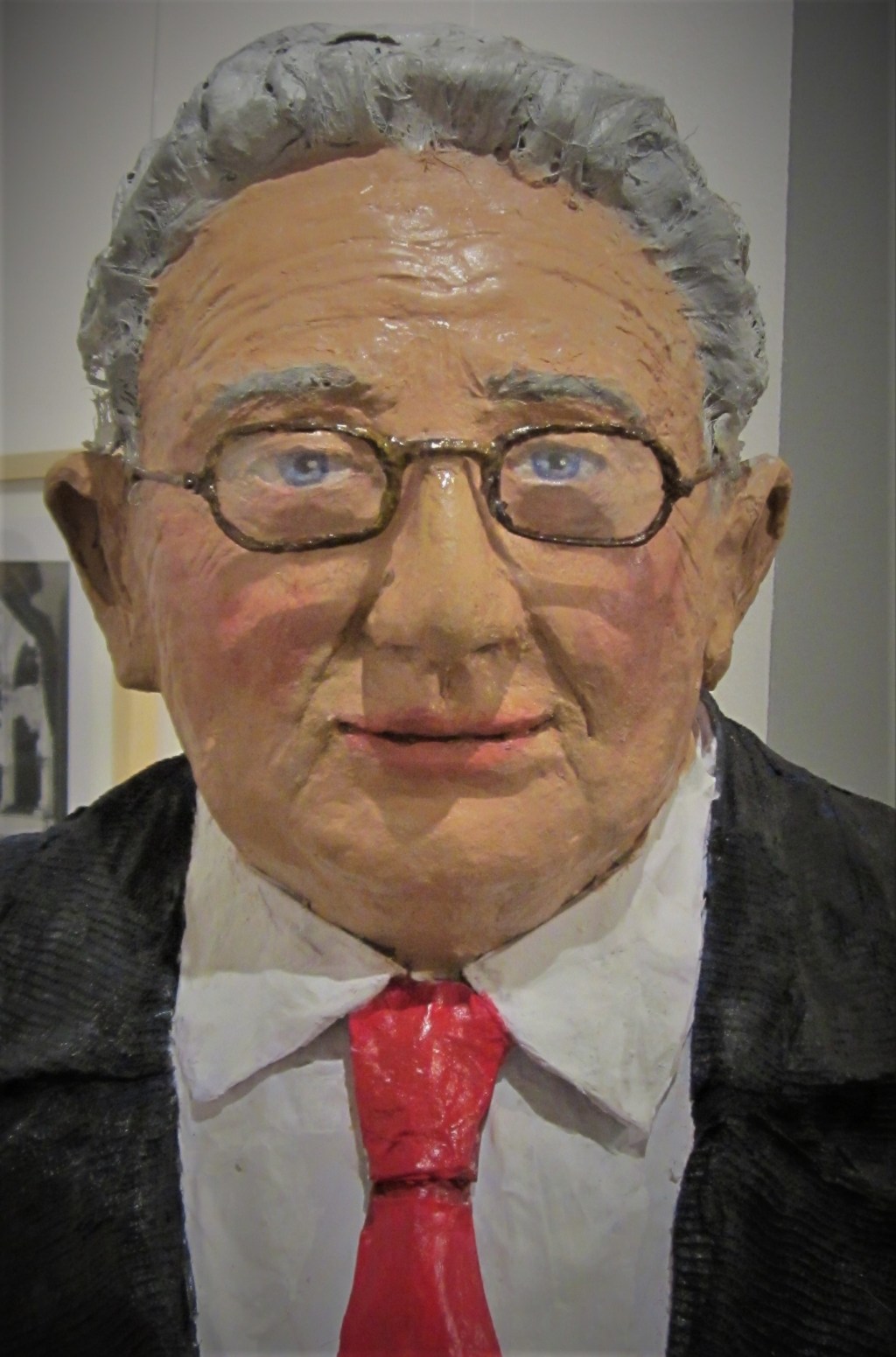
That Time I Met Henry Kissinger

How do you pay only $440 a month to live in Manhattan?

Short of being lucky enough to benefit from rent control, you could try to save money by moving to a really small place in a really bad neighborhood. Even in 1991, though, with violent crime at a historic peak in New York, that was a stretch.

My solution was to live in International House on 124th Street, which required an application and a personal essay. It was, and still is, a place for graduate students and young professionals,  with two-thirds of the residents being from other countries. My room was 8 feet by 11 feet with a sink and a shared bathroom in the hallway.

I really liked living there, except for one small thing. Well, hundreds of small things. When I moved into my room, it was infested with roaches. I’m no stranger to them having been born in New York City, but I mean INFESTED. The previous resident hadn’t bothered to throw away his food and it had been there for a while, turning the room into an insect picnic. They came running out of the dresser so I couldn’t put my things away and had to keep my suitcase sealed. I’d often wake up with roaches in my bed. The silver lining? They scored me a dinner with Henry Kissinger.

What do roaches have to do with the recently departed diplomat? If you’re one of his harsher critics that might not sound like a stretch. In my case, though, as a graduate student in International Affairs at Columbia and also at the Harriman Institute for Soviet and Eastern European studies, he was near the top of my list for people whose brain I would have liked to pick at that moment. This was less than two years after the fall of the Berlin Wall and three months before the end of the Soviet Union.

About a week into my stay at International House I was trying to spend as little time as possible in my room. The office thought I was exaggerating and told me I had to wait another week for the exterminator. One Friday night there was a party for new residents. It featured a raffle for a set of luggage from a travel agent in the building (remember them?) and also one to either have a seminar with or to attend a dinner with a keynote speaker at International House’s $1,000 a plate fundraiser. That speaker was Henry Kissinger so I put in my name for both.

I got tired of waiting for the winner of the luggage raffle to be announced so I went to the bar in the basement and then to bed. I was working 30+ hours a week that semester and taking six classes so I was really tired. Bright and early Saturday morning I was woken up by the phone in my room. Brushing a roach off of myself, I picked up and heard a cheery greeting from Barbara Evans, who was the wife of the president of I-House, Gordon Evans.

“We were looking for you last night. Congratulations–you won the luggage!”

The unwanted wake-up call up by someone who was (sort of) in a position of responsibility for my squalid living conditions didn’t spark the most gracious response. I told her how upset I was about the roaches and the lack of response. As soon as I put the receiver down, I realized how rude I had been. Later that day I left a handwritten note in the office apologizing. Mrs. Evans was (or is, I hope-here’s an article from just three years ago about her and Mr. Evans and their experience at a retirement community at Oberlin College) a cheery, trailing wife of a member of the WASP foreign policy establishment. She had married him and left college before graduating, living all over the developing world, including Pakistan, Ghana, and Nigeria, from the 1950s to the 1970s.

A couple of days later I received a lovely note back from Mrs. Evans suggesting that I scatter some boric acid to control the roaches (I did and it helped). I also felt like even more of an ass for being so rude to this lovely woman. We exchanged a couple more notes. About a week later I was informed that I had somehow won BOTH of the other raffles–the seminar and the dinner. 

This was obviously her doing. Not only that but I was seated at the table with Mr. & Mrs. Evans and the guest of honor himself. Various people who had paid $1,000 to hear his wisdom kept walking over to be introduced to the great man. 

Also seated at the table were John Whitehead, who had been chairman of Goldman Sachs and Deputy Secretary of State, and his wife, Nancy Dickerson, the “First Lady of TV News.” I was such a naive dummy that I had only the vaguest idea of what Goldman Sachs was. Years later my favorite boss ever, then CS First Boston research chief John Conlin, joked that if I got an offer from Goldman he’d pack my bags himself.

Others knew better and, during the reception, a young Asian woman barged her way into the group as I was chatting with Messrs Kissinger and Whitehead. Ignoring Henry, she shoved her résumé into Mr. Whitehead’s hands. His wife looked horrified so I guess the ploy didn’t work. My I-House buddies Vik and Phil laughed at me for not asking for an internship.

Anyway, Kissinger is the man I was awed to meet. I wasn’t too smooth, fumbling questions and looking less-than-sharp in my $130 suit. I actually had a very hard time understanding his froggy-voiced, German-accented answers. I didn’t know enough to ingratiate myself and ask someone for a job. 

I do think I got more out of it than a nice memory and a funny story, though. It was an early lesson in being nice to people. It isn’t just the right thing to do–occasionally what goes around comes around. Lacking family connections, I got my start in my first career, Investment banking, and my second career, financial journalism, through chance meetings. (Hi Zoli, hi Gabby!).

Ironically, this was probably the high point of my foreign policy geekery. Several days earlier my I-House and SIPA buddy Vik told me about his sad life as an investment banker before going to grad school. I had zero idea about finance, but I was curious about his weird, lucrative former profession. He said I could just take all the finance classes at Columbia Business School (which is why I was taking the maximum six classes a semester instead of four) and get hired to privatize companies in Eastern Europe. I spent a fascinating and financially-rewarding decade helping to do that. I’m so glad I did it that way instead of working for some stuffy nongovernmental bureaucracy or as a diplomat. 

Likewise, I’m very fortunate that I didn’t become an academic. I have lots of respect for people buried in archives and presenting papers at conferences. Newspaper articles with a fraction of the depth but multiples of the reach are more my speed. In college I was fascinated by Kissinger, the ultimate academic-diplomat. It felt almost unreal to have dinner with him, but neither of those paths would have been right for me.

investing

Could the Next Berkshire Hathaway Be a Meme Stock?

An investor being called “the next Warren Buffett” is a lot like an athlete gracing a magazine cover or a company slapping its name on a stadium. And it isn’t just a prelude to a stumble–compiling a track record as good and long the Oracle of Omaha’s is basically impossible.

But what about turning a company into “the new Berkshire Hathaway?” There are and have been a handful of stocks that have served investors very well as pools of patient capital such as insurer Markel, cable baron John Malone’s various entities and some now-defunct conglomerates with roots in the 1960s.

Before last week, money-losing videogame retailer GameStop seemed like a pretty unlikely addition to that short list. Its meme-inspired shareholders have the attention spans of fleas and the company’s C-suite resembles a revolving door as it heads for its sixth consecutive year of losses. 

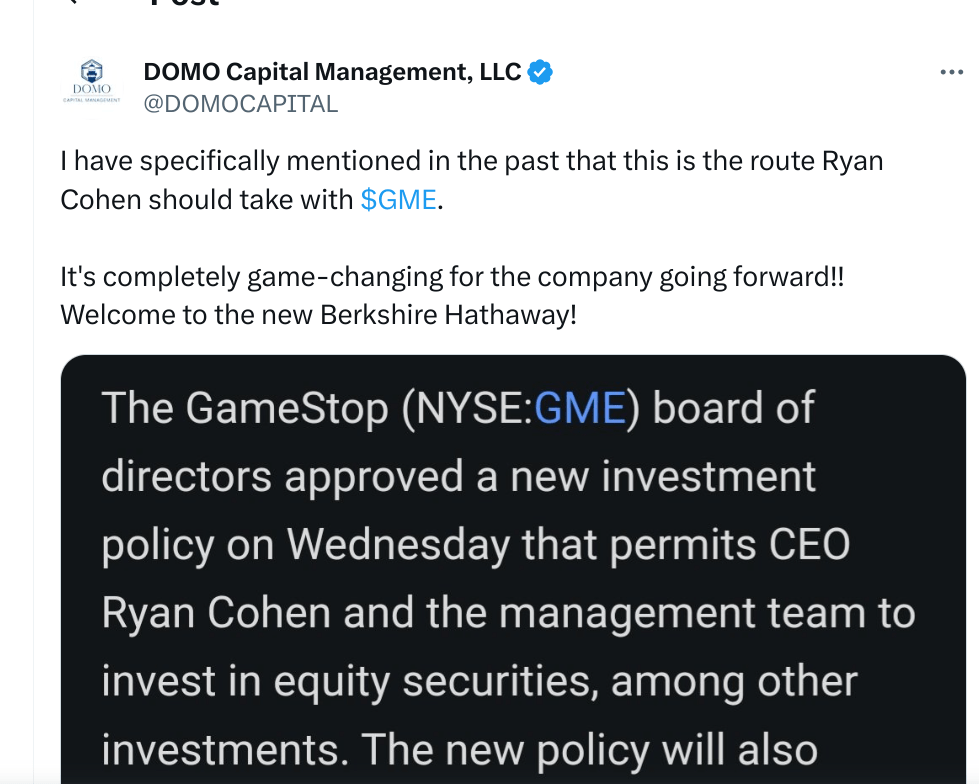
Yet the board’s recent decision to allow Chief Executive and Chairman Ryan Cohen to invest the company’s cash in stocks–a step one analyst called “inane”–has invited Berkshire comparisons that aren’t completely off-base. The textile company that became Buffett’s investment vehicle was itself a lousy business. Buffett eventually threw in the towel on those operations, using the company’s excess cash to earn early investors 40,000 times their money.

Cohen certainly has a, um, different approach than Buffett, but he has shown a knack for buying low and selling high. He mainly bought his GameStop stake before “Roaring Kitty” helped send its shares to the moon, accumulating most of his 36.8 million shares in mid-2020 for about $30 million. Less than a year later, with the stock still elevated from a historic squeeze, the company sold a split-adjusted 20 million shares, raising $1.67 billion in an at-the-market offering to its enthusiastic retail investors. The stake owned by his holding company, RC Ventures, is still worth close to $400 million.

More recently, RC Ventures invested $120 million in Bed Bath & Beyond and pushed for changes and board representation. Individual investors dove in, despite the company’s well-documented risk of insolvency. Cohen then sold his entire stake months later for a quick profit of nearly $60 million prior to its bankruptcy filing.

Stocks tend to rise when news breaks of Berkshire taking a stake, but those gains pale in comparison to when a meme stock CEO makes an investment. For example, in 2022 nearly-defunct gold miner Hycroft mining surged by more than 600% after movie chain AMC Entertainment Holdings took a stake. So why not ride the coattails of an investor with social media street cred and an apparent Midas touch? 

An obvious reason is that convincing people to buy overvalued stocks isn’t an infinitely repeatable exercise. Buying undervalued ones can be, but it often takes years to be proven right. Attracting sufficiently patient shareholders has been challenging even for Buffett, who has been prematurely accused more than once of “losing his touch.” Is the YOLO trader crowd going to stick around after a few bad years?

If not, he needs different shareholders. But they’ll have to trust him. Cohen, who faces a Securities and Exchange Commission probe into his Bed Bath & Beyond trading, hasn’t been accused of wrongdoing. The fact remains, though, that in order to earn his big scores in publicly-traded stocks, thousands with less money and sophistication had to lose. That could make it hard both to raise more cash in public markets or to pursue the sort of handshake deals Buffett has made over the years.

Even after losing more than four-fifths of its value since its Jan. 2021 heyday, not a single analyst polled by FactSet recommends buying GameStop’s shares. Of course the lesson of the meme stock explosion was that the approval of serious people in boardrooms isn’t always necessary or even desirable to make money in the stock market. And don’t forget the people who earned some of those people’s ultimate compliment–comparisons with Warren Buffett–when riding high: Michael Pearson of Valeant Pharmaceuticals, Eddie Lampert of Sears Holdings and Sam Bankman-Fried of FTX.

So clearly Wall Street isn’t always the best judge of character. Even so, Cohen will have to put up some impressive gains to even enter that conversation and they’ll have to accrue to his public shareholders, not him personally.

investing · journalism · Uncategorized

A Financial Crisis in Plain Sight?

Who could have seen it coming?

Financial markets are full of surprises. Here’s how to possibly avoid some of the costlier ones. After they are sitting on losses or regretting a missed opportunity, some investors will literally blame the messenger. Why didn’t my favorite financial publication warn me about this, or why were they so pessimistic about what turned out to be a great opportunity?

There are reasons for this. One should be obvious: Unlike parts of the paper like my column at The Wall Street Journal, Heard on the Street, reporters report. They rely on the assessments and opinions of participants in the financial markets. If most people expect, say, a recession, as a majority of Wall Street economists did this time last year, that is likely going to be the conversation they have with any two or three talking heads. It is also likely to be reflected in prices. And, as we know, they were dead wrong–the U.S. economy actually grew at an annual rate of above 5% last quarter.

Another reason is that the people who sit on the masthead of a publication are overly obsessed with big, round numbers. They are one way that financial journalists, and hence the savers and speculators who follow them, miss the forest for the trees.

Financial journalists and editors are told to drop what they’re doing because some big, round financial number is about to be breached. The number is lighting up search engines so we need to be all over it–clicks are what pay the bills these days. Just like a watched pot never seems to boil, though, those milestones taunt us. Sometimes we even wind up ignoring the big picture as a result–a mistake we’re making right now.

I recall conversations in February 2020 at The Wall Street Journal about what seemed like the imminent crossing of Dow 30,000. The day that the index got the closest to that milestone China reported that the number of cases of a deadly virus recently named Covid-19 were actually 10 times as high as previously thought. In the sixth paragraph of the “pan”–our daily, rolling markets story–a Goldman Sachs report saying that a drop-off in exports to China could lop half a percentage point off of U.S. economic growth that quarter gets a mention.

As we know, investors who took comfort in that mild assessment, if they ever even got that deep into the article, were about to be blindsided by what should have been an obvious risk to their portfolios and the world economy. The index would within weeks be flirting with 18,000 points.

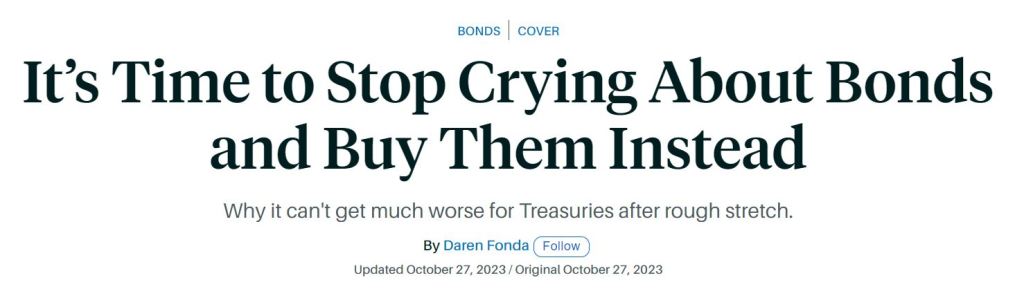
The recent breach of 5% on the benchmark U.S. Treasury note was a bit different. Just like a watched pot never boils, it took quite a while to happen. And when it did (only during non-U.S. trading for those of you checking), the tsunami of coverage went from causing angst to inspiring a wave of buying buy people who haven’t seen yields like this since the Bush administration. Here’s Barron’s Magazine:

Whether or not you locked in 5% or are cursing yourself for sitting on the sidelines doesn’t matter all that much. What does is that the cost of money went from nothing to quite a bit in a hurry after many years of artificially low interest rates. During that time,  government borrowing around the world ballooned–especially in the United States. Federal debt held by the public has gone from $5 trillion in 2007 to more than $25 trillion today. 

The interest on that debt is climbing fast as old bonds roll over and new ones are issued. It was more than $800 billion in the past 12 months and is well on its way to passing $1 trillion a year. For perspective, net interest is now nearly the size of all non-defense discretionary spending. And I’m afraid that defense isn’t about to become less of a priority. As alarming as that sounds, the average rate on that debt was only 2% a year ago and just recently crossed 3%. Despite all the attention it received in newsrooms, the 10 year note was actually the last maturity to breach 5%.

If bond yields stay even at today’s slightly more modest level for any appreciable length of time then already ominous projected trillion dollar annual deficits will be much higher. That will affect not just our pocketbooks but America’s ability to wage war, deal with banking crises, and much more. The panglossian 10-year budget projections by the Congressional Budget Office have interest rates somehow staying at 3% this year and no recessions ever. Anyone paying attention should see that rates being this high could have a double-effect on the budget deficit by also pushing growth lower, hurting tax revenue.

Like Covid pretty becoming uncontainable by early 2020, it might in theory be possible to alter that trajectory with some extreme efforts like massive tax hikes, but the political will and recognition of the threat need to be far greater. If this were just a warning about interest costs being high for a while or taxes needing to rise then you could call my cute headline alarmist. The problem, though, is that the numbers will within just a couple of years be too big to reverse. 

How so? Either rising bond yields will become self-fulfilling as the people who buy bonds with the hope of an expected positive return worry about America losing control of its budget with programs like Social Security and Medicare set to deplete their funding early next decade. Like an emerging market, a vicious cycle of rising rates can accelerate the reckoning. By my estimate, simply adding a single percentage point to the average interest rate would result in $3.5 trillion in additional borrowing by 2033.

More likely, though, the effect of all this on the economy will soon push the Fed to resume expansion of its balance sheet or to at least start cutting no matter how high inflation is. With fixed income, it is your real return that matters, and that could turn negative. Of the few tricks left in the Fed and Treasury’s arsenal to control the problem, allowing that to happen is the most likely. 

This is what risk expert Michele Wucker calls a “Gray Rhino” – “a highly probable, high impact yet neglected threat” – a mix of a black swan and elephant in the room. Yet record sums have flowed into exchange traded funds that own long-term U.S. Treasury bonds.

That has been a good short-term trade, but it sounds like a potentially awful long-term bet. Buying anything on the assumption that a greater fool will provide liquidity when you’ve made your money is a silly risk. I’ll finish this essay with the standard “not investment advice” boilerplate, but I’ll also tell you what I’m doing with my own little pile of savings. None of it is in bonds with a maturity beyond three years except for those that compensate me for future inflation. I’ll gladly give up a capital gain in long term bonds to avoid what, through inflation or some other means, looks like it could be ugly.

Uncategorized

Yes, Ukraine Is a Real Country

I’m writing this eight hours after the shocking headlines that left so many of us feeling anguished and helpless. Whatever the eventual scope of Vladimir Putin’s “special military operation” by the time you read this, it’s a good moment to consider the question of what is and isn’t a real country and how worried we should be when parts of one are lopped off by invaders.

In Putin’s view, Ukraine is just part of the same Slavic, Russo-centric motherland. Once upon a time I shared his opinion, though not for the same cynical reasons. While my lifelong interest in the region and certificate from Columbia’s Central and East European (now Harriman) Institute hardly makes me an expert in the region–there are thousands of people with the language skills and specialization you should listen to before me–allow me to share my early impressions of the country now being sliced apart and of its people.

I had been living in Budapest, Hungary in the summer of 1992 between my two years of graduate school and the highlight of my summer was going to be a late August train trip through the former Soviet Union. With Hungary’s rickety telephones and Russia’s even worse ones, it would take 30 attempts to get through on a static-filled line on a call that could cost me half my then-meager weekly pay. But I finally got a visa, a plane ticket and a few hundred dollars and I flew to St. Petersburg on a Tupolev 134, my first of many journeys on scary Soviet passenger jets.

I stayed with Yuri, a Russian man a few years older than me whom I had befriended that year at International House in New York. The city was poor but stunning. Walking through the archway to the Hermitage where the October Revolution had started 75 years earlier, strolling along the canals during the long summer nights, and visiting the Summer Palace were magical experiences.

My friend Caryn and I had some trouble securing sleeper train tickets to Moscow because local mafiosi had bought them all up and were selling them at a 1,000% markup. That made them a whopping $5 or so. After an exciting night of drunken brawls outside the locked door to our compartment (the train had to stop briefly to evacuate an injured passenger by ambulance), we continued to Moscow. It was the first of several trips I would take to Russia’s capital over the next 10 years. The highlight was touring the Kremlin, which felt like (and recently had been) the fading center of an empire spanning 11 time zones. The lowlight was being attacked outside the Lenin Museum by a nationalist demonstrator whom I had photographed because he had the one sign not in Cyrillic: “Death to USA Fascist Israel.” He yelled американский еврейский шпион! (American Jewish spy!) at me as he tried, unsuccessfully, to take my 35 millimeter camera. I still have a snapshot of him somewhere.

After buying more tickets from mafiosi, we departed a couple of days later for Kyiv. Ukraine had only officially been a country for eight months with 92% of its people voting in a referendum to leave the Soviet Union. Functionally, though, it was somewhere in-between. There were no border or passport checks. There wasn’t even a national currency yet. I exchanged a very small number of dollars for “karbovanets” – coupons that looked like Monopoly money and were hardly worth more. I remember paying about a dollar for 600 rides on the Kyiv metro despite the fact that we would be there for just a couple of days. I didn’t have a smaller bill. Despite being rich by local standards, there was hardly anything good to buy. The only proper meal we had was at the home of our hosts, friends of Caryn’s boss in St. Petersburg. She spoke Russian with them and, in typically Russian fashion, their generosity to guests was humbling. As with Yuri and his family in Moscow, we were given the best of what they had to eat and drink when they had very little and allowed to take up the best spot in a tiny, cramped apartment.

Other than being poorer and more chaotic than Russia’s two major cities, I had a hard time feeling that I was in the capital of a different country. Everyone we encountered spoke Russian, and not as a second language–they all spoke Russian to one another as well. A monument to the fort that was the original site of the Kievan Rus, the seed of what would later become Russia, centered around “Muscovy” to the northeast, had a recently-installed plaque in Ukrainian and Russian. I spent a long time comparing the two inscriptions in their own forms of Cyrillic and searching for the handful of differences. It seemed like a stretch to turn what was a dialect into a full-fledged language.

Our next stop after another overnight train, Lviv in western Ukraine, was definitely no longer Russian. Caryn had to use her knowledge of Czech to fill in some of the linguistic blanks. The feel and the architecture were different. But were they Ukrainian? This was once Lvov and before that Lemberg–a Polish and before that a Hapsburg city populated by Jews, Germans, and Poles. The people living there had mostly moved into a depopulated city from the countryside. It was even poorer than Kyiv. We met a young man who spoke good English and asked what the very best place was to eat in the city. Blowing the rest of our soon-to-be-worthless banknotes, we feasted and asked him about life there.

Boarding the train to Hungary, we saw an older man shake the hands of two military officers on the platform still wearing their Soviet uniforms with the peaked caps. He then got into our compartment and it turns out he was a Hungarian doing some kind of business with the locals. He didn’t know English so I spoke Hungarian with him and Caryn spoke Russian with him for the trip to the border. Each of us would translate back to English in the three-way conversation.

When we got to the border, the train had to stop for about two hours because the Soviet Union had a different track gauge than the rest of Europe, ostensibly for security reasons. The train had to be lifted by a crane to have its wheels changed and, while that was happening, two Ukrainian guards got on to shake down the passengers. I had read in a Hungarian paper that summer that anyone not buying a through ticket would be thrown off and forced to bribe their way across the border, potentially waiting for days. The chaotic crowd outside the train window at the station confirmed it. I had sprung most of the rest of my dollars for a far more expensive “international ticket,” but I had lost a small paper customs certificate given to me in St. Petersburg that declared how much “valuta” (foreign currency) I had brought in with me. This was a Soviet form with a hammer and sickle and from what supposedly was a different country, but the guards wanted it and I was afraid that we would be thrown off the train too.

This was happening in the town of Чоп, Ukraine, which is where my father was born. It was Čop when he was born (part of Czechoslovakia) and Csap when my grandfather was born (part of the Austro-Hungarian Empire). All of the Hungarian and Yiddish-speaking local Jewish population had been taken away to Auschwitz almost 50 years earlier and my dad’s family (who by then had moved to nearby Ungvár and then forcibly to its Jewish ghetto) were among the small number of survivors. After the war, the sliver of territory became the Soviet Union and by that time the new nation of Ukraine. So here was another town, like Lviv, populated by “Ukrainians” living in houses built by dead or departed people.

Knowing well that antisemitism remains rife in Ukraine, I was in no mood to delve into family history with the agitated guards, but I wanted to stay on the train. I switched to Hungarian and the two of them did immediately and flawlessly, becoming much more friendly when I told them my father was born in the town. They asked what life was like in America, when he had left, and I kept the details sparse. Then I raised the delicate subject of the missing Soviet form and they looked at each other and told me not to worry about it. I guess I was like a combination hometown boy and celebrity to them. 

As the train started rolling again for the four hour journey to Budapest, I left Ukraine impressed with the warm, resilient people, but not with their claim to being a country with an especially strong historical legacy. First of all, the linguistic and religious differences were more of a spectrum, becoming more Ukrainian (and Polish and Ruthenian) as we headed west, with a little sliver of Hungarian as we reached the Carpathians. The borders of this new country were a Soviet bureaucratic construct.

Thirty years later, my opinion has changed. I’ve been back to the former Soviet Union many times, though never to Ukraine again. What has made the difference has been the bloody, senseless wars and ethnic cleansing I’ve seen in the region and beyond in the name of nationalism and religion. This is the 21st century. We have nuclear weapons and we have weaponized social media that can cause far more harm far more quickly than ethno-religious wars in the past. 

What I’ve heard from friends is that Kyiv, which seemed like such a Russian city back then, is far more Ukrainian today. Even if that weren’t the case, though, it’s a recognized country with borders. If we live in a world where might makes right and maps can be constantly redrawn then we live in a far scarier world. For all of our sakes, we need to stop and say “no more.” A speech in the United Nations by Kenya’s Martin Kimani about Ukraine using the example of his own continent, where borders are even more arbitrary, put it beautifully:

Today, across the border of every single African country, live our countrymen with whom we share deep historical, cultural and linguistic bonds. At independence, had we chosen to pursue states on the basis of ethnic, racial or religious homogeneity, we would still be waging bloody wars these many decades later. Instead, we agreed that we would settle for the borders that we inherited, but we would still pursue continental political, economic and legal integration. Rather than form nations that looked ever backward into history with a dangerous nostalgia, we chose to look forward to a greatness none of our many nations and peoples had ever known.

Martin Kimani

For all of our sakes, let’s forget the historical back-and-forth and just focus on the map. You can see it there in clear black lines–Ukraine is a real country.

investing · The book

The Psychology of the Meme Stock “Revolution”

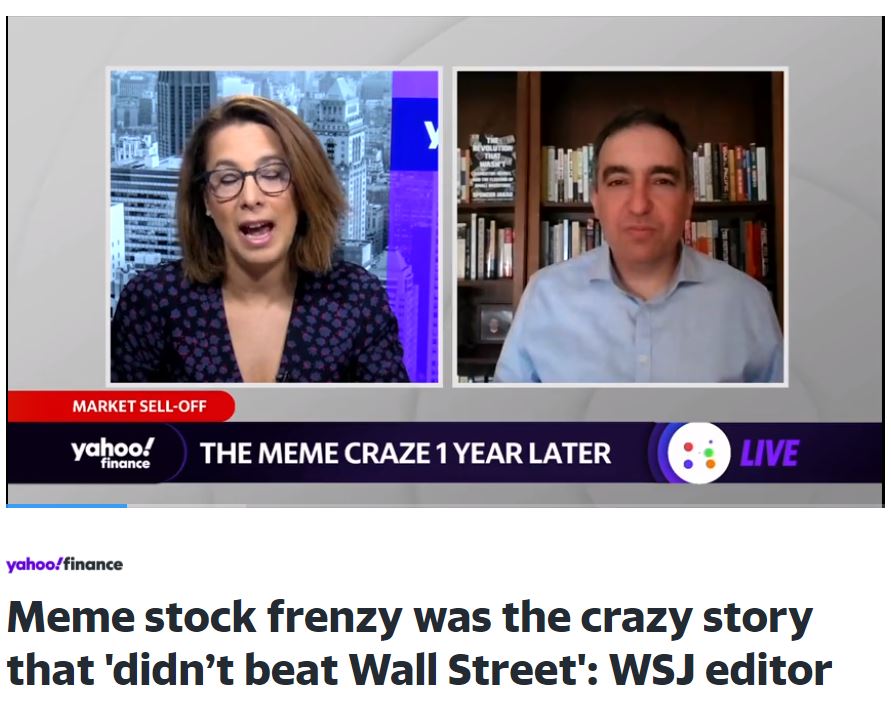
A year ago, the concentrated financial power and frustration of millions of novice stock traders rocked Wall Street, alarmed Washington and turned journalists into armchair sociologists. The stranger-than-fiction story sent both publishers and Hollywood studios scrambling to tell it. I’m one of the lucky people who got paid to delve into GameStop mania in the form of a book and I was surprised by much of what I learned.

“The Revolution That Wasn’t” might sound like a “nothing to see here folks” type take, but that couldn’t be further from the truth. Sure the efforts of millions of mostly young speculators to stick it to the man and make a fortune in the process didn’t live up to the breathless headlines of late January 2021. They actually delivered Wall Street and already rich corporate insiders a massive payday. Yet they also showed the awesome power that apps we carry on our smartphones can have over markets.

 I get asked frequently whether another stock will rise from obscurity to become a national obsession again. Probably not quite the way that GameStop did: The crowd’s energy has surged again and again into fruitless attempts to recreate last January’s magic that require “diamond hands” – holding onto crumbling meme stocks no matter what to effect the “mother of all short squeezes,” but professional investors are no longer asleep at the wheel. The more interesting question is why GameStop mania happened in the first place.  I often think of this quote to put things into context:

“We find that whole communities suddenly fix their minds upon one object, and go mad in its pursuit; that millions of people become simultaneously impressed with one delusion, and run after it, till their attention is caught by some new folly more captivating than the first.”

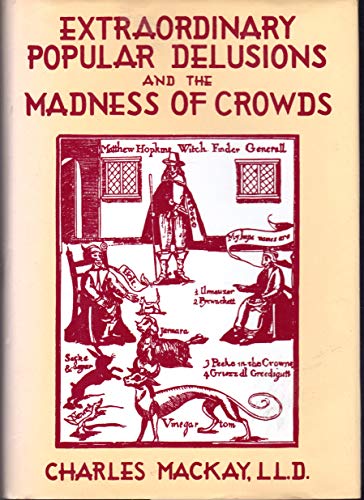
Charles Mackay wrote that passage decades before anybody could describe themselves as a psychologist. He was a journalist, like me, and his classic, “Extraordinary Popular Delusions and the Madness of Crowds,” was published in the midst of Britain’s 1840s Railway Mania. His description of that and other episodes like the South Sea and Mississippi bubbles and Tulip-mania in the preceding centuries are rich with insight into human nature. We have been through numerous manias since then as well – most recently dot-coms and housing. History doesn’t repeat, but it certainly rhymes.

As a long-time investing columnist for The Wall Street Journal and a student of financial history, I still was surprised at some of the new twists to this age-old pattern in the GameStop story. The human psyche hasn’t changed, but Wall Street and Silicon Valley’s understanding of it certainly has. Nobody working at stock brokerages like Robinhood or social media firms like Twitter, TikTok, or Reddit predicted that an informal army of amateurs would blow multi-billion dollar holes in major investment firms for fun and profit. They surely understood, though, that they were pushing psychological buttons that could enrich them at the public’s expense.

Take reinforcement. Since behaviorist B.F. Skinner’s experiments on the variable reward ratio in the 1950s, games of chance such as slot machines and their digital equivalents have been designed to provide stimuli that, for far too many people, lead to addiction. While the stock market isn’t really “a casino,” as some critics contend, the newest generation of smartphone based trading apps borrow heavily from the gambling world to create engagement. Robinhood, which has captured about half of all new brokerage accounts opened in the past five years, has been sued for using animated confetti and giving away free shares of widely ranging value–a lottery-like prize– for opening accounts and referring new customers.

Today it is nearly free and effortless to be an investor by buying and holding diversified index funds and it is becoming common knowledge that even the pros can’t beat those plain vanilla products 80 percent of the time. But index funds are far less profitable for the industry. Instead of having them “set it and forget it,” checking their portfolios occasionally, online brokers have convinced some customers to trade thousands of times a year. Robinhood’s active users check their accounts several times a day.

“You were born an investor,” claim its ads targeted at young people. Their costly level of hyperactivity is in part due to the “illusion of control” described by Ellen Langer’s experiments in which people put an irrational value on personal agency. That is why lottery sales are far higher when people can pick their own numbers despite identical odds. 

Meanwhile, the Dunning-Kruger Effect–the behavioral bias that makes novices overconfident in their abilities–was put on steroids by the pandemic. The wave of new account openings coincided with both the arrival of pandemic stimulus checks and the quickest rebound ever from a bear market in 2020. In a trend never seen before, 96 percent of stocks would rise in the ensuing year, making investing look easy. Dave “Day Trader” Portnoy, himself a newbie who boasted that he was better than 91 year-old legend Warren Buffett, would livestream himself picking tiles out of a Scrabble bag to choose stocks to his huge social media audience. Success, as they say, is the worst teacher.

And when they opened the app, Robinhood and its many imitators showed them the day’s most active stocks for a reason–to stoke the fear of missing out. Studies have tied acting on FOMO to feelings of regret. When the newest speculators buy too late or sell too early to make a score, they are encouraged to keep trying, as exploited by gambling establishments through the near miss effect (like when a slot machine displays two of three cherries or the ball in roulette falls one slot away from giving you that big payoff).

Of course so many people with so little money turning themselves into a major force in the market wouldn’t have been possible a generation ago. Trading stocks has become progressively cheaper. Robinhood was the first successful broker to charge nothing for a trade, though.

Trading isn’t really free–huge market makers gladly pay brokers to fill their customers’ orders–but the fact that small investors who have never paid a commission in their lives perceive it as costing nothing has triggered the “zero-price effect” described by behavioral finance experts. Demand normally rises when prices fall. The formula goes haywire, though, once prices hit nothing for something that also entertains us. Trading stocks for “free” has been made so much like a game that retail activity has exploded. 

This shift to zero at every major broker happened just in time for the pandemic, which supercharged locked-down and bored young people’s speculative tendencies. And because they got “house money” via stimulus checks, investors’ sometimes crippling fear of financial loss as described by Prospect Theory was short-circuited at a critical time. Millions opened accounts, many of whom had already dabbled in recently-legalized sports betting, and they found they liked stocks even more. The sharp market rebound from the initial pandemic plunge created unprecedented volatility and excitement. And brokerages’ irresponsibility in allowing newbies to trade complex stock options, with their asymmetric payoffs and finite time horizon, made investing resemble sports betting.

But what to buy? Young Americans’ love of social media meant that it was “finfluencers” like Portnoy rather than Mom and Dad’s broker at Morgan Stanley who provided ideas. The most influential voices were the most confident and often the wildest. And it was those stocks that did best for a while, reinforcing the wisdom of following the crowd. The top 100 stocks highlighted by Robinhood on its app rose by 102 percent in 2020 according to an index created by newsletter writer Noah Weidner–some six times as much as the benchmark S&P 500. Baskets of companies with no profits or those heavily shorted by skeptics also had a great year.

And, because Millennials and Gen Z share private information online so readily, those bragging about big scores on those stocks often backed it up with screenshots of their brokerage accounts. This triggered a phenomenon called social proof in which apparently successful people, even if they were just lucky, gained undue influence.

Virality was instrumental in the runaway popularity of small, money-losing companies. On Reddit’s r/wallstreetbets in particular, which would become the epicenter of the GameStop squeeze, reckless wagers in crowd favorites were the most likely to become “upvoted” and hence visible to somebody logging on. The wave of buying would become self-reinforcing and the support of certain stocks has become tribal and almost cult-like for some who dub themselves “apes” and who subscribe to conspiracy theories involving nefarious hedge funds and even journalists like me.

As of this writing, the thrill of overnight fortunes made and lost last year hasn’t faded for many trading novices. With the exception of those who are turning meme stocks into an obsession, though, the spell will break eventually. As Mackay sagely wrote 180 years ago: 

“Men, it has been well said, think in herds; it will be seen that they go mad in herds, while they only recover their senses slowly, one by one.”

(This post originally appeared on LinkedIn)

Book reviews · The book

LA Times and The Economist Reviews!

My first impression of a person who reviews others’ work for a living came at age 12 from watching the Mel Brooks film History of the World Part One where we’re introduced to Ugg, the world’s first artist, and then the world’s first art critic. He delivers a scathing verdict on Ugg’s cave painting without saying or writing a word.

I am very happy to report that neither of the two fine publications, The Los Angeles Times nor The Economist, that have so far reviewed my book peed on it. This is what the LA Times had to say:

Jakab is a former investment banker who currently writes the Wall Street Journal’s “Heard on the Street” column; he knows what he’s talking about. He’s skilled at translating concepts like puts and calls and short sales and gamma squeezes into language most anyone can understand — a true gift.

LA Times

And later in the review:

Like so much reporting in recent years, Jakab’s book is both depressing and necessary … Anybody who buys and sells stocks, and anyone who “invests” in anything old or new, should read this book.

LA Times

Now that’s nice. And The Economist, which I have been reading for 30 years now, came through with a really flattering take too.

Spencer Jakab, a columnist at the Wall Street Journal, unknots the threads of this complex financial tale. His is a pacey and comprehensive account that takes in the structural changes in finance and the media that made the turmoil possible. 

The Economist

And lower down

…Mr Jakab’s knowledge of Wall Street shines in the historical context he provides and the industry aphorisms he relays (the retail investors who can lose out when hedge funds prosper are typecast as “a lot of dentists”). Despite the density of the subject matter, which includes “rehypothecation” and “gamma squeezes”, the story is deftly told. If the first draft of history was not quite on the money, as Mr Jakab contends, his second go has set the record straight.

The Economist

Please check out the book.

Book reviews · The book

Be Like Ron Weasley

And recognize a troll when you see one.

If you know me at all then you’ve been bombarded with messages about the book. I hate to be annoying, but I also hate to see a year of hard work go unacknowledged. If too few people buy a book then it turns into a vicious cycle – next stop pulp mill, and no more publishing contracts for yours truly either.

What does that have to do with trolls? Quite a bit this time, unfortunately. My book points out how ordinary investors were taken advantage of by companies that got rich off of hyperactive stock trading, among other things. The victims in my story really do believe they are victims, but because they weren’t allowed to KEEP buying meme stocks for a few days a year ago. It’s evidence that the system is rigged. Well it is, but not by an illegal conspiracy.

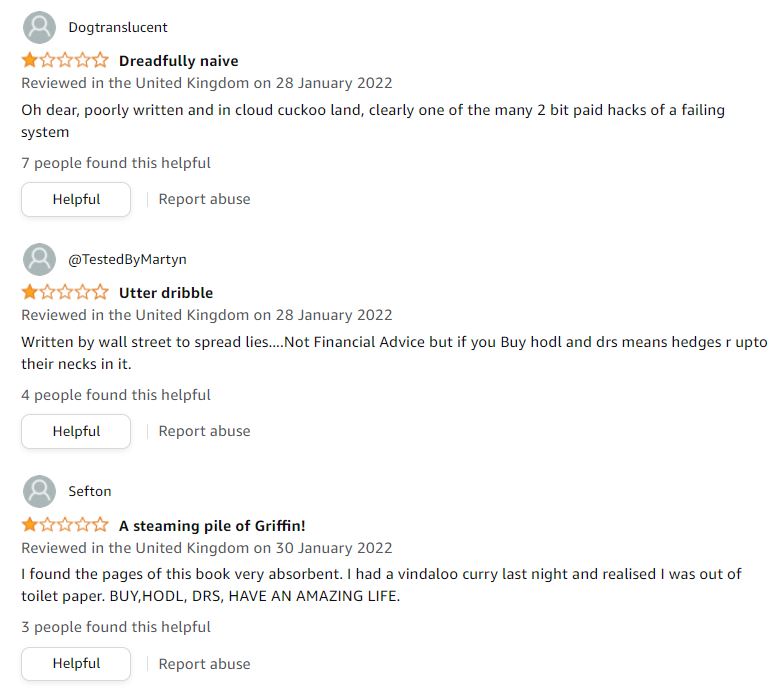
Pointing this out makes them angry. I’m a hack and I work for the Wall Street Journal, which is owned by Ken Griffin (no, it isn’t). I am a paid shill for hedge funds (I wish) and I didn’t even read the WallStreetBets message board (oh boy did I read it). I don’t want to insult anyone, and I’m sympathetic to the newest generation of investors, but there are some unpleasant aspects to the online army that made GameStop the most traded security in the world.

They haven’t read my book, but they would prefer you didn’t either. So if you go onto the UK Amazon page, where it went on sale a few days ago, this is what you’ll see:

I personally avoid things on Amazon with poor reviews and many potential readers have doubtless done the same. When the book goes on sale tomorrow in the U.S. and elsewhere then you’ll probably see the same phenomenon from “MoxPlatinum” and others.

My ego isn’t so fragile, but this is injurious in other ways. It’s a prime example of how some people behave toward strangers these days online – ironically a phenomenon I discuss in the book in the part dealing with the horrifying online harassment campaigns against some of the main characters. If I saw, say, a local baker wearing a shirt touting a political candidate who offended me, it just might make me upset enough to shop elsewhere. Or it might not if she’s really good. But I would never threaten her livelihood by saying her stuff tastes bad without actually sampling it.

So whether you know me or not, can I ask a favor? I spent a year of hard work baking this cake. If you don’t like it then please feel free to say so, but only after you’ve had a bite. And if you did then please consider writing something nice and maybe clicking on some legitimate negative feedback as helpful, not that it’s “utter Dribble” (the word is “drivel,” by the way). And please extend the same courtesy to other writers you know whose online reviews are suspiciously negative. I do and I will even more now.

Thank you!

Columns · investing · The book

Wall Street Journal book excerpt

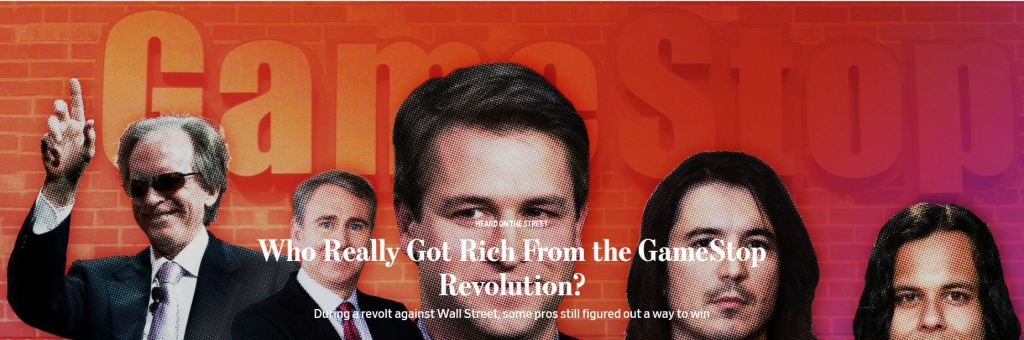
(L-R) Bill Gross, Ken Griffin, Jason Mudrick, Vlad Tenev and Baiju Bhatt SIUNG TJIA/WSJ

Today’s Wall Street Journal has a 1,500 word excerpt of one of the chapters in my book. The article’s title is “Who Really Got Rich from the GameStop Revolution?” One helpful reader has already written to complain that they had to read too far into the article to find out. When I answer a WSJ subscriber (and I always do, unless they’re menacing or insulting), I try to be courteous. Still, the huge photo of five billionaires behind the article’s title was a pretty good hint, I think.

Anyway, the excerpt is an interesting part of the story but one of the less-surprising things you’ll learn if you read the book. Far more interesting to me was how trading and social media apps are so effective at getting people to act recklessly. The human psyche changes very slowly, but companies’ understanding of how to push our psychological buttons has evolved as quickly as the technology they can bring to bear. I’ve been working in or writing about financial markets for 29 years and I learned a lot while doing my research. You don’t have to be especially interested in finance for this to change the way you see things.

The book’s U.S. release is Tuesday, February 1st, available for pre-order now!

investing · The book

Podcast Mania!!!!

Not me

I’ve been invited on A LOT of podcasts recently-like losing my voice a lot. I’m profoundly grateful to all the hosts helping me to get the message out about the book on small investors and GameStop mania. The great thing is that they’re all different because the audiences and hosts differ. Here’s a wrap – so far.

New Books Network interviewer Daniel Peris, who is a fund manager, dissected the whole crazy story without getting too technical. His questions were sharp and it looks like he has some great episodes on politics and history. He’s a Russian politics buff and we had a great chat about that after the podcast ended.

Personal finance specialist Rick Ferri had me on the Bogleheads on Investing podcast. The Bogleheads are acolytes of the late Jack Bogle, a pioneer of passive investing and the founder of Vanguard. Bogle has literally saved Americans, and cost Wall Street, tens of billions of dollars. If you want a methodical explanation of what happened and who’s who in this story then this is your best listen.

The multitalented James Altucher, who used to be both a day trader and hedge fund manager, has a great podcast that I’ve listened to for years on and off. It was a thrill to be a guest. His questions were rapid fire and they kept me on my feet. If you’re not into hearing me drone on too long then this is the one you want.

Veteran financial journalist Roben Farzad had me on Full-Disclosure Radio, which also runs on some NPR stations. He understands this stuff inside and out and it was a very relaxing talk for me – so relaxing that I made a Freudian slip and called GameStop “Blockbuster.” Oops. As an extra bonus, he also interviewed The Mulligan Brothers, the filmmakers behind the upcoming documentary “Apes Together Strong.”