economics

Nice City Ya Got There

Shame if something happened to it.

There’s a type of person I know who’s very educated yet shockingly naive about some things. We all have our biases and blind spots so I’m sure the same applies to me, but I don’t think it does about yesterday’s electoral earthquake in New York City. I’ll state from the outset that this isn’t a political newsletter: I don’t support a candidate, am not registered to any party, and I’ve never given money to one.

I also no longer live in the city—I just go there a lot, including for work. I guess that makes me one of the “bridge and tunnel crowd,” but I’ll always feel like a New Yorker.

The man the aforementioned educated folks are relaxed or even excited about having as the next mayor of the country’s largest city and business and cultural capital is Zohran Mamdani, who just won the Democratic mayoral primary. Here’s a New York Times writeup with some background. Here’s a less-flattering take on his economic policies by my employer’s editorial page that didn’t make it into “all the news that’s fit to print.”

Draw your own conclusions. I’m interested in why some friends and acquaintances who do live in New York see things so differently than me. Less-educated and single-issue voters are easily-swayed, but what’s the appeal for people who have read and traveled widely?

I think it’s because they don’t understand that safety and prosperity aren’t guaranteed and that they might not have to suffer if they’re wrong about radical policies. I hate resorting to composite sketches, but I’ll make an exception and engage in some insensitive stereotyping because, like I said, our backgrounds explain so much.

This person lives in New York but wasn’t born there, only having moved here as a young adult after Times Square was Disney-fied. One and probably both parents are American-born and they grew up in a small town or in suburbia.

They went to a good and possibly elite university and might have a master’s degree in something like journalism, education or public policy. With the amount of money mom and dad or grandpa’s trust fund paid in tuition, or what they took out in unwise loans, they could be making way, way more with a similar professional degree in law, finance or medicine.

They’re cool with that because those people are, in their assessment, soulless drones or sell-outs. There’s a certain nobility in semi-poverty. Sure these people pay enough in rent that they could have a material standard of living far above their cramped co-op or rental in Prospect Heights if they lived in Dallas, but then they’d have to live in Dallas.

Little Atticus and Clementine like the neighborhood so much and the French immersion at PS 321 is wonderful. Grandma is paying for a tutor and it looks like both have a shot of getting into Hunter. She also might be able to help out if they wind up going private—Grace Church or Berkeley-Carroll would be nice.

Sorry. To be clear, I think people fitting the above composite make cities hip and vibrant. They keep weird ethnic restaurants, cool bookstores, and art cinemas in business. They don’t jump the turnstile, they give back more than they take and they add to a city’s cultural appeal. Long may the graduates of Oberlin, Northwestern, and Middlebury migrate here and make it their home—the next craft IPA’s on me!

So, on to my perspective. I was born in Queens in 1969 to Hungarian émigrés and didn’t really speak English until I started school. I wasn’t aware of such things at the time, obviously, but between then and the time I started first grade close to one million people had left the city because of crime and deteriorating public services. Here’s the famous “FORD TO CITY: DROP DEAD” headline when it was teetering on the edge of bankruptcy in 1975.

I’m not trying to paint you some picture of an Oliver Twist upbringing amid urban horrors—it was fine. My sister and I were latchkey kids raised by an educated, loving single mother. But the normal 1970s New York City stuff happened to us: Petty crime, overcrowded classrooms, and nervously riding dirty, graffiti-smeared subways. My sister’s best friend and her little brother, who lived around the corner, were shot and killed when she was in third grade.

I had 43 kids in my fifth grade class and distinctly remember sharing desks and using a textbook so old that it referred to America having 48 states. The summer of 1977, between second and third grade, was memorable. There was a 25-hour blackout that resulted in widespread looting and the Son of Sam murdered someone in our neighborhood. When my grandmother told me that he’d been caught I felt so relieved because I was worried about my mom coming home from work by herself at night.

Speaking of her work, it was at the infamous Manhattan State on Ward’s Island between Manhattan and Queens—an institution where the city used to put people once called “criminally insane.” In the 1970s, after effective antipsychotic drugs were invented and budgets were slashed, these places were thinned out. You can see plenty of people on the subway or street today who might have been residents back in the day. A lot clearly aren’t taking their meds.

That left my mom with a smaller but really lovely set of patients. It was a scary place and a colleague of hers lost an eye after being stabbed with a fork. One of the final straws came when she was attacked (we left the city just before I started junior high). The aides who were supposed to stop that weren’t doing their job and she was only saved by another patient. There was very little accountability for state and city employees and the nurses would walk out every day with food and paper goods under their coats stolen from taxpayers.

Why is coming from behind the Iron Curtain significant? Because deciding New York has become too crazy is an option if you’re American and your mom and dad live somewhere safe and boring and speak English. It isn’t when you’re the only person in your family in the entire country earning a salary, able to drive a car or who can function as an American adult. There’s no moving back home, and growing up in a communist country has already given you a brutal lesson in the utter folly of policies that are contributing to the decay you see in your new home.

If you’re lucky you get approached about moving somewhere very alien where they’re desperate to take advantage of hard-working people like you but can’t understand your accent, which is what she did—another story for another time. Lots of poor New Yorkers today don’t have that option if the city starts to look and smell like the 1970s.

How did people feel about the future of New York City back then? The year we “escaped” from New York the movie “Escape From New York” came out. It takes place in a dystopian 1997 and Manhattan has been turned into a walled-off prison. It’s ridiculous, but I remember watching it on cable TV shortly after we got out of town and thinking: “Yeah, could happen.”

It was around then that my uncle, who literally escaped from Hungary in 1966, discovered he could make more money as a master plumber than as an engineer. He worked very hard and did a job on some buildings in Greenpoint in Queens. When the owner couldn’t pay him he took possession of them through something called a “workman’s lien.”

The joke was on him—for a while—because nobody wanted the buildings in that blighted area and he had to pay the taxes. Today the neighborhood is full of hip apartments, coffee shops and clubs. People who moved here after 1985 or so and moan about the cost of finding a place to live can’t imagine a time when people were overjoyed if you showed up to buy their apartment. My mom looked at a six-room place on East 95th Street in Manhattan in 1977—we were renters then—and could have paid $26,000. Those apartments go for millions today.

The catch was that there wasn’t school choice like they have now. My sister and I would have gone to a much rougher one in Spanish Harlem than out in Queens.

If you’re middle class, but even if you’re working class, New York City is incomparably more livable today than it was then. That didn’t just happen magically. It took a few good mayors and a long boom on Wall Street. The crack epidemic and the not-so-good Mayor Dinkins set that back a bit during the only years I lived in Manhattan (I was a grad student at Columbia). Homicides peaked at six-a-day in 1990, but it’s been a mostly improving trend.

People from other parts of the country sometimes don’t believe it, but New York is safer than several U.S. cities today. Even Bill de Blasio—or “that communist,” as my mom calls him—wasn’t incompetent enough to really hurt things that much.

But my friends and acquaintances shouldn’t push their luck. Demonstrably dumb ideas like rent control, taking over supermarkets to keep grocery prices down and cutting back policing will leave a mark if they coincide with a downturn in the economy.

And why they feel okay with having a culture warrior as mayor is beyond me. That isn’t his job. Back when Abraham Beame was mayor and Ford told the city to drop dead, we didn’t have today’s divisive politics.

I believe some people would take malicious pleasure in seeing New York City suffer if the transit system, the regional tunnels and bridges or the entire city found itself short of cash and this guy went to Washington, cap in hand. New York isn’t going to enter an “urban doom loop” that places like St. Louis, Missouri have because it’s too vibrant. Even so, dumb policies and incendiary speech at a time when Wall Street money stops paving the streets with gold is flirting with disaster.

Travel

Exploding TVs, Exploded Chicken

The year I graduated from high school, before I took my first class in the dismal science, I got a memorable economics lesson.

That winter I visited Communist Hungary, where my parents grew up. Unlike my previous trips, I was old enough to explore on my own and I spent hours walking around Budapest. I also was aware by then that the country had a sort of hybrid economic system—a blend of limited free enterprise and central planning dubbed “goulash communism.”

In terms of wealth, Hungary was about as poor as Mexico at that time, but it was ahead of even the U.S. on some measures of human development—things like crime and education.

In terms of the environment, sadly, the system was a failure. Air pollution back then was 30 times the “acceptable limit.” Since there was no independent media. When Chernobyl, about 700 miles away exploded nine months earlier, word only spread when western radiation detectors picked up the signs days later. A group called Duna Kӧr, started that decade to oppose a controversial dam on the Danube along the border with then-Czechoslovakia, presented an early challenge to Communist rule.

Hungary was relatively prosperous within the Eastern Bloc. You knew there were tens of thousands of Soviet troops somewhere, but they mostly weren’t allowed to leave their barracks, in part because they’d be shocked at how easy it was to buy food and many consumer goods. That made it a lovely place for someone with dollars and able to speak the language in the 1980s. By contrast, even in 1992 when I was backpacking through Russia and Ukraine, I was vastly wealthier (600 rides on the Kyiv Metro for a buck), but I found hardly anything I wanted to buy.

It was possible to make a good bit of money in Hungary in the late 1980s through limited private enterprise. The vast majority of people lived in a parallel economic reality, though, where having a telephone at home was a major bureaucratic achievement.

I remember walking into an auto showroom where the various Eastern Bloc models were on display. It had salespeople, but it might have been the easiest job in the world: Next to each model there was a price and then the number of years you’d have to wait to get the car.

At the top of the list was the relatively new Lada Samara, the most-modern car ever built in the Soviet Union, described by Car and Driver magazine as “early Hyundai” producing “noises that would shame a John Deere dealer.” I can’t recall the price, but the wait was 15 years. The price was lower but the wait identical for the Lada “Zhiguli,” based on a 1960s Fiat 124. (I would buy a used 1986 model in 1993 for $1,400—my Hungarian-American friend Peter and I shared it and paid $700 each). Everything in it broke except the engine and transmission and the heat was on full blast all year. Cool car, though—this is how it looked:
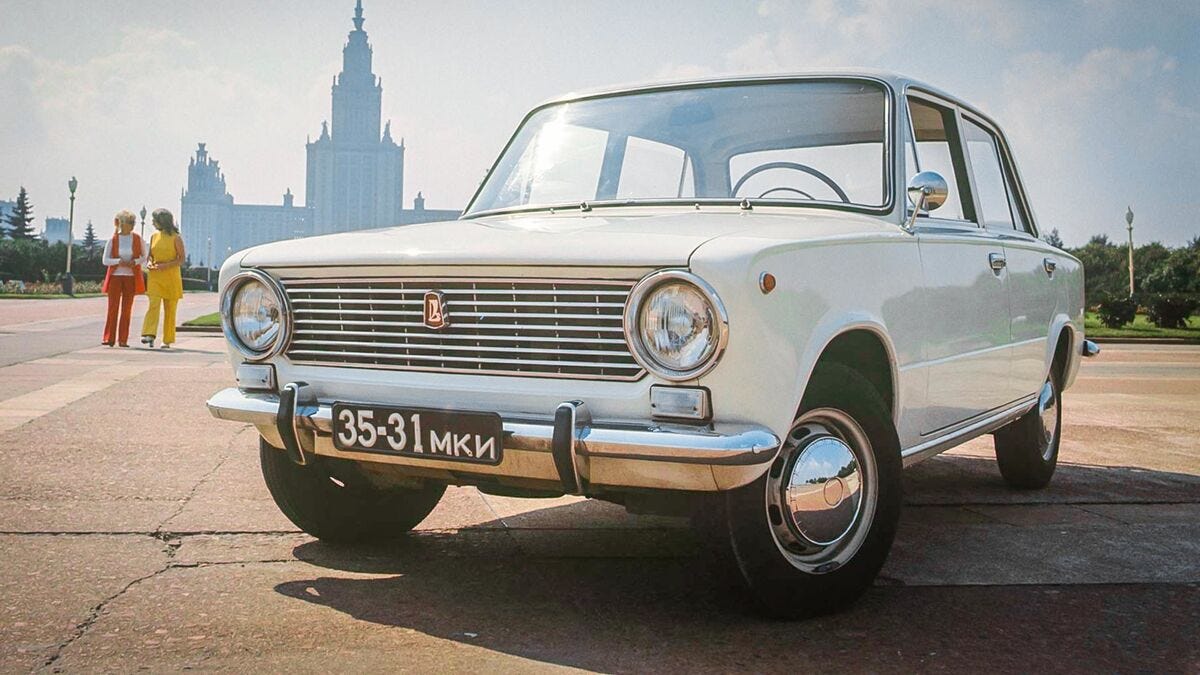
VAZ-2101 | Classic Cars Wiki | Fandom

At the bottom of the list was the Trabant, East Germany’s car of the year in 1957 and every year after that. Appearing on many lists of the worst vehicles in history, it was made of something called duroplast instead of metal and had a two stroke, smoke-belching 24 horsepower engine you’d only find on a lawnmower today. I could have bought one about 10 years after spotting it in the showroom for around $120 (vetoed by Mrs. Jakab 😢). I wrote a Wall Street Journal cover story about people who imported them to the U.S. out of nostalgia. In 1987, though, the waiting list was eight-and-a-half years.

Here’s Ronald Reagan with a joke about the Soviet car salesman.

Around that time—the last couple of years before the Iron Curtain fell—some young, entrepreneurial Hungarians took full advantage of the wacky economy. Two close friends I’d meet at work six years later, both of whom are a couple of years older than me and who were university students in East Germany at the time, exploited mismatched Eastern Bloc currency prices and exchange rates and Hungary’s relatively lax travel requirements to make small fortunes. They flew as far away as China or Cuba—any place in the Communist orbit—to their hearts’ content. But they would have been poor as soon as they crossed into the West.

When I moved to Hungary in the early 1990s, armed with lots of graduate courses in how economies are supposed to work, I got several new lessons of how they did in practice. Lots of things existed then that barely do now because they aren’t worthwhile.

For example, when I was backpacking in St. Petersburg in 1992 a smart U.S. grad student asked me about the economic differences between Russia and Hungary, which seemed vast on the surface. He asked if there were people who repaired zippers in Budapest. Yes, all over—that and all kinds of things. He said it was a sign of an underdeveloped economy because it still was worth someone’s considerable labor to do that rather than for people to buy a replacement. A coat or pair of jeans traded at a world market price and was very expensive.

When I moved to Budapest, I hesitated to tell friends in the U.S. my starting salary because it was so low—the temporary price of bypassing U.S. HR departments to get a job there. But my pay was a lot higher than family friends more than twice my age who mostly had advanced degrees. Back then it was totally normal for someone in Hungary to ask what your salary was because they all were pretty similar. I had to tie myself in knots to avoid giving a straight answer and embarrassing them.

But it was a fascinating and fun time for me—exactly the reason I went to live there and why I traveled all around the region. I used to keep track of things like how many McDonald’s each country had and when I’d go for a walk somewhere I’d count the percentage of western-made cars, which rose gradually. On my last trip to Hungary I still spotted a few Polish, East German and Soviet ones, which is sort of amazing.

After moving to Budapest, I wanted to lose my accent and practice my Hungarian as much as possible so, in addition to speaking it most of the day, I got a TV to watch after work. There was a cable in my apartment that allowed you to view a few channels in German or English, but I unplugged it so that I’d be forced to watch the two domestic terrestrial channels.

The cheapest color TV you could buy was an Orion—a Hungarian brand. It cost about as much as a TV would have in the U.S., whereas import taxes made a Japanese SONY, Finnish Nokia, or German Grundig quite a bit more expensive.

Orion TV1934B | CRT Database

It gave me a lesson in the folly of import substitution. It was just so inefficient for Hungarians to make TVs or Russians to pay Fiat to license an obsolete model from the 1960s. Likewise, the only way people would buy a U.S. made iPhone, which would come to about $3,500, would be if every competing device was taxed enough to make them more expensive too.

At least the domestic iPhone would be a desirable brand, though. I mentioned to people at work what TV I got and a couple said, with a slight look of concern: “Hmm, it’s probably okay.” Apparently a shortage of Japanese transistors had forced the company to substitute Soviet components that had caused several Orions to explode, but they figured mine was probably new enough that it wasn’t an issue. Other than the vague fear of burning down my apartment, and the fact that the remote control was a random series of tiny, unlabeled color buttons, it was a fine TV that I had for years.

Money was very tight for me initially as I had to pay American student loans on that modest salary. One way to save money was to buy something called “exploded chicken.” Unable to scrounge up enough hard currency, Russian importers had suddenly stopped buying certain Hungarian food products.

They don’t seem to have been discerning clients since one big poultry factory’s machinery was broken and they would just put cooked chicken with broken bones in a thick metal can with Cyrillic writing on it and sell as much of it as the former Soviet Union would take. It showed up in Hungarian markets and I think it cost about 40 cents. Artist’s impression of me in 1993:
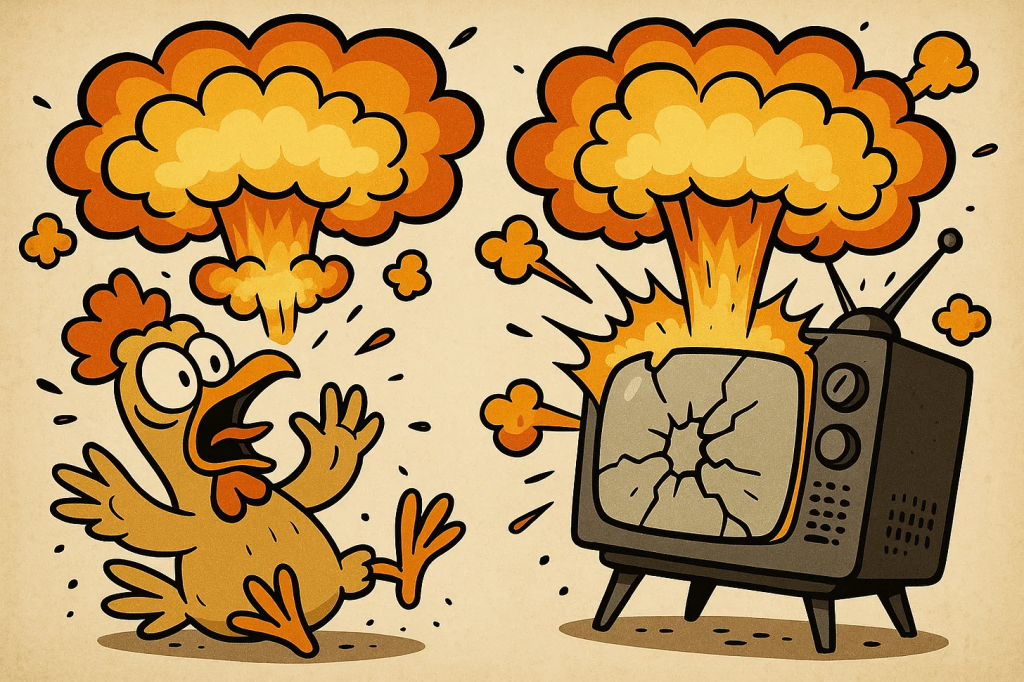
As long as you didn’t mind picking out slivers, it was an okay dinner. I imagine tariffs that seem to change by the day will result in a few shortages in one part of the world and bargains elsewhere.

Free trade is underrated.
Travel

Balaton Memories

Growing up in the U.S., your idea of a beach vacation may have been sunny Florida or something more modest like The Jersey Shore. In communist Hungary, the nicest place to go was “Balaton.” It’s a lake, but no ordinary one as far as Hungarians, or the hundreds of thousands of East Germans who also vacationed there, were concerned. (it’s called “Plattensee” in German). Nearly 50 miles wide and eight or nine across, it was the equivalent of an ocean for a landlocked country where foreign travel rarely was possible.

Amphicarbalaton

I’ve been there a few times, but my most memorable visit by far was in August 1979, the summer between fourth and fifth grade. It was my first trip and I had been regaled with tales of how wonderful it was by my mom, who spent summers camping there as a “Young Pioneer.” By “memorable” I don’t mean pleasant, by the way, though that’s not her fault.

The three of us (me, my mom, and my sister) went there with my mom’s best friend from medical school and her daughter, who is my age. The whole trip was weird to an American kid — you went there on a slow, packed, stuffy train filled with people smoking harsh cigarettes. Passengers brought lots of food with them — bread, salami, cheese and juicy Hungarian peppers and tomatoes — no McDonald’s. Never ones for modesty, most Hungarians on the train already were half naked and ready to jump in the water. By the time they got to the actual beach, most of the women were truly naked from the waist up — an eye-opener for an American kid (I didn’t mind that part).

Instead of a hotel, most people, including us, rented a room or an entire house in a village near the shore. The one we rented seemed incredibly rustic to me — we had to feed the owners’ chickens — but it made for pretty luxurious digs by local standards. Anyway, the trip started out fine. We were on the southern, shallow side of the lake and I went swimming on the first afternoon. I remember having a nasty fall on the rocks and being carried out, sobbing, by a very kind East German teenager. It turned out to be my last excursion into the lake as I started feeling ill the following morning. We found out later that lots of people developed similar symptoms. In a communist country, this sort of information trickles out slowly, if at all.

I got worse and worse and I developed a high fever. I should note here that, back in Budapest before our trip, I had watched a popular Hungarian children’s film on TV based on a famous play called A Pál Utcai Fiúk (The Paul Street Boys) by Ferenc Molnár. In the end, the hero dies of a fever – typical, cheery Hungarian youth programming! Being nine years old and already a budding hypochondriac, I had visions of succumbing to my illness like the hero in the movie. At first my mom wanted to try a home remedy — chicken soup — but we couldn’t eat the live ones in the yard. She bought a duck instead and made some very greasy soup. It didn’t work and finally she found the lone local doctor.

Being the eastern bloc, this took a while and he had no medicine anyway. After scouring the area, my mom finally found some Bulgarian penicillin. I don’t want to sound bratty, but it was the most disgusting thing I’ve ever had to ingest — a bottle of poop-brown liquid with an aroma to match. I kept vomiting it up and, after a while, developed a Pavlovian reaction to the bottle, barfing as soon as she unscrewed the cap.

It was also really hot in the peasant house and I just lay in bed most of the day drenched in sweat. There was no ice or, of course, air conditioning. The main diversion was playing with the stray cats who wandered into the house and lay down in my bed. One day I picked up what looked like a glass of water on the table. It was actually vodka that my mom’s friend, who was a bit of a lush, was drinking straight.

I finally got so sick that my mom had to take me back to Budapest and call in a favor to get me treated in a “special” hospital. What was so special about it? I’m not sure, but I shudder to think of what the run-of-the-mill ones were like. A nurse took me into a room and pulled out the most gigantic needle I’ve ever seen — 1940s medical technology — to draw blood. She stuck it in my arm, but blood started spurting out all over me because she had neglected to place a glass tube on the other end. After yelling at me for not being “a man,” she found the missing piece and I was free to go.

They didn’t seem to have any normal penicillin either because I had to go back every day after that on a train, trolley, and bus while feeling awful to get a shot in my leg with a slightly smaller needle. After the shots my legs would stiffen and I had to limp back to the bus. They alternated sides each day. I was sick for the rest of our trip but a bit better than at the lake. When we got home, I went to the pediatrician in Queens, got some medicine, and it took me about a day to improve. I nearly had a fit when they asked to draw blood but was relieved when it was just a virtually painless finger prick. I had a bacterial infection.

They say that young children can’t appreciate being taken abroad. I’m not sure that’s quite true, though it may seem like that at the time. My sister and I didn’t really understand how different life was behind the Iron Curtain, even in Hungary, the “happiest barracks in the camp.” I thought lots of kids went on trips like that. I remember bringing back a “Pioneer” belt buckle with the inscription “Előre” (forward!) that I wore to school. They didn’t know quite what to make of it at P.S. 174.

Elore

This all made a strong impression on me — especially getting so sick and thinking, with my childish logic, that I might die of a fever. For lots of poor people in the world, that’s a distinct possibility.

I don’t want to scare anyone away from Balaton, by the way. It’s actually very nice and the water is perfectly clean now. It also has plenty of beautiful villas and some nicer hotels than back then, plus vineyards and spas. I went there twice when I lived in Hungary — once on a boozy weekend with some friends when we rented a cheap “Zimmer Frei,” Hungarian style, and once on a more high-end trip involving a sailboat with work colleagues. I had a pretty good time but, unlike probably 99.9% of people who went there as kids, my initial association with Balaton was unpleasant — feeling sick, scared, and uncomfortable.

Youthful memories leave an outsize imprint. My sons used to ask me when they were young if it was really “the best lake in the world.” Um, no, but that’s what their grandmother keeps telling them. She’s still lobbying for them to go there with her.

These days even middle class Hungarians are as likely to jet off to places like Corfu on cheap package tours as to spend time on Balaton. The analogy I would draw is New Yorkers who used to flock to the Catskills in the 1950s but now travel to Florida with the advent of air conditioning and affordable airfares. It’s not a perfect comparison. Balaton is special and accessible in a way that no similar place is for all Americans. It’s culturally significant enough to show up in many brands.

Going to Balaton may not quite rise to the level of a formative memory, but it’s a powerful one. I was inspired to write all this down after reading Gary Shteyngart’s wonderful memoir, Little Failure. He grew up near my neighborhood in Queens around the same time as me after emigrating from the Soviet Union, but the portion that got me reminiscing about my trip to Balaton was his description of summer beach vacations in Crimea. He also detailed some pretty medieval medical treatment he got for his asthma because Soviet doctors didn’t have modern inhalers.

I got off very lightly by comparison. Now all I have to do is become a bestselling author! Oh, one more thing. Sharp-eyed readers will notice that the postcard at the top of this entry shows not only Balaton but, for some strange reason, an Amphicar in the lake (I wrote about those a while back).