Uncategorized

Goodbye, Yellow Brick Road?

“Don’t fight the Fed” is one of the oldest and best-known nuggets of investing wisdom out there, but do people really understand it?

I have my doubts. Coined more than 50 years ago by the late, great Martin Zweig, who warned investors to be cautious ahead of the October 1987 stock market crash, it basically means that, when the world’s most powerful central bank puts its finger on the scale, you would be wise to be on the same side. Buy when policy is loose, be cautious when it is restrictive.

But something can go from being a novel and useful insight about markets in 1970 to such a piece of conventional wisdom in 2024 that it is best ignored. You might even want to bet the other way by taking some chips off of the table. (Hey, you’re something from the publisher of “The Hungarian Contrarian”–what were you expecting?).

My column this weekend made that point by comparing the faith people have in Jerome Powell sending stocks soaring to new highs to the blind belief Dorothy and her companions initially had in the Wizard of Oz. There was initial excitement in the market, but, as has been the case the last couple of times a bull market was long in the tooth, the market might soon conclude that the man behind the monetary curtain frantically pulling levers isn’t really so “great and powerful.”

Back in Zweig’s heyday the Fed just had to lean in a certain direction to make markets move and individual investors weren’t parsing every word. For 25 years now–ever since the Fed opened the spigots to save the financial system following hedge fund Long Term Capital Management’s collapse–it has repeatedly ridden to the rescue in an increasingly aggressive fashion. That has reinforced the expectation that whatever leads the Fed to be concerned enough about the economy that it might cut rates, or stop raising them, is great for stocks. Once upon a time a disappointing report on the labor market was unequivocally bad news. Now it often sends stocks rallying. When cause and effect are that muddied it should give investors pause.
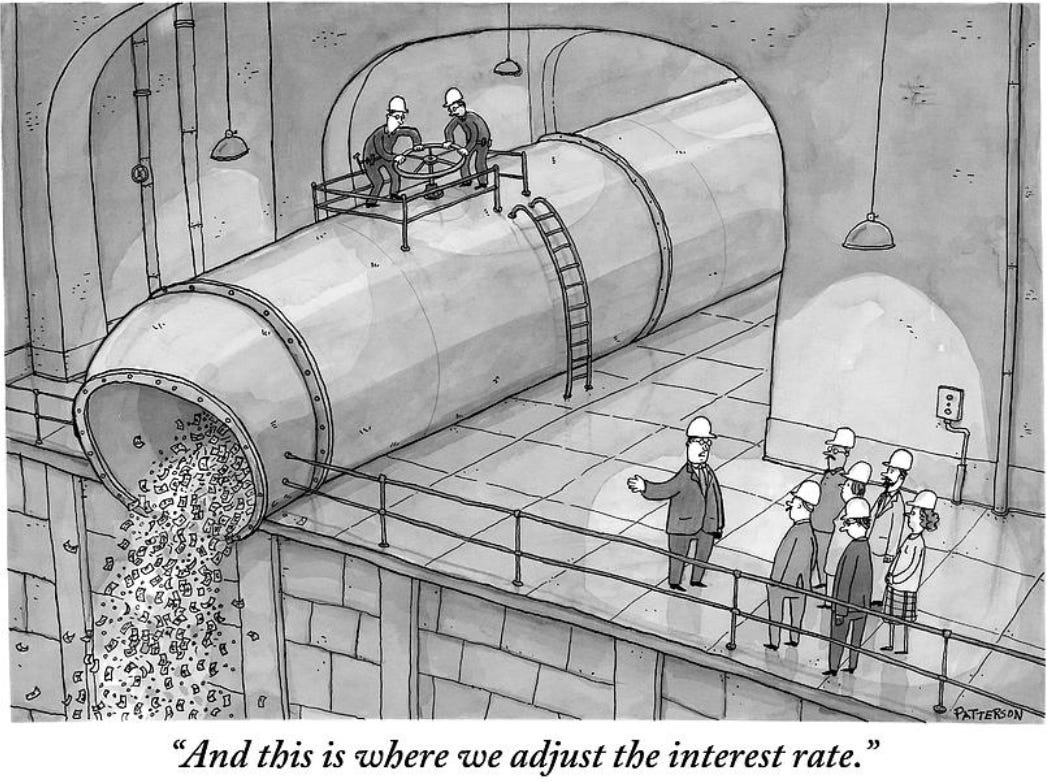
Why? For one, monetary policy isn’t some sort of magic wand. It takes quite a while to filter through to companies and individuals and to have an actual effect on corporate profits. If the economy is already weakening and valuations high at the outset then the start of a cutting cycle can be a massive head fake.

From my column:

Take the start of the rate-cutting cycle in 2007—one that coincidentally began on the same day of the year, the same starting federal-funds rate, and was for an identical amount, half a percent (50 basis points)—as Wednesday’s move. The effect was electric: The Dow Jones Industrial Average had its largest gain in more than four years, rising 336 points, the equivalent of about 1,000 points today. Lehman Brothers shares were among the top performers, surging 10%.

But, as we know now, stocks were just three weeks from their bull-market peak, a recession would begin in January 2008, and Lehman would collapse less than a year later in the largest-ever U.S. bankruptcy. By that time, the Fed had cut rates six more times—moves of 25, 25, 75, 50, 75 and 25 basis points, in that order. The moves took rates to 2%, their lowest in nearly four years. In the two months following the Lehman panic, the Fed made three more steep cuts, slashing rates to zero (technically a range of 0% to 0.25%) for the first time ever.

Stocks surged then too, with the benchmark S&P 500 jumping 4.7%. The Dow’s gain of 360 points would be nearly 1,700 today. Yet they erased all of that day’s rally in less than a week and would go on to shed another quarter of their value before bottoming in March 2009.

To be clear, the conditions that existed during the housing crisis were extreme, sparking the worst U.S. economic downturn since the Great Depression. Extreme events are by definition rare, and most predictions of doom are false alarms. More money is lost bracing for bear markets than in them, even when they really happen.

Will history repeat? That’s doubtful–the conditions back then were extreme. The housing crisis sparked the worst U.S. economic downturn since the Great Depression. There are plenty of excesses now, but only limited signs that the economy might be headed for a recession at the moment. But starting valuations matter and, based on reliable long-term measures, stocks are more expensive than they have been more than 95% of the time over 150 years of history. They also have returned more than 35% since the Fed began to raise rates. 

A few readers took my column as doom-mongering. It isn’t. I’m trying to puncture a silly narrative that a handful of people in Washington can take a decision that sends stocks soaring from all-time highs. That isn’t their job and, even if it were, they wouldn’t have the power to make stocks rise in perpetuity. The market’s initial rally means nothing. If life were that simple then recessions and bear markets would barely ever happen. In the past century alone there have been 17 and 22 of them, respectively. The Fed has existed during that entire period.

Don’t fight the Fed, but don’t speculate on stocks at record highs because you think it’ll bail you out either.


career · investing · journalism

If the Man Wants a Purple Suit …

I’m in the process of clearing out my basement and, as dusty old boxes sometimes do, the contents of one took me on a trip down Memory Lane. They also made me think about a lesson I learned that investors would do well to understand today.

The artifacts were the lucite “deal toys” from various initial public offerings and secondaries I worked on as an equity analyst. These usually adorn the desk and then, as they get more senior, the office of any self-respecting investment banker. Lots of trophies made you a “big swinging dick.” Fighting my hoarder tendencies and my ego, I dumped them in the trash.

But there were three rectangular hunks of clear plastic in that box that I kept: my Institutional Investor awards. Back then at least, the best thing you could do for your career as an analyst was to be “II ranked” in that magazine’s annual survey of fund managers–coming in among the top three in a category. And if you were number one then the magazine would write a flattering blurb with anonymous quotes and a caricature artist would make a drawing of you as an athlete–football in the U.S. and soccer in Europe. Your face also was on the cover of the magazine. It figured heavily into your career prospects and bonus. Andy Kessler wrote a nice piece about it back in 2001 when I was still in the business.

As soon as I heard about this, I made it my goal to be on that magazine cover, and for three years in a row I was. Is that because I was so good at picking emerging market stocks? I suppose I was okay, but it really was a measure of how much clients liked and valued you. For most of them that meant how often you called, how ready you were to organize trips and entertainment for them, and how smart you made them feel. I remember hearing one of our large clients repeat almost verbatim to a bunch of his clients, a group of pension consultants–a rare peek for me at how that particular sausage was made–part of the presentation I had recently given him. He got a detail or two mixed up, but I don’t think they noticed.

But before my Institutional Investor glory and all those 90 hour weeks and client ass-kissing, pretty much exactly 30 years ago, I was wet behind the ears and, to quote Liar’s Poker, still “lower than whale shit on the bottom of the ocean floor” at dear-departed CS First Boston. Our then-largest client asked me about two Eastern European companies and I told him that I was pretty sure one was run by a crook and that the other one, despite being backed by some well-respected financiers, was headed for bankruptcy. Much to my surprise, the client wasn’t happy that I had shared this opinion with him and bought more of them instead of the stock that I recommended.

A salesman covering the account who had way more Wall Street experience than almost anyone on my team took me out to lunch in Budapest that summer of 1994 and clearly was exasperated at what a dummy I was. “Spencer, if the man wants a purple suit, sell him a purple suit.” In other words, we’re in the selling business. If someone wants to do something dumb then he’s a big boy so just make sure we’re the ones who get the fat commission.

I remember feeling like a little kid learning that there‘s no Santa Claus*, but he was absolutely right. One company went bankrupt and the CEO looted the other one. A competing analyst got quite a bit of attention for a brilliant exposé about him and his offshore dealings and I remember feeling envious–probably an indication of why I later went into financial journalism. But I made way more money than her in the business and got to be on those magazine covers, so there’s that.

Even after all these years, Wall Street isn’t so much in the advice as in the customer satisfaction business. Last week I saw one of my former Wall Street Journal colleagues, Eric Wallerstein, on CNBC. He was a brilliant financial scribe and I’m sure he’ll do really well in his new role as chief strategist at Yardeni Research. But in an interview on “Closing Bell,” Scott Wapner immediately gave him a hard time because the firm he had just joined hadn’t raised its S&P 500 target for the end of the year. The figure had already been reached after a torrid first half. Everyone else was doing it, and Eric said he still liked the market, so why not raise it?

The interaction tells you how un-serious financial media can be. First of all, if I remember correctly, Eric’s boss, Wall Street veteran Ed Yardeni, had set a 5,400 point target in 2023 when the S&P 500 was around 4,000, so he made a good call. But I’m pretty sure he doesn’t possess a crystal ball to tell you where an index, much less an individual stock, will be trading in six months. 

There’s nothing like a rapidly rising market to make people even more confident in stocks, though, so CNBC’s viewers were looking for a number to underpin their optimism. I hate to sound so dismissive of my former profession: Analysts and strategists work hard and do a lot of useful things, but spending thousands of hours writing hundreds of pages to tell people what they want to hear with a false degree of precision isn’t one of them. 

A prime example of the horse following the cart comes from the market’s now-favorite stock, Nvidia. If an analyst had been really, really smart then he or she might have guessed that AI chips would be worth their weight in gold and that Nvidia would get a lot more valuable. 

But last April, with the stock at $27.75, analysts’ price targets all clustered at or slightly above that level with the average target being 2.3% higher. There were no three-digit price targets (the stock has since split so I mean on the current number of shares). Any analyst who had stuck his or her neck out and said that would be a legend but probably would have been doing it to gain notoriety like Henry Blodget and his infamous “Amazon $400” call in 1998. Merrill Lynch soon fired its analyst covering Amazon and hired Blodget from second-tier broker CIBC Oppenheimer for a princely sum.** It isn’t worth the career risk of making a prediction like that for someone already working at a top firm. And if you are going to stick your neck out at a big bank, try to be an optimist. This week JPMorgan Chase dumped its strategist, Marko Kolanovic, described as “the biggest bear” on Wall Street for, among other things, missing the AI boom.

Back to Nvidia: Fast forward to last July and the price and the average target had jumped dramatically to $46.75 and $50.09. By this January those numbers were $61.53 and $67.45. In April it was $86.40 and $99.70, respectively, with analysts racing to keep up. At the end of June 2024 it was $125.83 and $129.01 with not a single “sell” recommendation out of 62 analysts polled by FactSet (55 “buy” or “overweight” and 7 “hold”).

Yes, good things have happened. No, it isn’t the case that any serious discounted cash flow model making good faith projections instead of looking at the stock price spit out exactly $28 last April and $128 today. That doesn’t mean the latter number can’t be right, or even too conservative, but it does tell you that analysts are watching the price rise and telling their customers what they want to hear. 

As another recently-departed WSJ colleague, Charley Grant, wrote as his swan song this past week, “No Nvidia in Your Portfolio? You’re Just Toast.” For both analysts and fund managers–the ones who pay them and vote in those surveys–not being on board has been career suicide. At the time of Charley’s article, Nvidia stock was up a whopping 149% year-to-date compared with 4.1% for the average S&P 500 stock so just missing that one name, or even worse some of the others lifted by AI mania, would devastate a fund manager’s relative returns. And forget about getting your caricature on that magazine cover if you insist Nvidia is really worth $50 a share and stick to your guns.

If you’re reading this and you aren’t paid a salary by Wall Street then take note: Your career isn’t at risk if you don’t own the latest hot thing. You might have one less thing to brag about to your friends, but don’t let groupthink or FOMO make you do something that leaves your spidey-senses tingling–you’ll be better off in the long run. The next time a well-paid investing professional makes a persuasive case for something that doesn’t feel or sound right to you, just picture this guy in your mind.

*I felt almost the same way a month into my current career as a journalist when I was told that it really didn’t matter if I wrote well since that isn’t what I get paid for.

**He was later banned from the securities industry for life.

investing · The book

Markets Have Reached Peak Consonant

img_1926

We’ve hit peak consonant and that has me worried about the stock market.

There’s a difference between being an investor and a speculator. I advise readers to stick to the former in my book and to keep it simple. But I also point out that the awful performance of most ordinary savers has a flip side since the markets are a zero sum game. Aside from fees, which are considerable and keep many fund managers and advisers in fine fettle, a small number of speculators reap the rewards of outwitting a large number of suckers. When you zig they often zag. if you want to be one of those guys or girls who can sniff out opportunity or danger and profit from it then you have to be able to read the writing on the wall. I think I just saw it.

The trend of naming companies and products with few or no vowels seems to have peaked. The shuttered burger store pictured above, which I walked by yesterday on Broadway,  is exhibit A. Why on earth would this matter, though? Names are just names, after all, and the likes of Flickr, Scribd, or Unbxd are mostly private companies or, like Tumblr,  divisions of public ones with other activities.

Ah, but trendy names have been a recurring sign of danger in markets. Back in the early 1960s there were the “tronics.” Any company associated with space or electronics did marvelously for a while as the government poured cash into the Space Race. Burton Malkiel writes about a company that sold records door-to-door and changed its name to Space Tone. It saw its stock rise sevenfold in a short period. This sort of irrationality signaled not only a bubble for those particular companies but the beginning of the end of the Kennedy Bull Market.

Years later, most of us were in the market already during the granddaddy of them all when hundreds of companies with a dot-com in their names achieved lofty valuations. We all know how that ended.

In fact it seems that, even outside of a bubble, avoiding companies with exciting names is smart. The great investor Peter Lynch wrote in One Up On Wall Street, the first book I ever read about investing, that “a flashy name in a mediocre company attracts investors and gives them a false sense of security,” and he warned against buying stocks that have an x in their name.

I decided to test this out for an article I wrote for the Financial Times back in 2010 and found 109 companies in the Wilshire 5000 that began or ended with an ‘x.’ They were, in fact, more expensive, far more volatile, and less likely to be profitable. In a stock picking game I’ve been playing for several years I’ve blindly shorted such stocks and made decent returns doing so. ‘Q’ is just as bad.

So back to the vowel-less companies. Is it a case of what’s old is new again? The Semitic languages, including modern Hebrew and Arabic, had some of the first alphabets and are written mostly without vowels. When I went to Hebrew school they were written in but are considered training wheels in modern Hebrew, much to my confusion in Israel.

That’s not the case here. There is no convenience factor as with those scripts, just a hipness quotient. My former colleague John Carney once made up a fake company called Grindr that would grind down your enemies, but it turns out someone grabbed the name to start a gay dating app. I considered grabbing the url for Tstr, perhaps to launch a grilled cheese company, but it already was  claimed by “Tacoma & Seattle Trailer Repair.” Darn.

Anyway, the moment has passed and you’ve been warned. The stock market as a whole is at the 96th percentile of all observations in 135 years based on the Shiller P/E ratio and companies like Tesla with no earnings or free cash flow are worth multiples of established competitors many times their size. Put “cloud” in front of a product and you can command double the multiple. I can go on and on.

Watch out below – srsly.