Uncategorized

My Mom Was a Billionaire

Here’s what that taught me

I’m the target of good-natured ribbing in my upper-middle-class New Jersey suburb for my spending habits. My wife’s friends told her they’ll pass on going on vacation with us because I’m too cheap and would probably take a bus from the airport, pack sandwiches, and stay at budget hotels.

Guilty as charged. That’s in part because both my mom and dad spent money like there was no tomorrow when they were kids. They had to–there was no time to waste. 

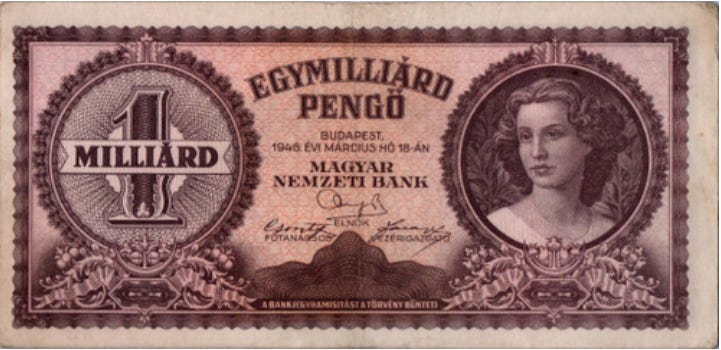
Without running water or medicine, hardly any food or clothing, and her father murdered by the Nazis, my mom was the poorer of my parents, but she managed to save a little bit of money in 1946, the year she turned five, to buy herself some candy. The banknote she had probably made her a local currency billionaire, yet it was literally worth less than the paper it was printed on by the time she was ready to spend it. My grandmother didn’t have the heart to tell her. With both of his parents still alive and the wisdom of being a decade older, my dad had a few more zeros on his net worth–not that it mattered much.

That was the insane reality in postwar Hungary. From time-to-time I’ve quizzed my colleagues in finance or journalism about which country had the highest inflation in history. They almost always guess Weimar Germany, Brazil, Zimbabwe, or, occasionally, early 1990s Yugoslavia. Nope.

In that fateful year Hungary’s inflation rate hit 41,900,000,000,000,000%. Not a year—a month. At the peak it took about 15 hours for prices to double. I once asked my grandmother how often she was paid and what she did with the money. Couldn’t she just throw it out the window on her lunch break for someone to buy groceries with it before they changed prices on her way home? She just smiled and shrugged. Nobody really wanted to hang on to cash so the main value of her job was that they fed her. She said that if you really needed medicine then the only way to get it was if you had a little bit of gold, which she didn’t.

Here’s the sort of thing my mom might have had in her pocket–a billion pengő–though maybe it was just 10 million, or a million or a thousand, depending on exactly what month she set it aside. (Milliárd=billion in Hungarian).

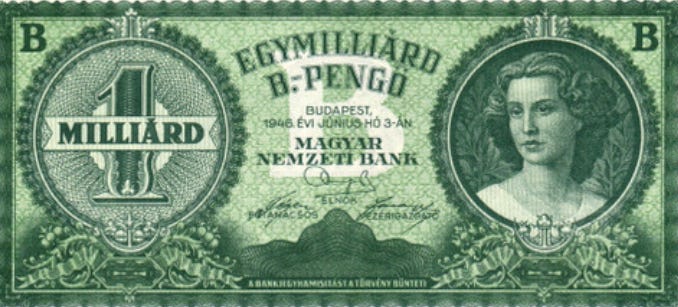
To keep things somewhat manageable, and to save scarce paper, old bills were printed over and reissued in denominations with nine zeros removed–the millpengő. That only lasted for several weeks, so then came the billpengő. (Billió=trillion).

Three months after the above bill was produced, the government printed, but never issued, a sextillion pengő note (one followed by 21 zeros). Then they gave up and scrapped the currency entirely, introducing the forint and making every pengő legally worthless. (I have almost the full collection of banknotes at home, but unfortunately not the rare specimen below, which is worth about $7,000 today to a collector).

Lots of people have parents who grew up poor. It usually makes you a bit frugal–no bad thing in moderation, though sometimes people don’t want to take trips with you 😢. But having almost no money and seeing money cease to have meaning are two entirely different things. To me, at least, those stories make any level of wealth or savings seem ephemeral.

It’s hard to imagine that in a country as blessed as the United States, the issuer of the world’s reserve currency. We have an “exorbitant privilege” compared with people whose wealth, salary, and future pensions are denominated in rubles, bolívars, dirhams, ringgits, pesos, reais, or, sadly, forints. Everything from the cars in our driveways to the appliances in our homes and smartphones in our pockets are more-likely-than-not procured from industrious foreigners who gladly accept electronic bits and bytes representing dollars. Since we don’t have as many useful things to sell them, the surplus is recycled into our financial system. Trillions of dollars are parked in Treasury bills, notes, and bonds earning hundreds of billions in interest annually. With a budget deficit of $1.8 trillion last fiscal year–the second biggest ever–the interest is effectively deferred, with no anxiety about it being paid.

You can read plenty of clickbait nonsense on the internet from doom-mongers comparing America’s fiscal future to Weimar Germany or Zimbabwe (they would cite Hungary if they or their readers were more aware of history). Things would have to go very, very wrong for that to happen.

But we certainly could get a whiff of it. I’m surprised how little my educated friends and neighbors question the solidity of our currency. It’s just a construct, backed by nothing but faith in America’s centrality to the world economy, the wisdom of its leaders, and its military might. 

My wife and I had dinner this past weekend with two couples who also just shipped their youngest child off to college this year. The conversation soon turned from roommates and majors to the next exciting stage in our lives after becoming empty-nesters: retirement. One dad is old enough to have started collecting Social Security. While he could have gotten more if he had waited longer, I pointed out that it probably made sense to start taking it now because the retirement trust fund could be depleted in nine years. That was news to him and the others, but it was sort of like someone telling them the sun will one day consume the earth in a supernova–the sort of weird, theoretical thing they expect to hear from the nerdy finance guy they know, not an actual concern.

One reason most people aware of that projection by the government’s actuaries also don’t take it seriously is that they assume the federal government will step in and cover any projected shortfall. Paid for with what, though? Even on the outright panglossian projections of the Congressional Budget Office, which foresees no recessions, wars, or crises ever, Social Security, Medicare, and other mandatory outlays will be more than $6 trillion in 2033.

Meanwhile, debt held by the public will have doubled by that year to almost $50 trillion on those benign assumptions, and just the annual interest bill is projected at $1.6 trillion. Yet the model concludes that sane people will lend Uncle Sam the money to cover that interest due plus a deficit approaching $3 trillion for just 3.5% a year. That’s less than the yield on any Treasury bill, note, or bond being sold today.

So will politicians double payroll taxes on people still working or tell retirees that they’re out of luck and that they need to accept a third less each month? Probably neither, but you might not love the alternative. It’s something not totally unlike what Hungary was forced to do in 1945 and 1946. While the economy won’t be in ruins (I hope), the U.S. has an active central bank, borrows in its own currency, and does have a printing press. They don’t even need to worry about issuing banknotes any more because money is mostly electronic. Buying bonds and keeping interest rates artificially below inflation, dubbed “financial repression,” is one indirect way of doing this.

Is that outlandish? Between the prospect of doubling or tripling taxes, what would you expect Washington to do? Taking a step so likely to spur inflation is in-and-of-itself a form of taxation and is dubbed “the cruelest tax” because it raises money from people who live on a fixed income.

Before you pore over the actuaries’ report about Social Security, that might not be the thing that breaks. A war, a financial crash, or another pandemic could all push us close to the precipice. Or it could be that the scales fall from our creditors’ eyes one day and interest rates start to rise on their own, forcing the Federal Reserve’s hand. There is some speculation that the moment is nigh, though that has been predicted prematurely many, many times.

None of this remotely means the dollar will go the way of the pengő, but seeing our savings lose a third or a half of their real purchasing power would be pretty lousy. I started off this note telling you how annoyingly frugal I am. If my fears about the fragility of our currency are justified then I’m doing the exact wrong thing. I should be living it up and accumulating possessions instead of saving as much as I can. 

If you see a new car in my driveway or hear that I’ve been flying business class and staying at The Four Seasons, that might be why. After all, I’m the child of billionaires.

Uncategorized

Goodbye, Yellow Brick Road?

“Don’t fight the Fed” is one of the oldest and best-known nuggets of investing wisdom out there, but do people really understand it?

I have my doubts. Coined more than 50 years ago by the late, great Martin Zweig, who warned investors to be cautious ahead of the October 1987 stock market crash, it basically means that, when the world’s most powerful central bank puts its finger on the scale, you would be wise to be on the same side. Buy when policy is loose, be cautious when it is restrictive.

But something can go from being a novel and useful insight about markets in 1970 to such a piece of conventional wisdom in 2024 that it is best ignored. You might even want to bet the other way by taking some chips off of the table. (Hey, you’re something from the publisher of “The Hungarian Contrarian”–what were you expecting?).

My column this weekend made that point by comparing the faith people have in Jerome Powell sending stocks soaring to new highs to the blind belief Dorothy and her companions initially had in the Wizard of Oz. There was initial excitement in the market, but, as has been the case the last couple of times a bull market was long in the tooth, the market might soon conclude that the man behind the monetary curtain frantically pulling levers isn’t really so “great and powerful.”

Back in Zweig’s heyday the Fed just had to lean in a certain direction to make markets move and individual investors weren’t parsing every word. For 25 years now–ever since the Fed opened the spigots to save the financial system following hedge fund Long Term Capital Management’s collapse–it has repeatedly ridden to the rescue in an increasingly aggressive fashion. That has reinforced the expectation that whatever leads the Fed to be concerned enough about the economy that it might cut rates, or stop raising them, is great for stocks. Once upon a time a disappointing report on the labor market was unequivocally bad news. Now it often sends stocks rallying. When cause and effect are that muddied it should give investors pause.

Why? For one, monetary policy isn’t some sort of magic wand. It takes quite a while to filter through to companies and individuals and to have an actual effect on corporate profits. If the economy is already weakening and valuations high at the outset then the start of a cutting cycle can be a massive head fake.

From my column:

Take the start of the rate-cutting cycle in 2007—one that coincidentally began on the same day of the year, the same starting federal-funds rate, and was for an identical amount, half a percent (50 basis points)—as Wednesday’s move. The effect was electric: The Dow Jones Industrial Average had its largest gain in more than four years, rising 336 points, the equivalent of about 1,000 points today. Lehman Brothers shares were among the top performers, surging 10%.

But, as we know now, stocks were just three weeks from their bull-market peak, a recession would begin in January 2008, and Lehman would collapse less than a year later in the largest-ever U.S. bankruptcy. By that time, the Fed had cut rates six more times—moves of 25, 25, 75, 50, 75 and 25 basis points, in that order. The moves took rates to 2%, their lowest in nearly four years. In the two months following the Lehman panic, the Fed made three more steep cuts, slashing rates to zero (technically a range of 0% to 0.25%) for the first time ever.

Stocks surged then too, with the benchmark S&P 500 jumping 4.7%. The Dow’s gain of 360 points would be nearly 1,700 today. Yet they erased all of that day’s rally in less than a week and would go on to shed another quarter of their value before bottoming in March 2009.

To be clear, the conditions that existed during the housing crisis were extreme, sparking the worst U.S. economic downturn since the Great Depression. Extreme events are by definition rare, and most predictions of doom are false alarms. More money is lost bracing for bear markets than in them, even when they really happen.

Will history repeat? That’s doubtful–the conditions back then were extreme. The housing crisis sparked the worst U.S. economic downturn since the Great Depression. There are plenty of excesses now, but only limited signs that the economy might be headed for a recession at the moment. But starting valuations matter and, based on reliable long-term measures, stocks are more expensive than they have been more than 95% of the time over 150 years of history. They also have returned more than 35% since the Fed began to raise rates. 

A few readers took my column as doom-mongering. It isn’t. I’m trying to puncture a silly narrative that a handful of people in Washington can take a decision that sends stocks soaring from all-time highs. That isn’t their job and, even if it were, they wouldn’t have the power to make stocks rise in perpetuity. The market’s initial rally means nothing. If life were that simple then recessions and bear markets would barely ever happen. In the past century alone there have been 17 and 22 of them, respectively. The Fed has existed during that entire period.

Don’t fight the Fed, but don’t speculate on stocks at record highs because you think it’ll bail you out either.

career · investing · journalism

If the Man Wants a Purple Suit …

I’m in the process of clearing out my basement and, as dusty old boxes sometimes do, the contents of one took me on a trip down Memory Lane. They also made me think about a lesson I learned that investors would do well to understand today.

The artifacts were the lucite “deal toys” from various initial public offerings and secondaries I worked on as an equity analyst. These usually adorn the desk and then, as they get more senior, the office of any self-respecting investment banker. Lots of trophies made you a “big swinging dick.” Fighting my hoarder tendencies and my ego, I dumped them in the trash.

But there were three rectangular hunks of clear plastic in that box that I kept: my Institutional Investor awards. Back then at least, the best thing you could do for your career as an analyst was to be “II ranked” in that magazine’s annual survey of fund managers–coming in among the top three in a category. And if you were number one then the magazine would write a flattering blurb with anonymous quotes and a caricature artist would make a drawing of you as an athlete–football in the U.S. and soccer in Europe. Your face also was on the cover of the magazine. It figured heavily into your career prospects and bonus. Andy Kessler wrote a nice piece about it back in 2001 when I was still in the business.

As soon as I heard about this, I made it my goal to be on that magazine cover, and for three years in a row I was. Is that because I was so good at picking emerging market stocks? I suppose I was okay, but it really was a measure of how much clients liked and valued you. For most of them that meant how often you called, how ready you were to organize trips and entertainment for them, and how smart you made them feel. I remember hearing one of our large clients repeat almost verbatim to a bunch of his clients, a group of pension consultants–a rare peek for me at how that particular sausage was made–part of the presentation I had recently given him. He got a detail or two mixed up, but I don’t think they noticed.

But before my Institutional Investor glory and all those 90 hour weeks and client ass-kissing, pretty much exactly 30 years ago, I was wet behind the ears and, to quote Liar’s Poker, still “lower than whale shit on the bottom of the ocean floor” at dear-departed CS First Boston. Our then-largest client asked me about two Eastern European companies and I told him that I was pretty sure one was run by a crook and that the other one, despite being backed by some well-respected financiers, was headed for bankruptcy. Much to my surprise, the client wasn’t happy that I had shared this opinion with him and bought more of them instead of the stock that I recommended.

A salesman covering the account who had way more Wall Street experience than almost anyone on my team took me out to lunch in Budapest that summer of 1994 and clearly was exasperated at what a dummy I was. “Spencer, if the man wants a purple suit, sell him a purple suit.” In other words, we’re in the selling business. If someone wants to do something dumb then he’s a big boy so just make sure we’re the ones who get the fat commission.

I remember feeling like a little kid learning that there‘s no Santa Claus*, but he was absolutely right. One company went bankrupt and the CEO looted the other one. A competing analyst got quite a bit of attention for a brilliant exposé about him and his offshore dealings and I remember feeling envious–probably an indication of why I later went into financial journalism. But I made way more money than her in the business and got to be on those magazine covers, so there’s that.

Even after all these years, Wall Street isn’t so much in the advice as in the customer satisfaction business. Last week I saw one of my former Wall Street Journal colleagues, Eric Wallerstein, on CNBC. He was a brilliant financial scribe and I’m sure he’ll do really well in his new role as chief strategist at Yardeni Research. But in an interview on “Closing Bell,” Scott Wapner immediately gave him a hard time because the firm he had just joined hadn’t raised its S&P 500 target for the end of the year. The figure had already been reached after a torrid first half. Everyone else was doing it, and Eric said he still liked the market, so why not raise it?

The interaction tells you how un-serious financial media can be. First of all, if I remember correctly, Eric’s boss, Wall Street veteran Ed Yardeni, had set a 5,400 point target in 2023 when the S&P 500 was around 4,000, so he made a good call. But I’m pretty sure he doesn’t possess a crystal ball to tell you where an index, much less an individual stock, will be trading in six months. 

There’s nothing like a rapidly rising market to make people even more confident in stocks, though, so CNBC’s viewers were looking for a number to underpin their optimism. I hate to sound so dismissive of my former profession: Analysts and strategists work hard and do a lot of useful things, but spending thousands of hours writing hundreds of pages to tell people what they want to hear with a false degree of precision isn’t one of them. 

A prime example of the horse following the cart comes from the market’s now-favorite stock, Nvidia. If an analyst had been really, really smart then he or she might have guessed that AI chips would be worth their weight in gold and that Nvidia would get a lot more valuable. 

But last April, with the stock at $27.75, analysts’ price targets all clustered at or slightly above that level with the average target being 2.3% higher. There were no three-digit price targets (the stock has since split so I mean on the current number of shares). Any analyst who had stuck his or her neck out and said that would be a legend but probably would have been doing it to gain notoriety like Henry Blodget and his infamous “Amazon $400” call in 1998. Merrill Lynch soon fired its analyst covering Amazon and hired Blodget from second-tier broker CIBC Oppenheimer for a princely sum.** It isn’t worth the career risk of making a prediction like that for someone already working at a top firm. And if you are going to stick your neck out at a big bank, try to be an optimist. This week JPMorgan Chase dumped its strategist, Marko Kolanovic, described as “the biggest bear” on Wall Street for, among other things, missing the AI boom.

Back to Nvidia: Fast forward to last July and the price and the average target had jumped dramatically to $46.75 and $50.09. By this January those numbers were $61.53 and $67.45. In April it was $86.40 and $99.70, respectively, with analysts racing to keep up. At the end of June 2024 it was $125.83 and $129.01 with not a single “sell” recommendation out of 62 analysts polled by FactSet (55 “buy” or “overweight” and 7 “hold”).

Yes, good things have happened. No, it isn’t the case that any serious discounted cash flow model making good faith projections instead of looking at the stock price spit out exactly $28 last April and $128 today. That doesn’t mean the latter number can’t be right, or even too conservative, but it does tell you that analysts are watching the price rise and telling their customers what they want to hear. 

As another recently-departed WSJ colleague, Charley Grant, wrote as his swan song this past week, “No Nvidia in Your Portfolio? You’re Just Toast.” For both analysts and fund managers–the ones who pay them and vote in those surveys–not being on board has been career suicide. At the time of Charley’s article, Nvidia stock was up a whopping 149% year-to-date compared with 4.1% for the average S&P 500 stock so just missing that one name, or even worse some of the others lifted by AI mania, would devastate a fund manager’s relative returns. And forget about getting your caricature on that magazine cover if you insist Nvidia is really worth $50 a share and stick to your guns.

If you’re reading this and you aren’t paid a salary by Wall Street then take note: Your career isn’t at risk if you don’t own the latest hot thing. You might have one less thing to brag about to your friends, but don’t let groupthink or FOMO make you do something that leaves your spidey-senses tingling–you’ll be better off in the long run. The next time a well-paid investing professional makes a persuasive case for something that doesn’t feel or sound right to you, just picture this guy in your mind.

*I felt almost the same way a month into my current career as a journalist when I was told that it really didn’t matter if I wrote well since that isn’t what I get paid for.

**He was later banned from the securities industry for life.

Columns

A Real Hotel California

Something funny happened when my late mother-in-law came to live with us six years ago. No, it wasn’t that I decided to move to a tent–she was lovely. But she really needed her own place. Renting anything that was nice, close to us, and accessible to public transportation was beyond her budget. Then my wife and I lucked out and found a beautiful co-op, studio apartment with majestic views of Manhattan and two swimming pools for only $62,500.

That isn’t a typo. The monthly fees, which included everything from utilities to cable to a parking spot for us, were just $1,000. Co-op rules made it impossible for someone of her limited means to buy it, even if we gave her the money, so we did and she just paid the fees.

As an owner (technically a shareholder), I got the financial statements and board meeting notes of the co-op, which consisted of five large buildings. (Here’s an explainer for those of you unfamiliar with this type of apartment, which is most common in the Northeast). The balance sheet was a mess due to its unionized workers’ reliance on a multi-employer pension plan that was underfunded. As more employers default, the surviving ones pick up the liabilities.

I was aware of that going in. But the most surprising thing was how some of the other residents saw things. For example, there was a big debate about what to do with a gorgeous penthouse apartment the co-op had taken into possession when the owners died and their estate defaulted. It had a spacious balcony big enough for a party with an unobstructed view of the Manhattan skyline and Hudson River. If it had been a condo it would have been worth millions. Yet the co-op board had it on sale for $38,000, barely half what we paid for my mother-in-law’s far smaller place, and was finding no takers. The problem is that the fees were proportional to floor space and they had climbed to more than $7,000 a month–about what the most expensive rental in town would cost.

The board minutes indicated that residents were shocked it was so cheap and were wary of selling even at that price because it would depress the value of their own apartments. But the foregone fees were costing them all money every month they hesitated, and that the low price wasn’t the actual problem–it was what it foreshadowed. The liabilities they had all signed up for could eventually erase the resale value of their smaller apartments too.

The penthouse was, financially-speaking, far inferior to a rental of similar quality, which is why nobody was interested. If you can’t afford a fancy place any longer, you just move out at the end of the lease. A landlord doesn’t chase you down asking for that amount in perpetuity until you can find someone else to live there. And if there are some emergency expenses like fixing a roof, he or she can’t just tack on the cost to your rent.

We sold our apartment at a small profit after my mother-in-law’s passing, but I thought about the upside-down economics of that complex as I was researching my latest column for The Wall Street Journal. If you own any type of property, and certainly if you’ve ever considered buying a timeshare, keep reading.

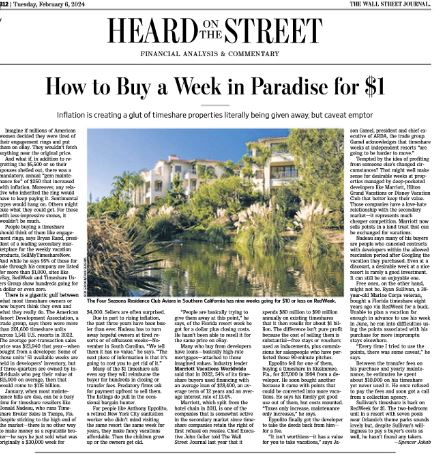
It was provocatively titled “How To Buy a Week in Paradise for $1.” The average sale price for a timeshare unit bought from a developer is about $24,000, typically for a one-week per-year deed. There are 1,541 resorts in the U.S. alone with more than 200,000 units divided into 51 weeks (one is for maintenance). If just three-quarters are owned by individuals who attended one of those 90 minute sales pitches and owners’ mental accounting puts existing units’ value at just $15,000 apiece then the combined (imaginary) value of those weeks is well over $100 billion. These days some people buy units in a land trust giving them points to use, but the same principle applies, and the points are even more profitable for developers (I explain why here).

Timeshares bought on the secondary market might be worth it for larger families who enjoy going to the same place every year or people with the patience to navigate complex exchange schemes, but what are they really worth? Even some beautiful properties can be had for a dollar. There’s a reason the developer doesn’t just take them back for free.

The management of an absolutely stunning Four Seasons resort in southern California that let me use a photo angrily asked the paper to take it down when I pointed out in the caption that several units could be had there for practically nothing. At least one actually cost less-than-nothing as the desperate seller was willing to pay $1,000 in property closing fees too. You can check out any time you like, but you can never leave.

(Here’s a pic of the print issue where the photo appeared).

Just a casual search on sites like RedWeek or Timeshare Users Group turns up hundreds of listings for a buck, or even zero, and that understates the problem because many properties would only be worth buying if you were paid way more than the closing costs. Sellers can’t afford that, and those sites don’t accept negative numbers anyway. Owners who just walk away are hounded by collection agencies. Two people I spoke with, a retired New York sanitation worker and an ex-Marine sniper who was wounded in Iraq, are still trying to sell properties they thought were bargains.

It is possible to force a resort to take a property back by hiring a reputable lawyer. But someone has to pay those delinquent fees to keep the lights on. Distress compounds the burden on those who can afford, and choose, to keep paying.

The high-end of the timeshare market–the most desirable weeks at nice resorts, such as President’s Day week in Florida or Vail managed by a large, deep-pocketed company–is still worth something. Maybe a week was purchased for $30,000 and could sell for $4,000, which is a specific example cited to me in the article by broker Don Nadeau. As one person told me, buyers should think of resorts more like engagement rings than property–their value is immediately less than what you pay a developer, but you can still enjoy it and have a sentimental attachment.

So I hope that you don’t own a timeshare that you regret, but I encourage those of you with larger families to consider renting weeks from owners at a secure site–I’ve used verified transactions on RedWeek. They can be a good deal for people on both sides of the transaction.

How does this apply to homeowners? Well, taken to an extreme, the math eventually works the same way. 

A pretty typical house near mine is for sale for $749,000. The owner had tried to rent it for $3,800 a month in 2021, according to Zillow. I would expect it to sell because a shortage of properties is keeping prices high in New York City suburbs for now, but the underlying costs have gone up a lot. Someone making a 20% down payment would still be out-of-pocket $60,000 a year for their mortgage, insurance, and property tax. The latter two of those can keep going up as inflation and the wages and health care costs for local, unionized teachers and police march higher. We just got our assessment for 2024 yesterday and I’m trying not to think about it.

Clearly you would struggle to make money as a landlord buying it at today’s mortgage rates and prevailing rents–you’d be out of pocket by about $10,000 a year even before maintenance. But what about just biting the bullet and owning it? It’s an investment, right?

When my wife and I bought our house 20 years ago, the combined tax and insurance was 1.5% of the price we paid. Today it is nearly double that–not a deal killer, but not good. Extrapolating that trend, if we decided to become snowbirds in 20 years, that would have grown to 6% of the home price every year. Of course that assumes all of our neighbors are able to keep paying those taxes. What if many can’t, or if there is a political uproar resulting in people below a certain income or wealth level receiving a break at the expense of those able to keep paying? What if that starts to hit the appreciation of homes in our town and state? The $38,000 co-op cost more than $80,000 a year.

Of course the dirty secret of the timeshare business is that they were never “worth” $30,000. The price reflected the costs of a slick sales job and all the goodies they had to give away. Marriott buys back old timeshares for $80 million to $90 million a year that it resells for $1 billion or so, according to my conversation with its CEO, John Geller. That means you can pay slightly more than Marriott would pay–maybe 15 or 20 percent of the price at a presentation–and get a timeshare that way too. Yet even some bargain hunters are now surprised at the difficulty of finding a buyer.

Homes don’t have a secret secondary market and the math won’t get so extreme. But it can grow to enough of a burden that people who counted on retiring on their home equity might find that there isn’t nearly as much left as they expected there to be. The older couple who sold us our house in 2003 were very interested in maximizing the sale price because it was pretty much all they had saved, and that was pretty typical.

The moral of the story? Other than steering clear of timeshare promotions (unless you are 100% confident you won’t buy) is to consider the future liabilities of things that sound like investments.

investing · journalism · Uncategorized

A Financial Crisis in Plain Sight?

Who could have seen it coming?

Financial markets are full of surprises. Here’s how to possibly avoid some of the costlier ones. After they are sitting on losses or regretting a missed opportunity, some investors will literally blame the messenger. Why didn’t my favorite financial publication warn me about this, or why were they so pessimistic about what turned out to be a great opportunity?

There are reasons for this. One should be obvious: Unlike parts of the paper like my column at The Wall Street Journal, Heard on the Street, reporters report. They rely on the assessments and opinions of participants in the financial markets. If most people expect, say, a recession, as a majority of Wall Street economists did this time last year, that is likely going to be the conversation they have with any two or three talking heads. It is also likely to be reflected in prices. And, as we know, they were dead wrong–the U.S. economy actually grew at an annual rate of above 5% last quarter.

Another reason is that the people who sit on the masthead of a publication are overly obsessed with big, round numbers. They are one way that financial journalists, and hence the savers and speculators who follow them, miss the forest for the trees.

Financial journalists and editors are told to drop what they’re doing because some big, round financial number is about to be breached. The number is lighting up search engines so we need to be all over it–clicks are what pay the bills these days. Just like a watched pot never seems to boil, though, those milestones taunt us. Sometimes we even wind up ignoring the big picture as a result–a mistake we’re making right now.

I recall conversations in February 2020 at The Wall Street Journal about what seemed like the imminent crossing of Dow 30,000. The day that the index got the closest to that milestone China reported that the number of cases of a deadly virus recently named Covid-19 were actually 10 times as high as previously thought. In the sixth paragraph of the “pan”–our daily, rolling markets story–a Goldman Sachs report saying that a drop-off in exports to China could lop half a percentage point off of U.S. economic growth that quarter gets a mention.

As we know, investors who took comfort in that mild assessment, if they ever even got that deep into the article, were about to be blindsided by what should have been an obvious risk to their portfolios and the world economy. The index would within weeks be flirting with 18,000 points.

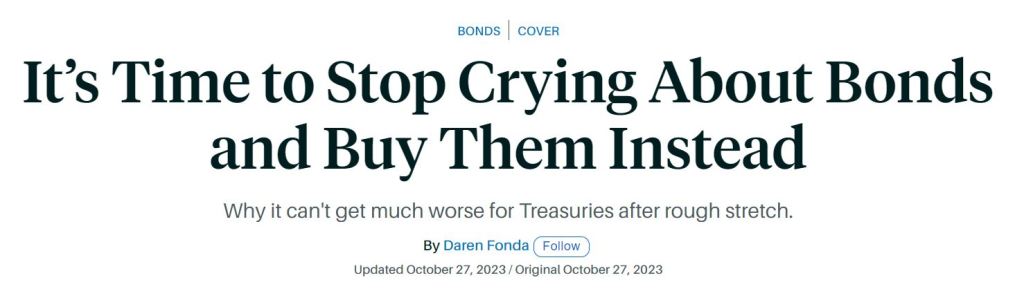
The recent breach of 5% on the benchmark U.S. Treasury note was a bit different. Just like a watched pot never boils, it took quite a while to happen. And when it did (only during non-U.S. trading for those of you checking), the tsunami of coverage went from causing angst to inspiring a wave of buying buy people who haven’t seen yields like this since the Bush administration. Here’s Barron’s Magazine:

Whether or not you locked in 5% or are cursing yourself for sitting on the sidelines doesn’t matter all that much. What does is that the cost of money went from nothing to quite a bit in a hurry after many years of artificially low interest rates. During that time,  government borrowing around the world ballooned–especially in the United States. Federal debt held by the public has gone from $5 trillion in 2007 to more than $25 trillion today. 

The interest on that debt is climbing fast as old bonds roll over and new ones are issued. It was more than $800 billion in the past 12 months and is well on its way to passing $1 trillion a year. For perspective, net interest is now nearly the size of all non-defense discretionary spending. And I’m afraid that defense isn’t about to become less of a priority. As alarming as that sounds, the average rate on that debt was only 2% a year ago and just recently crossed 3%. Despite all the attention it received in newsrooms, the 10 year note was actually the last maturity to breach 5%.

If bond yields stay even at today’s slightly more modest level for any appreciable length of time then already ominous projected trillion dollar annual deficits will be much higher. That will affect not just our pocketbooks but America’s ability to wage war, deal with banking crises, and much more. The panglossian 10-year budget projections by the Congressional Budget Office have interest rates somehow staying at 3% this year and no recessions ever. Anyone paying attention should see that rates being this high could have a double-effect on the budget deficit by also pushing growth lower, hurting tax revenue.

Like Covid pretty becoming uncontainable by early 2020, it might in theory be possible to alter that trajectory with some extreme efforts like massive tax hikes, but the political will and recognition of the threat need to be far greater. If this were just a warning about interest costs being high for a while or taxes needing to rise then you could call my cute headline alarmist. The problem, though, is that the numbers will within just a couple of years be too big to reverse. 

How so? Either rising bond yields will become self-fulfilling as the people who buy bonds with the hope of an expected positive return worry about America losing control of its budget with programs like Social Security and Medicare set to deplete their funding early next decade. Like an emerging market, a vicious cycle of rising rates can accelerate the reckoning. By my estimate, simply adding a single percentage point to the average interest rate would result in $3.5 trillion in additional borrowing by 2033.

More likely, though, the effect of all this on the economy will soon push the Fed to resume expansion of its balance sheet or to at least start cutting no matter how high inflation is. With fixed income, it is your real return that matters, and that could turn negative. Of the few tricks left in the Fed and Treasury’s arsenal to control the problem, allowing that to happen is the most likely. 

This is what risk expert Michele Wucker calls a “Gray Rhino” – “a highly probable, high impact yet neglected threat” – a mix of a black swan and elephant in the room. Yet record sums have flowed into exchange traded funds that own long-term U.S. Treasury bonds.

That has been a good short-term trade, but it sounds like a potentially awful long-term bet. Buying anything on the assumption that a greater fool will provide liquidity when you’ve made your money is a silly risk. I’ll finish this essay with the standard “not investment advice” boilerplate, but I’ll also tell you what I’m doing with my own little pile of savings. None of it is in bonds with a maturity beyond three years except for those that compensate me for future inflation. I’ll gladly give up a capital gain in long term bonds to avoid what, through inflation or some other means, looks like it could be ugly.

Columns · The book

Robinhood Traders Robbed Themselves

You might have noticed that the stock market is a tad wobbly these days. Your own portfolio might be significantly wobblier than the headline numbers suggest if you piled into some of the most popular stocks on social media, so I hope you didn’t.

A lot of those same stocks happen to be in the top 20 or top 100 on Robinhood which, for anybody who reads my book (out on February 1st), won’t come as a surprise. This herd-following behavior was in fact pretty profitable for a while. I wrote about the downside of that today.

A clever young man, Noah Weidner, kept track of an index of the most popular stocks owned by investors at the broker. More recently, even after the data feed was curtailed by the broker, he kept up a list of which stocks entered and exited the top 100. For the most part those rejected like energy ETFs, Berkshire Hathaway and Wells Fargo went on to do well. Meanwhile, most of those added have been among the biggest losers recently, including shares of Robinhood itself. I link to an academic study that does a nifty job of explaining why that happened.

Stay safe out there.

investing · The book

With the Mulligans on Full-D Radio

Full D Radio

I had the pleasure of being interviewed about the upcoming book by veteran financial journalist Roben Farzad on Full Disclosure Radio, which airs on NPR stations and is available as a podcast. This was a double treat because Roben is so well-prepared and also because he also interviewed two young men, Quinn and Finley Mulligan, for the same segment.

I spoke with a lot of smart people for the book, ranging from experts on options trading to social psychology to short selling to problem gambling to marketing to behavioral finance to Silicon Valley’s culture, but people like Quinn and Finley are really the subject of the book and their insight was tremendously valuable. They are among the “apes” who bought and continue to buy GameStop, AMC and other meme stocks either as a way of making money, sending a message, or both. While I don’t personally recommend doing that, their explanation in the podcast of why they and others continue to is smart and worth a listen. And they aren’t just any apes – the twin brothers are in the process of making a documentary about it, Apes Together Strong.

The rise of the apes and the rush of young investors into stock and crypto trading is the biggest personal finance story, if not financial story period, of the past few years. I knew I had to write about it as soon as one of my sons pointed me to what was happening on r/wallstreetbets a year ago. The episode blew multi-billion dollar holes in some of the slickest hedge funds on Wall Street. But it also poured billions more into the coffers of other Wall Street establishments who claim to be “democratizing finance” and continues to do so.

I hope you’ll check out the podcast, the upcoming documentary and, of course, my book.

Columns

Oprah to Your Portfolio’s Rescue?

January is a month full of hope for dieters but, as the year rolls by, our resolutions tend to fall by the wayside. Gyms know this, which is why they get so many new members around now and why it’s so difficult to cancel memberships. WW, formerly known as Weight Watchers, doesn’t make it as tough. That’s not just ethical but smart: They have a lot of return customers.

I wrote about the company today. They were expecting a great 2021 even if lots of customers gave up as usual. Instead it was a dreadful year and their stock slumped by a third. Sentiment is about as bad as it was back in 2015 when Oprah Winfrey rode to the rescue, buying a tenth of the company, joining the board, and becoming their brand ambassador. Back then the stock rallied by 1,600% in three years.

I don’t think that will happen again, but it is cheap and one thing holding it back may soon reverse itself. Even though lots of people gained weight during the pandemic, the company’s bet that they would turn to their services to lose it proved wrong because people view dieting as punishment. They had already denied themselves so much during the pandemic that they were looking for a grace period.

There isn’t another Oprah waiting in the wings, but the stock is cheaper than it has been in quite some time. Full year results due next month might not look pretty. That might give patient investors a good entry point.

Uncategorized

Spinoffs: GE, Johnson & Johnson

I wrote this past week about corporate spinoffs, which are all the rage these days. In a spinoff, a company takes a division or two and hands it to its shareholders, creating a brand new public company. The new company usually doesn’t fit in with its new owners, which can be a very good thing for patient investors.

Funds will own, say, a bank, and now they have a small insurer or whatever and sell its shares. But the managers of the new insurer are suddenly even more motivated as they have stock options and a lot more upside if its shares do well. The famous value investor Joel Greenblatt wrote a gem of a book largely about spinoffs, You Can Be a Stock Market Genius.

As with lots of things in investing, though, the magic has faded. Investing in spinoffs used to be a formula for very good returns, but lately they have lagged. The problem might be too many people reading the same statistics and also too many activist funds pushing companies to split apart for no good reason. With both General Electric and Johnson & Johnson announcing split this past week, I asked whether these latest attempts would create more than some initial excitement.

Breaking apart a company can, in theory, unlock value. Corporate spinoffs as an asset class have done well historically. Value investor Joel Greenblatt highlighted the opportunity for the masses in his book “You Can Be a Stock Market Genius.” Several studies using data from the 1990s through the middle of the last decade have shown that a portfolio of spinoffs can beat the market by 10 to 15 percentage points in the year after they go public. Managers of a newly public company are more focused and valuations often rise to reflect those of peers. But there are catches. One is that investors have to hold on to the spinoff to reap the rewards, and many don’t. Initial selling pressure on spinoffs often creates opportunities for even more outperformance once a new shareholder base is established. But the spinoff secret is out. Activist investors now push companies to reshuffle the deck chairs to generate short-term stock-market gains. Trian, the fund that took a stake in GE in 2017 with disastrous timing, applauded Tuesday’s move.

Columns · investing

Aching Backs = Big Bucks

Sometimes a fairly small company that I know will otherwise fall through the cracks catches my eye. The latest one is “The Joint,” a fast-growing chain of storefront chiropractic clinics. I learned a lot in the process of reporting it, most of it about the business of franchising rather than the iffy science of back “adjustments.”

The chain had been on a rocket ship ride with its stock up by 3,000% since the current CEO took over in April 2016. Then it took a tumble on a short-seller’s report. I don’t think that the report blew the lid off of a flaky company, as some reports do. But it correctly pointed out that the stock was pricing in some unrealistic growth.

Probably the most analogous company, and one most readers will know, is Massage Envy. Its founder was CEO of The Joint for a while and he sold Massage Envy in 2008 when it was still in its growth phase. It has been stalled for the past decade or so.

Will this do better? Back pain is a big problem, but The Joint has lots of imitators like SnapCrack and Chiro Now with similar no-insurance, subscription-based formulas. It has around 1% of the overall U.S. market and is the biggest storefront player so there is plenty of room to grow. Unfortunately, its revenue opportunity isn’t as big as it seems because clinics charge a lot more and offer more services. The Joint’s market value of $1.2 billion already assumes it will snatch a large share of a pretty big pie at more than 100 times projected earnings for 2023 when its management thinks it will reach 1,000 stores.

Some stores’ impressive profits represent in part an owner-operator’s sweat equity. For both the occasionally underemployed practitioners and their patients, a storefront’s simplicity has been appealing compared with high-pressure clinics. If one views the chain as being at the very early stages of disrupting its sector and assumes that its head start will make it the McDonald’s of back pain then its valuation could be a bargain. But if it is more like another Massage Envy then the stock’s price and its future cash flows are seriously misaligned.

“Aching Backs Equal Big Bucks, but an Adjustment Looms” WSJ, October 16, 2021