career · investing · journalism

If the Man Wants a Purple Suit …

I’m in the process of clearing out my basement and, as dusty old boxes sometimes do, the contents of one took me on a trip down Memory Lane. They also made me think about a lesson I learned that investors would do well to understand today.

The artifacts were the lucite “deal toys” from various initial public offerings and secondaries I worked on as an equity analyst. These usually adorn the desk and then, as they get more senior, the office of any self-respecting investment banker. Lots of trophies made you a “big swinging dick.” Fighting my hoarder tendencies and my ego, I dumped them in the trash.

But there were three rectangular hunks of clear plastic in that box that I kept: my Institutional Investor awards. Back then at least, the best thing you could do for your career as an analyst was to be “II ranked” in that magazine’s annual survey of fund managers–coming in among the top three in a category. And if you were number one then the magazine would write a flattering blurb with anonymous quotes and a caricature artist would make a drawing of you as an athlete–football in the U.S. and soccer in Europe. Your face also was on the cover of the magazine. It figured heavily into your career prospects and bonus. Andy Kessler wrote a nice piece about it back in 2001 when I was still in the business.

As soon as I heard about this, I made it my goal to be on that magazine cover, and for three years in a row I was. Is that because I was so good at picking emerging market stocks? I suppose I was okay, but it really was a measure of how much clients liked and valued you. For most of them that meant how often you called, how ready you were to organize trips and entertainment for them, and how smart you made them feel. I remember hearing one of our large clients repeat almost verbatim to a bunch of his clients, a group of pension consultants–a rare peek for me at how that particular sausage was made–part of the presentation I had recently given him. He got a detail or two mixed up, but I don’t think they noticed.

But before my Institutional Investor glory and all those 90 hour weeks and client ass-kissing, pretty much exactly 30 years ago, I was wet behind the ears and, to quote Liar’s Poker, still “lower than whale shit on the bottom of the ocean floor” at dear-departed CS First Boston. Our then-largest client asked me about two Eastern European companies and I told him that I was pretty sure one was run by a crook and that the other one, despite being backed by some well-respected financiers, was headed for bankruptcy. Much to my surprise, the client wasn’t happy that I had shared this opinion with him and bought more of them instead of the stock that I recommended.

A salesman covering the account who had way more Wall Street experience than almost anyone on my team took me out to lunch in Budapest that summer of 1994 and clearly was exasperated at what a dummy I was. “Spencer, if the man wants a purple suit, sell him a purple suit.” In other words, we’re in the selling business. If someone wants to do something dumb then he’s a big boy so just make sure we’re the ones who get the fat commission.

I remember feeling like a little kid learning that there‘s no Santa Claus*, but he was absolutely right. One company went bankrupt and the CEO looted the other one. A competing analyst got quite a bit of attention for a brilliant exposé about him and his offshore dealings and I remember feeling envious–probably an indication of why I later went into financial journalism. But I made way more money than her in the business and got to be on those magazine covers, so there’s that.

Even after all these years, Wall Street isn’t so much in the advice as in the customer satisfaction business. Last week I saw one of my former Wall Street Journal colleagues, Eric Wallerstein, on CNBC. He was a brilliant financial scribe and I’m sure he’ll do really well in his new role as chief strategist at Yardeni Research. But in an interview on “Closing Bell,” Scott Wapner immediately gave him a hard time because the firm he had just joined hadn’t raised its S&P 500 target for the end of the year. The figure had already been reached after a torrid first half. Everyone else was doing it, and Eric said he still liked the market, so why not raise it?

The interaction tells you how un-serious financial media can be. First of all, if I remember correctly, Eric’s boss, Wall Street veteran Ed Yardeni, had set a 5,400 point target in 2023 when the S&P 500 was around 4,000, so he made a good call. But I’m pretty sure he doesn’t possess a crystal ball to tell you where an index, much less an individual stock, will be trading in six months. 

There’s nothing like a rapidly rising market to make people even more confident in stocks, though, so CNBC’s viewers were looking for a number to underpin their optimism. I hate to sound so dismissive of my former profession: Analysts and strategists work hard and do a lot of useful things, but spending thousands of hours writing hundreds of pages to tell people what they want to hear with a false degree of precision isn’t one of them. 

A prime example of the horse following the cart comes from the market’s now-favorite stock, Nvidia. If an analyst had been really, really smart then he or she might have guessed that AI chips would be worth their weight in gold and that Nvidia would get a lot more valuable. 

But last April, with the stock at $27.75, analysts’ price targets all clustered at or slightly above that level with the average target being 2.3% higher. There were no three-digit price targets (the stock has since split so I mean on the current number of shares). Any analyst who had stuck his or her neck out and said that would be a legend but probably would have been doing it to gain notoriety like Henry Blodget and his infamous “Amazon $400” call in 1998. Merrill Lynch soon fired its analyst covering Amazon and hired Blodget from second-tier broker CIBC Oppenheimer for a princely sum.** It isn’t worth the career risk of making a prediction like that for someone already working at a top firm. And if you are going to stick your neck out at a big bank, try to be an optimist. This week JPMorgan Chase dumped its strategist, Marko Kolanovic, described as “the biggest bear” on Wall Street for, among other things, missing the AI boom.

Back to Nvidia: Fast forward to last July and the price and the average target had jumped dramatically to $46.75 and $50.09. By this January those numbers were $61.53 and $67.45. In April it was $86.40 and $99.70, respectively, with analysts racing to keep up. At the end of June 2024 it was $125.83 and $129.01 with not a single “sell” recommendation out of 62 analysts polled by FactSet (55 “buy” or “overweight” and 7 “hold”).

Yes, good things have happened. No, it isn’t the case that any serious discounted cash flow model making good faith projections instead of looking at the stock price spit out exactly $28 last April and $128 today. That doesn’t mean the latter number can’t be right, or even too conservative, but it does tell you that analysts are watching the price rise and telling their customers what they want to hear. 

As another recently-departed WSJ colleague, Charley Grant, wrote as his swan song this past week, “No Nvidia in Your Portfolio? You’re Just Toast.” For both analysts and fund managers–the ones who pay them and vote in those surveys–not being on board has been career suicide. At the time of Charley’s article, Nvidia stock was up a whopping 149% year-to-date compared with 4.1% for the average S&P 500 stock so just missing that one name, or even worse some of the others lifted by AI mania, would devastate a fund manager’s relative returns. And forget about getting your caricature on that magazine cover if you insist Nvidia is really worth $50 a share and stick to your guns.

If you’re reading this and you aren’t paid a salary by Wall Street then take note: Your career isn’t at risk if you don’t own the latest hot thing. You might have one less thing to brag about to your friends, but don’t let groupthink or FOMO make you do something that leaves your spidey-senses tingling–you’ll be better off in the long run. The next time a well-paid investing professional makes a persuasive case for something that doesn’t feel or sound right to you, just picture this guy in your mind.

*I felt almost the same way a month into my current career as a journalist when I was told that it really didn’t matter if I wrote well since that isn’t what I get paid for.

**He was later banned from the securities industry for life.

investing · journalism · Uncategorized

A Financial Crisis in Plain Sight?

Who could have seen it coming?

Financial markets are full of surprises. Here’s how to possibly avoid some of the costlier ones. After they are sitting on losses or regretting a missed opportunity, some investors will literally blame the messenger. Why didn’t my favorite financial publication warn me about this, or why were they so pessimistic about what turned out to be a great opportunity?

There are reasons for this. One should be obvious: Unlike parts of the paper like my column at The Wall Street Journal, Heard on the Street, reporters report. They rely on the assessments and opinions of participants in the financial markets. If most people expect, say, a recession, as a majority of Wall Street economists did this time last year, that is likely going to be the conversation they have with any two or three talking heads. It is also likely to be reflected in prices. And, as we know, they were dead wrong–the U.S. economy actually grew at an annual rate of above 5% last quarter.

Another reason is that the people who sit on the masthead of a publication are overly obsessed with big, round numbers. They are one way that financial journalists, and hence the savers and speculators who follow them, miss the forest for the trees.

Financial journalists and editors are told to drop what they’re doing because some big, round financial number is about to be breached. The number is lighting up search engines so we need to be all over it–clicks are what pay the bills these days. Just like a watched pot never seems to boil, though, those milestones taunt us. Sometimes we even wind up ignoring the big picture as a result–a mistake we’re making right now.

I recall conversations in February 2020 at The Wall Street Journal about what seemed like the imminent crossing of Dow 30,000. The day that the index got the closest to that milestone China reported that the number of cases of a deadly virus recently named Covid-19 were actually 10 times as high as previously thought. In the sixth paragraph of the “pan”–our daily, rolling markets story–a Goldman Sachs report saying that a drop-off in exports to China could lop half a percentage point off of U.S. economic growth that quarter gets a mention.

As we know, investors who took comfort in that mild assessment, if they ever even got that deep into the article, were about to be blindsided by what should have been an obvious risk to their portfolios and the world economy. The index would within weeks be flirting with 18,000 points.

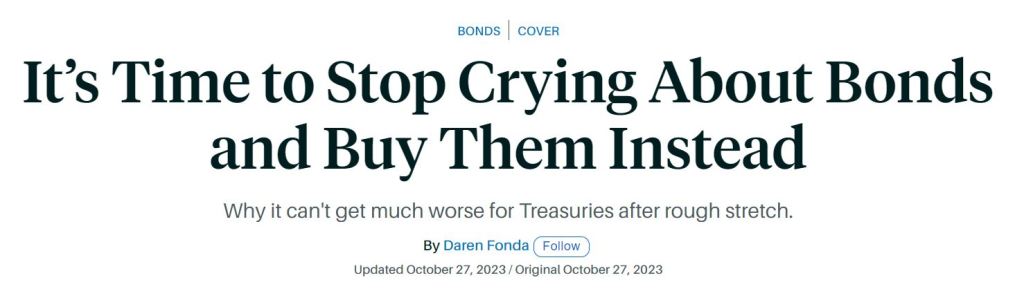
The recent breach of 5% on the benchmark U.S. Treasury note was a bit different. Just like a watched pot never boils, it took quite a while to happen. And when it did (only during non-U.S. trading for those of you checking), the tsunami of coverage went from causing angst to inspiring a wave of buying buy people who haven’t seen yields like this since the Bush administration. Here’s Barron’s Magazine:

Whether or not you locked in 5% or are cursing yourself for sitting on the sidelines doesn’t matter all that much. What does is that the cost of money went from nothing to quite a bit in a hurry after many years of artificially low interest rates. During that time,  government borrowing around the world ballooned–especially in the United States. Federal debt held by the public has gone from $5 trillion in 2007 to more than $25 trillion today. 

The interest on that debt is climbing fast as old bonds roll over and new ones are issued. It was more than $800 billion in the past 12 months and is well on its way to passing $1 trillion a year. For perspective, net interest is now nearly the size of all non-defense discretionary spending. And I’m afraid that defense isn’t about to become less of a priority. As alarming as that sounds, the average rate on that debt was only 2% a year ago and just recently crossed 3%. Despite all the attention it received in newsrooms, the 10 year note was actually the last maturity to breach 5%.

If bond yields stay even at today’s slightly more modest level for any appreciable length of time then already ominous projected trillion dollar annual deficits will be much higher. That will affect not just our pocketbooks but America’s ability to wage war, deal with banking crises, and much more. The panglossian 10-year budget projections by the Congressional Budget Office have interest rates somehow staying at 3% this year and no recessions ever. Anyone paying attention should see that rates being this high could have a double-effect on the budget deficit by also pushing growth lower, hurting tax revenue.

Like Covid pretty becoming uncontainable by early 2020, it might in theory be possible to alter that trajectory with some extreme efforts like massive tax hikes, but the political will and recognition of the threat need to be far greater. If this were just a warning about interest costs being high for a while or taxes needing to rise then you could call my cute headline alarmist. The problem, though, is that the numbers will within just a couple of years be too big to reverse. 

How so? Either rising bond yields will become self-fulfilling as the people who buy bonds with the hope of an expected positive return worry about America losing control of its budget with programs like Social Security and Medicare set to deplete their funding early next decade. Like an emerging market, a vicious cycle of rising rates can accelerate the reckoning. By my estimate, simply adding a single percentage point to the average interest rate would result in $3.5 trillion in additional borrowing by 2033.

More likely, though, the effect of all this on the economy will soon push the Fed to resume expansion of its balance sheet or to at least start cutting no matter how high inflation is. With fixed income, it is your real return that matters, and that could turn negative. Of the few tricks left in the Fed and Treasury’s arsenal to control the problem, allowing that to happen is the most likely. 

This is what risk expert Michele Wucker calls a “Gray Rhino” – “a highly probable, high impact yet neglected threat” – a mix of a black swan and elephant in the room. Yet record sums have flowed into exchange traded funds that own long-term U.S. Treasury bonds.

That has been a good short-term trade, but it sounds like a potentially awful long-term bet. Buying anything on the assumption that a greater fool will provide liquidity when you’ve made your money is a silly risk. I’ll finish this essay with the standard “not investment advice” boilerplate, but I’ll also tell you what I’m doing with my own little pile of savings. None of it is in bonds with a maturity beyond three years except for those that compensate me for future inflation. I’ll gladly give up a capital gain in long term bonds to avoid what, through inflation or some other means, looks like it could be ugly.

investing · journalism

On CNBC for GameStop Mania Anniversary

I spoke about the book (out in a week!!!!) with CNBC this morning. I’m no natural on TV and always a bit nervous about condensing the insights of a whole column, much less a 320 page book, into a series of soundbites. But I think Andrew Ross Sorkin’s questions were sharp and my answers were acceptably concise. Check it out:

Columns · journalism

This is not a spoof

It sounds like a spoof, but a New Jersey company that says it values “your privacy” is suing to thwart an effort to end a costly and invasive practice: calls from strangers using faked numbers made to appear familiar or even official.

Earlier this year, North Dakota made it a crime to “transmit misleading or inaccurate caller identification information with the intent to defraud or cause harm.” The company, called SpoofCall, argues the law is unconstitutional according to a report by The Bismarck Tribune.

Ironically, SpoofCard was until last year part of a company that also offered a service to “find out who’s calling from blocked numbers.” IAC bought the parent last year but says SpoofCard wasn’t part of the deal.

Chief Executive Officer Amanda Pietrocola says the company only objects to provisions punishing callers for “defrauding people of their time.” “Our goal is to find a happy medium here.” She says SpoofCard doesn’t do business with robocallers but won’t disclose how many calls it enables daily.

Tracking down the company’s attorney was straightforward, but contacting Ms. Pietrocola through her company’s own public website took more effort: It doesn’t list a phone number.

Columns · journalism

Airlines Could Charge Us Even More

No, it isn’t by installing a credit card reader in the lavatory or making us stand (but let’s not give them any ideas). Airlines already have charged extra for “preferred seating” as in I would prefer not to sit way in the back of the plane next to a screaming baby. Apparently, though, those seats (which I often seem to get) make it far more likely that you’ll survive. I wrote about this at work.

“Ladies and gentlemen, we are now ready for general boarding. Our diamond preferred ‘more likely to survive a crash’ passengers are welcome to come to the gate.”

You won’t be hearing an announcement like this at the airport any time soon, but it is a fact that some of the most and especially the least expensive seats on an aircraft give you better odds of living should tragedy strike. KLM India came under fire for spelling this out in a since-deleted tweet.

Discussing air travel fatalities isn’t only in bad taste but is believed to be bad for business. Or is it? U.S. airlines have found an additional source of income in recent years in charging for preferred seating—generally those that might have some extra legroom or let you deplane more quickly.

Seats at the back of the plane are therefore less likely to command a premium above the advertised fare, but perhaps they should according to KLM India’s tweet. Already-expensive ones near the front are slightly safer, but the fatality rate “is least for seats at the rear third of a plane.”

Columns · investing · journalism

In a galaxy far, far, away

The column I edit, Heard on the Street, has to find one mildly ridiculous business story for each issue of the paper, in addition to all the serious, analytical stuff. This usually isn’t a challenge, though there are occasional droughts when we have to dig deep.

Thank goodness for people like Patrick Byrne, CEO of Overstock.com. He is a gift to seekers of corporate hilarity and I was a bit mean to him today.


Patrick Byrne felt a great disturbance among his shareholders, as if millions of voices suddenly cried out for an explanation. This compelled the chief executive officer of Overstock.com to write one of the more bizarre news releases in recent memory about his reasons for selling 900,000 “founder’s shares” of the retailer.
“Frankly, I had no idea that shareholders would demand explanations of why and how I might want to use my cash derived from my labor and my property to pursue my ends in life,” he wrote.
Mr. Byrne detailed a number of personal projects, including charitable causes, for which he needed the cash. Even after all these years, he is most famous for a different rant about an alleged conspiracy to damage Overstock’s share price involving a “Sith Lord.” Mr. Byrne backed efforts to expose and punish allegedly manipulative short sellers.


Despite some spikes in the share price, the short sellers were basically right. Since the 2005 “Sith Lord” speech, the stock has dropped by 77% compared with a 133% gain for the S&P 500.
Perhaps Mr. Byrne should have directed more energy to running the company. Do or do not. There is no try.

Columns · investing · journalism

Making Monkeys out of Hedge Fund Stars

The darts don’t lie

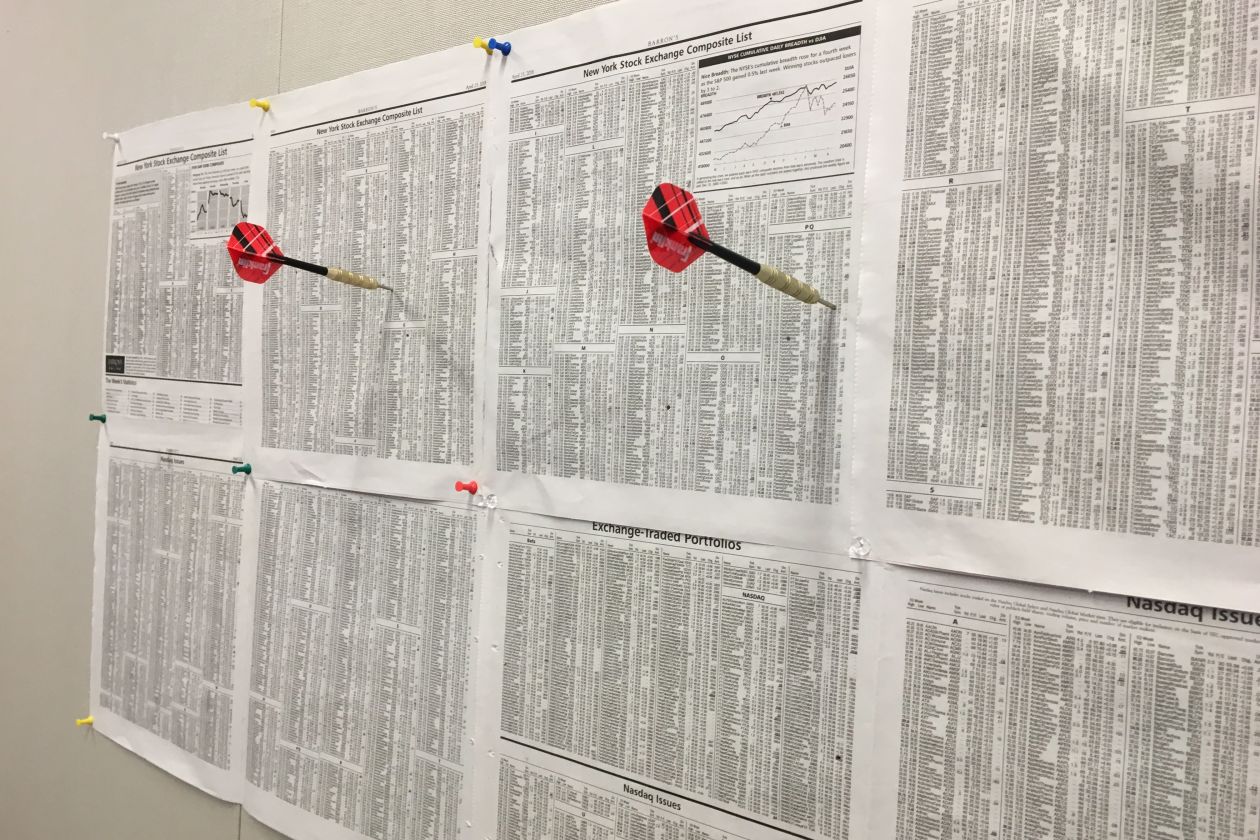
So we decided a year ago to poke some fun at the masters of the universe who unveil their stock picks each year at the Sohn Investment Conference . My team and I decided to throw darts at stock listings and see how things panned out. It was a blowout.


No animals were harmed in this financial experiment, but some human egos were bruised.
Burton Malkiel famously wrote in “A Random Walk Down Wall Street” that “a blindfolded monkey throwing darts at a newspaper’s financial pages could select a portfolio that would do just as well as one carefully selected by the experts.” A year ago the journalists at Heard on the Street decided to see if they could beat the crème de la crème—fund managers presenting their stock picks at the annual Sohn Conference in New York.
The results were brutal. Heard columnists, not monkeys, threw the darts at newspaper stock listings, but Mr. Malkiel would still approve. The columnists’ eight long and two short picks beat the pros’ selections by a stinging 27 percentage points in the year through April 22. Only 3 of 12 of the Sohn picks even outperformed the S&P 500.

journalism · The book

Mueller Needs a Literary Agent

I published my book without the benefit of a literary agent (long story), but going through the process without one made me appreciate what one can do for you, even if I got in the door at Penguin/RandomHouse on my own. This week I asked in an Overheard column how much money Robert Mueller could have earned if he had the rights to his free-to-read report on President Trump and his associates. Various versions were the number one, two, and four sellers on Amazon as of Monday morning.


If Robert Mueller was like most authors, he would be pingingAmazon.com ’s website hourly to track the popularity of his eponymous report. He also would be jumping for joy. As of Monday morning, various versions of the partially redacted text occupied the first, second and fourth slots among all books.

Of course, unlike the opportunistic publishers charging money for the 448-page tome, which can be read for free online, Mr. Mueller won’t be receiving royalties on his best seller. The fortunes of the various versions, available for preorder for as much as $26.89 in hardcover and $10.22 in paperback, speak volumes, though.
No. 2 in sales overall is a version containing a foreword by legal scholar and sometimes Donald Trump defender Alan Dershowitz. Despite costing a dollar more, readers seem to prefer a copy less flattering to the president featuring analysis by three Washington Post journalists.

From the Overheard column, April 22, 2019
journalism

Some personal news …

The following memo went out today at The Wall Street Journal from finance editor Charles Forelle.

I’m delighted to announce that Spencer Jakab is the new editor of Heard on the Street.
Spencer is a rock of the Journal’s financial commentary. He has been deputy editor of Heard since 2015, and he wrote the Ahead of the Tape column for years before that. His knowledge of companies, markets and financial instruments is encyclopedic. (By my Factiva count, Spencer did nearly 800 Tapes in about 45 months; good luck finding a topic in our universe he hasn’t touched.) He is an incisive financial thinker who embodies the Heard’s spirit of smart, provocative and timely analysis. He also writes killer ledes. He’s the ideal leader for our expansion of the Heard.
Before the Journal, Spencer worked at the Financial Times and here at Dow Jones Newswires, and was a stock analyst at Credit Suisse. He is the author of “Heads I Win, Tails I Win,” which is, naturally, a book about investing.
Spencer’s move means we are looking for a new Heard deputy. Please get in touch with him if you are interested. And please join me in warmly congratulating Spencer. I believe he’llbecelebratingatOlive Garden.
-Charles