Columns

A Real Hotel California

Something funny happened when my late mother-in-law came to live with us six years ago. No, it wasn’t that I decided to move to a tent–she was lovely. But she really needed her own place. Renting anything that was nice, close to us, and accessible to public transportation was beyond her budget. Then my wife and I lucked out and found a beautiful co-op, studio apartment with majestic views of Manhattan and two swimming pools for only $62,500.

That isn’t a typo. The monthly fees, which included everything from utilities to cable to a parking spot for us, were just $1,000. Co-op rules made it impossible for someone of her limited means to buy it, even if we gave her the money, so we did and she just paid the fees.

As an owner (technically a shareholder), I got the financial statements and board meeting notes of the co-op, which consisted of five large buildings. (Here’s an explainer for those of you unfamiliar with this type of apartment, which is most common in the Northeast). The balance sheet was a mess due to its unionized workers’ reliance on a multi-employer pension plan that was underfunded. As more employers default, the surviving ones pick up the liabilities.

I was aware of that going in. But the most surprising thing was how some of the other residents saw things. For example, there was a big debate about what to do with a gorgeous penthouse apartment the co-op had taken into possession when the owners died and their estate defaulted. It had a spacious balcony big enough for a party with an unobstructed view of the Manhattan skyline and Hudson River. If it had been a condo it would have been worth millions. Yet the co-op board had it on sale for $38,000, barely half what we paid for my mother-in-law’s far smaller place, and was finding no takers. The problem is that the fees were proportional to floor space and they had climbed to more than $7,000 a month–about what the most expensive rental in town would cost.

The board minutes indicated that residents were shocked it was so cheap and were wary of selling even at that price because it would depress the value of their own apartments. But the foregone fees were costing them all money every month they hesitated, and that the low price wasn’t the actual problem–it was what it foreshadowed. The liabilities they had all signed up for could eventually erase the resale value of their smaller apartments too.

The penthouse was, financially-speaking, far inferior to a rental of similar quality, which is why nobody was interested. If you can’t afford a fancy place any longer, you just move out at the end of the lease. A landlord doesn’t chase you down asking for that amount in perpetuity until you can find someone else to live there. And if there are some emergency expenses like fixing a roof, he or she can’t just tack on the cost to your rent.

We sold our apartment at a small profit after my mother-in-law’s passing, but I thought about the upside-down economics of that complex as I was researching my latest column for The Wall Street Journal. If you own any type of property, and certainly if you’ve ever considered buying a timeshare, keep reading.

It was provocatively titled “How To Buy a Week in Paradise for $1.” The average sale price for a timeshare unit bought from a developer is about $24,000, typically for a one-week per-year deed. There are 1,541 resorts in the U.S. alone with more than 200,000 units divided into 51 weeks (one is for maintenance). If just three-quarters are owned by individuals who attended one of those 90 minute sales pitches and owners’ mental accounting puts existing units’ value at just $15,000 apiece then the combined (imaginary) value of those weeks is well over $100 billion. These days some people buy units in a land trust giving them points to use, but the same principle applies, and the points are even more profitable for developers (I explain why here).

Timeshares bought on the secondary market might be worth it for larger families who enjoy going to the same place every year or people with the patience to navigate complex exchange schemes, but what are they really worth? Even some beautiful properties can be had for a dollar. There’s a reason the developer doesn’t just take them back for free.

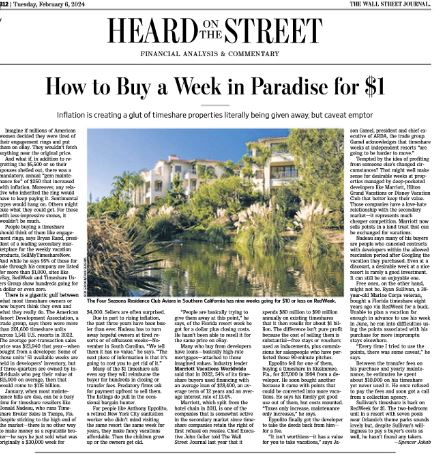
The management of an absolutely stunning Four Seasons resort in southern California that let me use a photo angrily asked the paper to take it down when I pointed out in the caption that several units could be had there for practically nothing. At least one actually cost less-than-nothing as the desperate seller was willing to pay $1,000 in property closing fees too. You can check out any time you like, but you can never leave.

(Here’s a pic of the print issue where the photo appeared).
Just a casual search on sites like RedWeek or Timeshare Users Group turns up hundreds of listings for a buck, or even zero, and that understates the problem because many properties would only be worth buying if you were paid way more than the closing costs. Sellers can’t afford that, and those sites don’t accept negative numbers anyway. Owners who just walk away are hounded by collection agencies. Two people I spoke with, a retired New York sanitation worker and an ex-Marine sniper who was wounded in Iraq, are still trying to sell properties they thought were bargains.

It is possible to force a resort to take a property back by hiring a reputable lawyer. But someone has to pay those delinquent fees to keep the lights on. Distress compounds the burden on those who can afford, and choose, to keep paying.

The high-end of the timeshare market–the most desirable weeks at nice resorts, such as President’s Day week in Florida or Vail managed by a large, deep-pocketed company–is still worth something. Maybe a week was purchased for $30,000 and could sell for $4,000, which is a specific example cited to me in the article by broker Don Nadeau. As one person told me, buyers should think of resorts more like engagement rings than property–their value is immediately less than what you pay a developer, but you can still enjoy it and have a sentimental attachment.

So I hope that you don’t own a timeshare that you regret, but I encourage those of you with larger families to consider renting weeks from owners at a secure site–I’ve used verified transactions on RedWeek. They can be a good deal for people on both sides of the transaction.

How does this apply to homeowners? Well, taken to an extreme, the math eventually works the same way. 

A pretty typical house near mine is for sale for $749,000. The owner had tried to rent it for $3,800 a month in 2021, according to Zillow. I would expect it to sell because a shortage of properties is keeping prices high in New York City suburbs for now, but the underlying costs have gone up a lot. Someone making a 20% down payment would still be out-of-pocket $60,000 a year for their mortgage, insurance, and property tax. The latter two of those can keep going up as inflation and the wages and health care costs for local, unionized teachers and police march higher. We just got our assessment for 2024 yesterday and I’m trying not to think about it.

Clearly you would struggle to make money as a landlord buying it at today’s mortgage rates and prevailing rents–you’d be out of pocket by about $10,000 a year even before maintenance. But what about just biting the bullet and owning it? It’s an investment, right?

When my wife and I bought our house 20 years ago, the combined tax and insurance was 1.5% of the price we paid. Today it is nearly double that–not a deal killer, but not good. Extrapolating that trend, if we decided to become snowbirds in 20 years, that would have grown to 6% of the home price every year. Of course that assumes all of our neighbors are able to keep paying those taxes. What if many can’t, or if there is a political uproar resulting in people below a certain income or wealth level receiving a break at the expense of those able to keep paying? What if that starts to hit the appreciation of homes in our town and state? The $38,000 co-op cost more than $80,000 a year.

Of course the dirty secret of the timeshare business is that they were never “worth” $30,000. The price reflected the costs of a slick sales job and all the goodies they had to give away. Marriott buys back old timeshares for $80 million to $90 million a year that it resells for $1 billion or so, according to my conversation with its CEO, John Geller. That means you can pay slightly more than Marriott would pay–maybe 15 or 20 percent of the price at a presentation–and get a timeshare that way too. Yet even some bargain hunters are now surprised at the difficulty of finding a buyer.

Homes don’t have a secret secondary market and the math won’t get so extreme. But it can grow to enough of a burden that people who counted on retiring on their home equity might find that there isn’t nearly as much left as they expected there to be. The older couple who sold us our house in 2003 were very interested in maximizing the sale price because it was pretty much all they had saved, and that was pretty typical.

The moral of the story? Other than steering clear of timeshare promotions (unless you are 100% confident you won’t buy) is to consider the future liabilities of things that sound like investments.
Columns · investing · The book

Wall Street Journal book excerpt

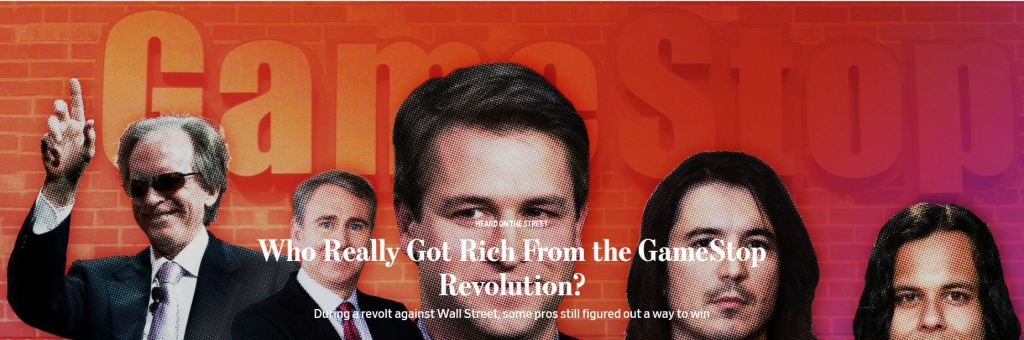
(L-R) Bill Gross, Ken Griffin, Jason Mudrick, Vlad Tenev and Baiju Bhatt SIUNG TJIA/WSJ

Today’s Wall Street Journal has a 1,500 word excerpt of one of the chapters in my book. The article’s title is “Who Really Got Rich from the GameStop Revolution?” One helpful reader has already written to complain that they had to read too far into the article to find out. When I answer a WSJ subscriber (and I always do, unless they’re menacing or insulting), I try to be courteous. Still, the huge photo of five billionaires behind the article’s title was a pretty good hint, I think.

Anyway, the excerpt is an interesting part of the story but one of the less-surprising things you’ll learn if you read the book. Far more interesting to me was how trading and social media apps are so effective at getting people to act recklessly. The human psyche changes very slowly, but companies’ understanding of how to push our psychological buttons has evolved as quickly as the technology they can bring to bear. I’ve been working in or writing about financial markets for 29 years and I learned a lot while doing my research. You don’t have to be especially interested in finance for this to change the way you see things.

The book’s U.S. release is Tuesday, February 1st, available for pre-order now!

Columns · The book

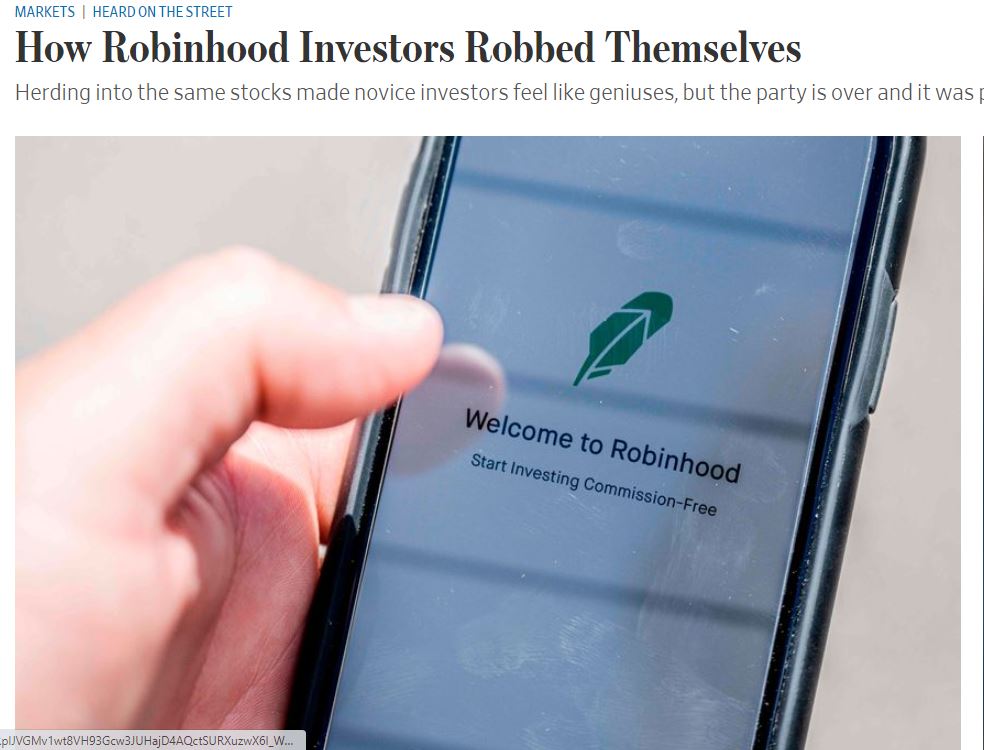
Robinhood Traders Robbed Themselves

You might have noticed that the stock market is a tad wobbly these days. Your own portfolio might be significantly wobblier than the headline numbers suggest if you piled into some of the most popular stocks on social media, so I hope you didn’t.

A lot of those same stocks happen to be in the top 20 or top 100 on Robinhood which, for anybody who reads my book (out on February 1st), won’t come as a surprise. This herd-following behavior was in fact pretty profitable for a while. I wrote about the downside of that today.

A clever young man, Noah Weidner, kept track of an index of the most popular stocks owned by investors at the broker. More recently, even after the data feed was curtailed by the broker, he kept up a list of which stocks entered and exited the top 100. For the most part those rejected like energy ETFs, Berkshire Hathaway and Wells Fargo went on to do well. Meanwhile, most of those added have been among the biggest losers recently, including shares of Robinhood itself. I link to an academic study that does a nifty job of explaining why that happened.

Stay safe out there.

Columns

Oprah to Your Portfolio’s Rescue?

January is a month full of hope for dieters but, as the year rolls by, our resolutions tend to fall by the wayside. Gyms know this, which is why they get so many new members around now and why it’s so difficult to cancel memberships. WW, formerly known as Weight Watchers, doesn’t make it as tough. That’s not just ethical but smart: They have a lot of return customers.

I wrote about the company today. They were expecting a great 2021 even if lots of customers gave up as usual. Instead it was a dreadful year and their stock slumped by a third. Sentiment is about as bad as it was back in 2015 when Oprah Winfrey rode to the rescue, buying a tenth of the company, joining the board, and becoming their brand ambassador. Back then the stock rallied by 1,600% in three years.

I don’t think that will happen again, but it is cheap and one thing holding it back may soon reverse itself. Even though lots of people gained weight during the pandemic, the company’s bet that they would turn to their services to lose it proved wrong because people view dieting as punishment. They had already denied themselves so much during the pandemic that they were looking for a grace period.

There isn’t another Oprah waiting in the wings, but the stock is cheaper than it has been in quite some time. Full year results due next month might not look pretty. That might give patient investors a good entry point.

Columns

YOLO, but Be Careful Out There

The rallying cries of the boldest meme stock and crypto traders are YOLO and BTFD – you only live once and buy the f*cking dip.

Sure, fine, but here’s an old school Wall Street concept that traders who feel like they are reinventing the wheel should consider. Actually it’s originally an idea applied to gambling, the Kelly Criterion. I wrote about it yesterday. There’s a great book all about Kelly’s idea by William Poundstone, “Fortune’s Formula: The Untold Story of the Scientific Betting System That Beat the Casinos and Wall Street.”

Two of the smartest guys I know, Victor Haghani and James White from Elm Wealth, wrote a paper on how traders who really think their stocks or coins are going to the moon should approach their bets. Basically there are two things that can happen in a simplified world: You can be right and make a fortune or you can be wrong and lose everything – a distinct possibility with money-losing companies and new, unregulated financial instruments. Those with extremely high expectations. like Bitcoin going to millions of dollars or AMC’s stock going to $500,000 (yeah, really), should bet LESS, not MORE.

Once your payoff is gigantic, you’re taking an unnecessary risk by using a meaningful share of your savings to own something. Yet this is what lots of retail “apes” claim they are doing. They compound it by buying the dip every time it goes down. It’s also what Michael Saylor, CEO of software company Microstrategy, has done. He sees gigantic upside for bitcoin and has had his company borrow heavily to buy it. He owns a lot himself too. If he bet just half as much and turned out to be right then he would have more money than he could spend (he already does in fact), but if he’s wrong he’ll lose almost everything. Kelly allows you to make an optimal bet based on what you think will happen and maximize your payoff while avoiding ruin.

Columns · investing · The book

Does Your Index Fund Have “Diamond Hands?”

Yes, these are Roaring Kitty’s hands

Anybody who has read my first book knows that I take a mostly dim view of active management. Still, this week I wrote about an episode central to my upcoming book that proves an exception: how active managers handled meme stocks.

When the market values of GameStop, and AMC went up several hundred or thousand percent based on no change in their fundamental value, active fund managers did the obvious thing – they dumped them and moved on. But index funds, which tend to beat those active managers in the long run, held tight with “diamond hands” because they have to. In some cases they bought more at inflated valuations as their assets grew or as those companies issued shares to their now almost entirely retail base of owners. The only passive investor I’m aware of that was able to take the money and run was Dimensional Fund Advisors (I interviewed their deputy head of portfolio management, Mary Phillips, for the column). Even today, with their share prices (in my opinion) still grossly elevated, the main owners of the meme stocks are the self-described “apes,” many of whom believe there is still a short squeeze looming because of phantom shares.

Active fund managers shouldn’t look a gift primate in the mouth. The last year that funds benchmarked to the Morningstar Large Blend category outperformed that benchmark was in 2013 and before that it was 2009, according to a study by Hartford Funds. Index funds have strung together several consecutive winning years over their active counterparts during extended bull markets in the past, too—for example between 1994 and 1999.

This is one of those cases when owning an index fund can be frustrating. As of today, the top two holdings in the Russell 2000 Value Index – let me repeat, “value” – are AMC and Avis Budget Group, another company that recently got the meme treatment for discussing the addition of electric vehicles to its fleet. Whatever.

Columns · investing

Aching Backs = Big Bucks

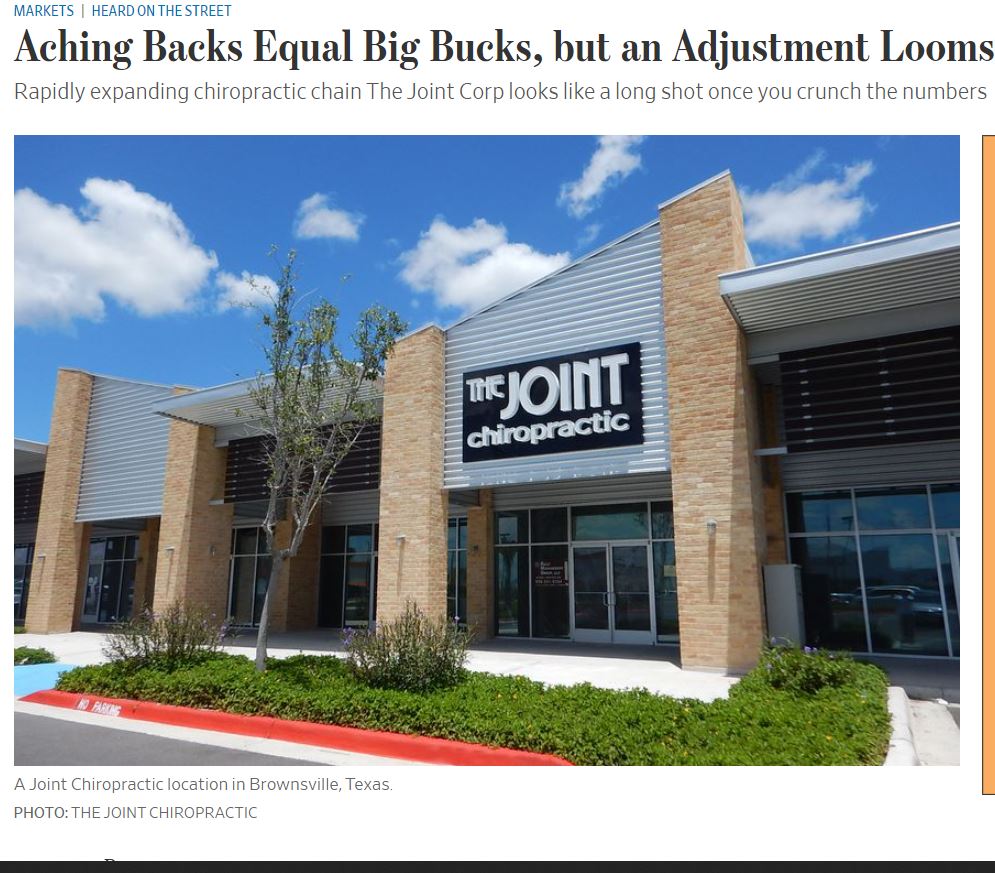
Sometimes a fairly small company that I know will otherwise fall through the cracks catches my eye. The latest one is “The Joint,” a fast-growing chain of storefront chiropractic clinics. I learned a lot in the process of reporting it, most of it about the business of franchising rather than the iffy science of back “adjustments.”

The chain had been on a rocket ship ride with its stock up by 3,000% since the current CEO took over in April 2016. Then it took a tumble on a short-seller’s report. I don’t think that the report blew the lid off of a flaky company, as some reports do. But it correctly pointed out that the stock was pricing in some unrealistic growth.

Probably the most analogous company, and one most readers will know, is Massage Envy. Its founder was CEO of The Joint for a while and he sold Massage Envy in 2008 when it was still in its growth phase. It has been stalled for the past decade or so.

Will this do better? Back pain is a big problem, but The Joint has lots of imitators like SnapCrack and Chiro Now with similar no-insurance, subscription-based formulas. It has around 1% of the overall U.S. market and is the biggest storefront player so there is plenty of room to grow. Unfortunately, its revenue opportunity isn’t as big as it seems because clinics charge a lot more and offer more services. The Joint’s market value of $1.2 billion already assumes it will snatch a large share of a pretty big pie at more than 100 times projected earnings for 2023 when its management thinks it will reach 1,000 stores.

Some stores’ impressive profits represent in part an owner-operator’s sweat equity. For both the occasionally underemployed practitioners and their patients, a storefront’s simplicity has been appealing compared with high-pressure clinics. If one views the chain as being at the very early stages of disrupting its sector and assumes that its head start will make it the McDonald’s of back pain then its valuation could be a bargain. But if it is more like another Massage Envy then the stock’s price and its future cash flows are seriously misaligned.

“Aching Backs Equal Big Bucks, but an Adjustment Looms” WSJ, October 16, 2021

Columns · investing

All That Glitters Isn’t Goldman

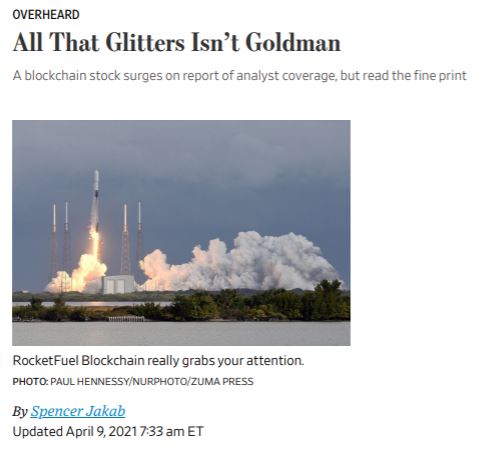
If you were to hold a contest to design the most-enticing name for a company right now you couldn’t do much better than “RocketFuel Blockchain.” And if you were to pick a bank to associate with it now or really any other time than Goldman Sachs would top your list. But read the fine print before you buy shares in a company by that name written up by Goldman … a lot of people seem not to have bothered.

“Following the release on April 1 of a news release titled “Goldman Small Cap Research Publishes New Research Report on RocketFuel Blockchain, Inc.,” the penny stock surged by as much as 335% in four days. Several lines down is a notice that the research firm, which accepts payment for reports, “is not in any way affiliated with Goldman Sachs & Co.”

And the report’s subject, formerly known as B4MC Gold Mines Inc., and before that as Heavenly Hot Dogs Inc., doesn’t appear to have any revenue and maybe not even a product, based on litigation about a patent that expired. The report was written by an analyst who, while he appears not to have lit the world on fire at more-established firms, has an auspicious name: Rob Goldman.”

Columns

Please Be Kind, Rewind

The documentary category is the first one that comes up when I scroll through Netflix. One of the top choices it offered me was “The Last Blockbuster” which is, as you might have guessed, about the very last Blockbuster Video store in the world (there was one in Perth, Australia that closed in 2019). The chain went bankrupt in 2010 and is sort of a punchline these days, but it’s nice to see at least one hanging on for now. I wrote a short Overheard about it on Friday.

The ironic thing is that it was Netflix that basically put Blockbuster out of business and is now profiting from a film about the very last one. Back in 2000 Blockbuster made what is one of the greatest business blunders in history by turning down an offer to buy Netflix for $50 million. It is worth almost 5,000 times that much today.

According to The Oregonian, the documentary’s popularity has revived the store’s fortunes with people buying lots of Blockbuster swag. If they’re one of the few people on the planet without a Netflix account, they can even rent a DVD copy of “The Last Blockbuster” there.

Columns

Not Quite Supertankers

One of the more overused clichés is “it’s like turning around a supertanker.” As a landlubber, I’ll go ahead and assume that’s true in the literal sense. Financially-speaking, though, the business of hauling oil across the world certainly turned on a dime in the past year. Daily earnings collapsed by 99% from last March to the past week as carriers capable of holding two million barrels became very expensive floating storage tanks when there was a glut and are suddenly hunting for cargoes as big exporters try to buoy prices.

Jinjoo Lee and I wrote about the dramatic turn. Our takeaway was that things are looking up for this extremely cyclical business.

A year after their incredible good fortune, an equal basket of four energy shipping firms has lagged the S&P 500 by 70 percentage points over the past year and is right back to its long-term average ratio of price to book value. With life and energy demand returning to normal, this is no time for investors to walk the plank.

https://www.wsj.com/articles/not-so-supertankers-deserve-a-look-as-pandemic-fades-11615815253